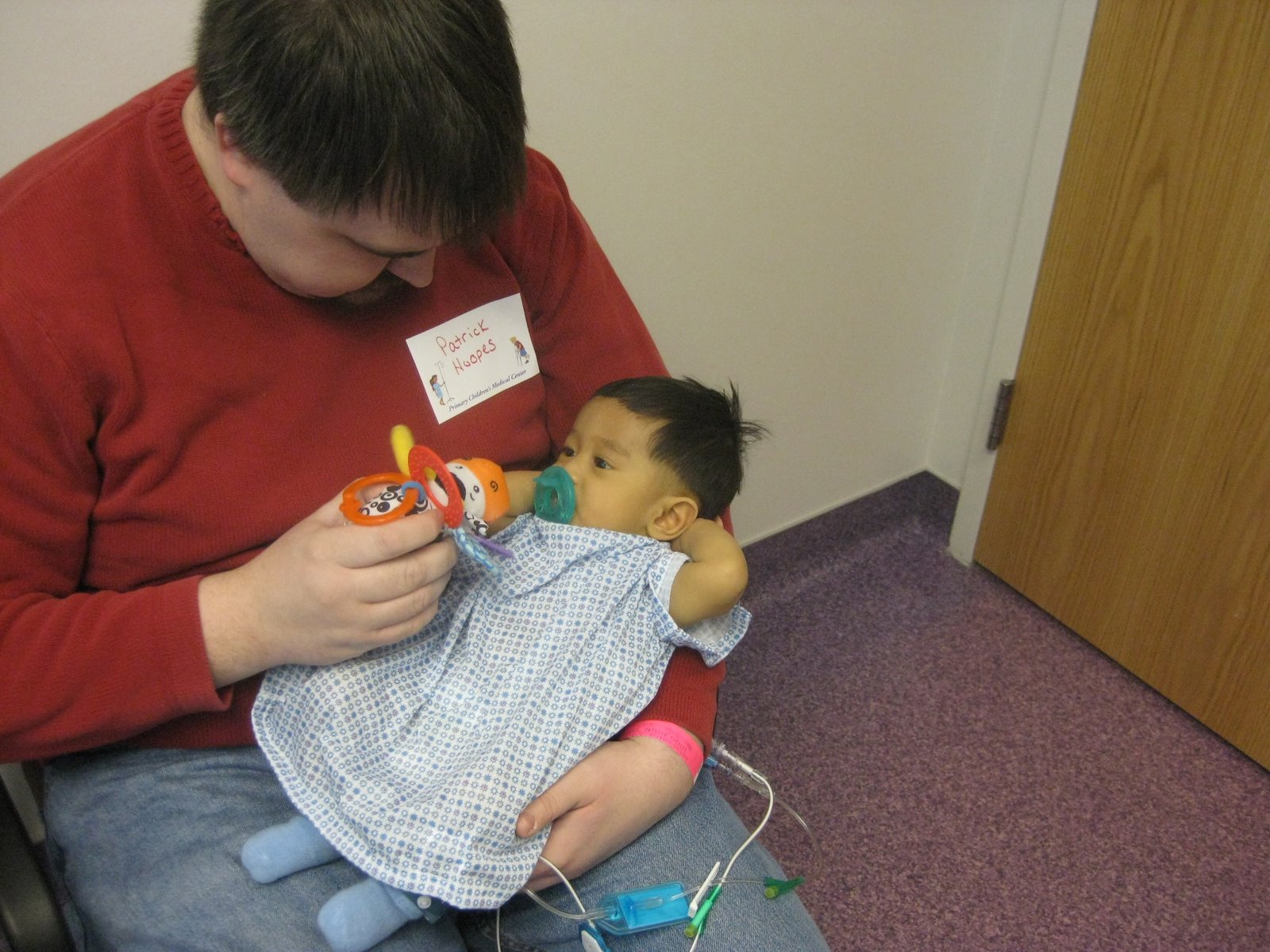
Children’s Organ Transplant Association

I wanted to take a minute to tell you about a group called theChildren’s Organ Transplant Association. This is a charitable organization devoted to making organ transplant available to children, regardless of financial circumstances.

The estimated price tag on a small bowel transplant is approximately $1 million. We are fortunate to have very good insurance and to be pretty solid financially right now. Nevertheless, every doctor’s visit, every trip to the E.R., and every new medication comes with a co-pay. And while we have an out-of-pocket maximum, it doesn’t apply to co-pays. Right now, that’s expensive, but manageable. After transplant, we are looking at doctors visits several times a week and about 50 medications at a time.

Besides the medical bills, an out-of-state transplant center brings its own expenses. We pay for transportation and hotels every time we go for an outpatient checkup. When transplant comes, we’ll need to book a flight at the very last minute, meaning steep airfare or, even more pricey, a charter flight to get to Seattle in the required 6-8 hours. Then we’re looking at splitting our income across 2 states for about 6 months as I stay with Patrick during his recovery while Brian works here at home.

If I think too much about it, the logistics of this make my head spin.

We’re doing all we can to save while times are good right now. Unfortunately, the more we put ourselves on solid ground, the more “needs-based” programs we are disqualified for.

Enter the Children’s Organ Transplant Association. COTA, as they call themselves, is a 501(c)3 charitable organization. Their purpose is to facilitate fundraising for children needing organ transplants. Funds raised are donated to COTA in Patrick’s behalf.. meaning they are set aside to help cover Patrick’s transplant related expenses.

These funds can help cover any of the costs I mentioned above. They cover anything related to the need for transplant (meaning all the medical stuff we’re doing now both in Salt Lake and in Seattle as well as, for example, medical expenses when he’s an adult that result from being transplanted.)

We have set up a fundraising campaign in Patrick’s name with COTA. It’s being organized by some of my family members and is staffed by family and friends. 100% of what is raised will go to COTA to cover transplant-related expenses. Donations are tax-deductible and some companies will match donations. On top of that, COTA has it’s own matching and incentive programs. COTA estimates we need to raise $70,000. Funds Patrick doesn’t use, for whatever reason will benefit other children.

I’m asked all the time what more people can do to help us. Well, this campaign could use help. It’s all run by volunteers, so if you have some time or ideas, then you can be of help to us. A training/planning meeting is planned for September 1st.

Re-evaluation at Seattle Children’s

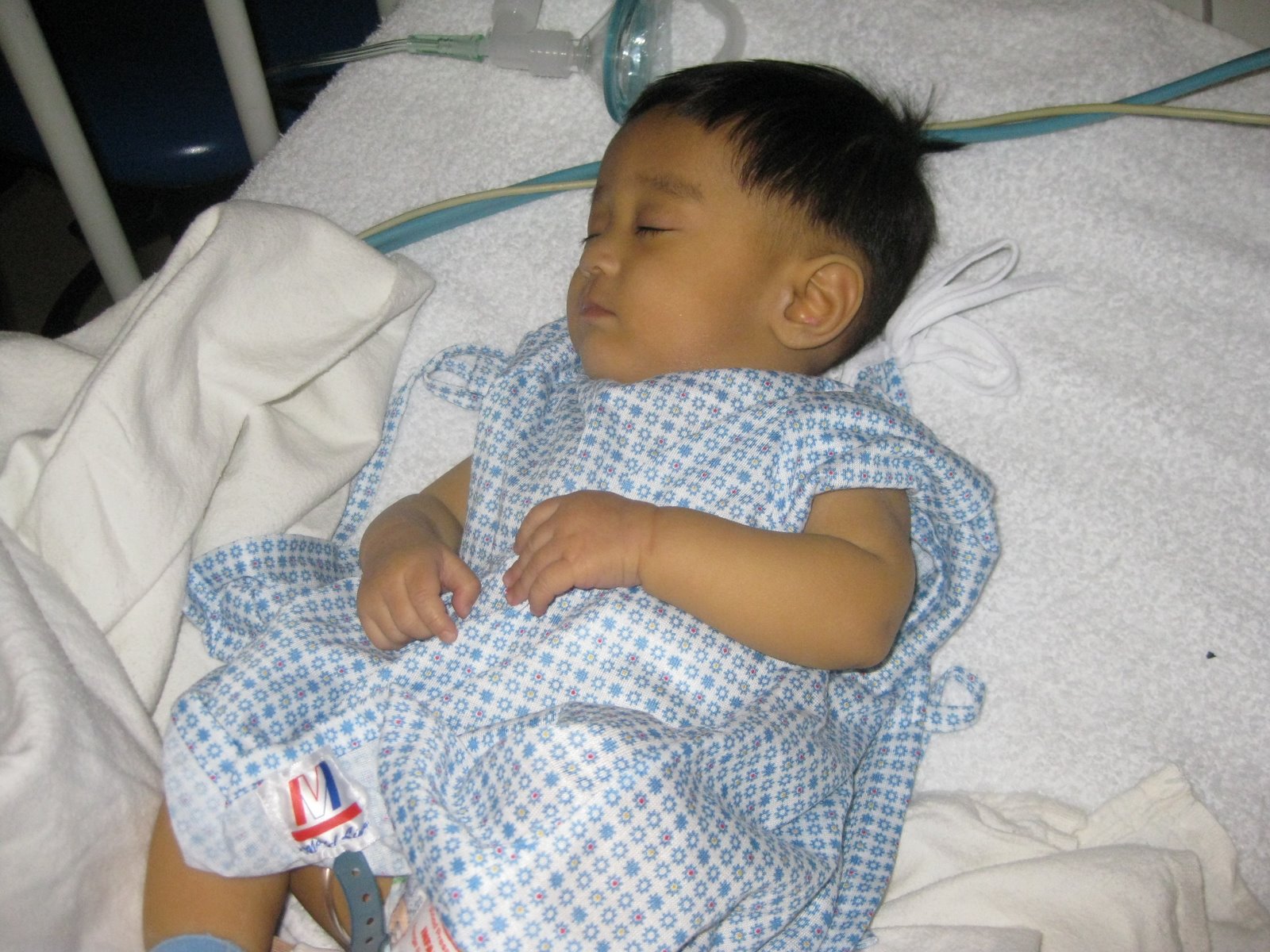
Sick boy on beanbag

You may have heard that Patrick had a day of office visits scheduled at Seattle Children’s hospital last week. After his cardiac arrest and the many complications that followed, they wanted to see him again to see if anything had changed that would affect his transplant status. They also wanted to look to see if he needed to be listed for a liver transplant.

Daddy & Patrick in the ERWhat you may not have heard is that Patrick was hospitalized Sunday night with another infection. This time it was a staph infection which, if caught early, can be treated through his central line and clear easily or, if more established or more resistent, could become a very persistent infection that can hang on for months.

I called Seattle Children’s and tried to reschedule our appointment. However, Dr. Horslen was going to be away for the next several weeks and they didn’t want him to stay inactive on the transplant list for that long. After a few days and some discussion, we made the decision on Tuesday to have Patrick admitted at Seattle Children’s so they could both treat the infection and do the evaluation.

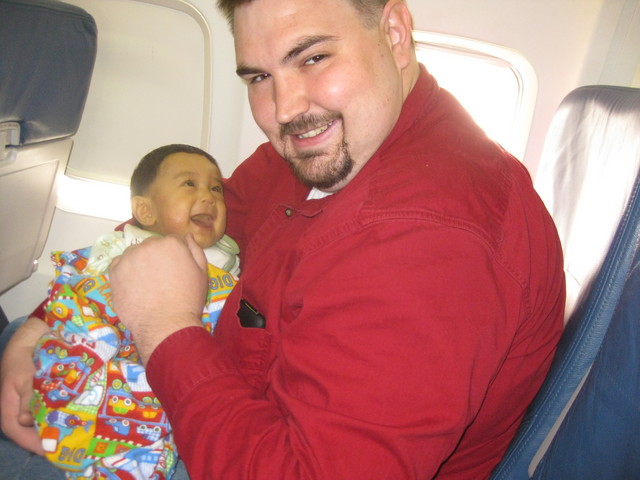
We got the final go ahead late in the day Tuesday. I was up till 1 a.m. packing.  Wednesday he was discharged from Primary Children’s with just time to go directly to the airport. The flight went well. They only real difficulty was that Patrick’s ostomy bag started leaking at takeoff. Well, and that I got a tad bit lost in the airport because we landed in the international terminal and airports aren’t as well marked when you have to take the back elevator routes.

Nevertheless, we arrived at Seattle Children’s around 6 p.m. – just as they were changing shifts. We met part of the medical team that would be following him and, as usual, wowed them by giving them in writing all the information they really would need. It took some time to get orders written, so we had another late night as labwork and meds came trickling in. It was about 2 a.m. before we made it to bed again.

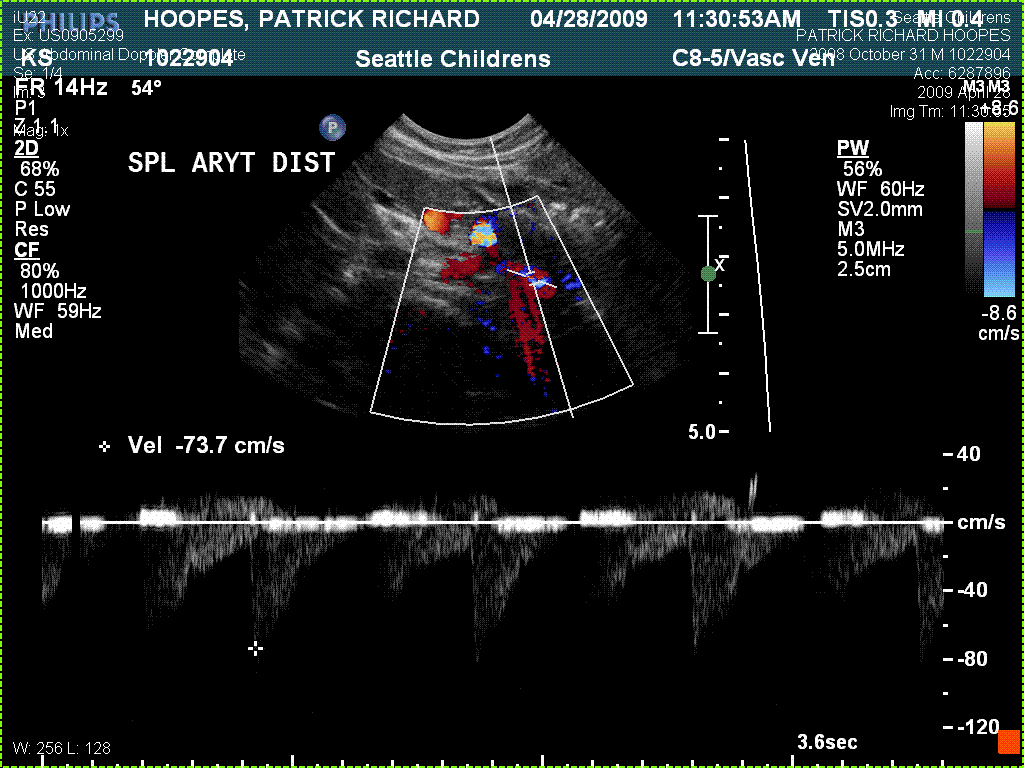
Smiley in SeattleThe nice thing about being inpatient is that it gave me a sense of what things will be like during his recovery after transplant. We started with an early abdominal ultrasound, specifically a doppler. Yes, this looks a bit like the weather map images, only it shows the flow of blood through the veins. They were looking to see if portal hypertension was developing. (As the liver scars, it starts to send blood through other vessels creating extra blood pressure through them. It can cause lots of complications.)

The team rounded about 10 a.m. It was a big group, about 15 people, including his GI Dr. Horslen, his transplant coordinator, nutritionist, and others who specifically follow him. They had looked at the ultrasound and the labs from the night before and at his labwork. Both looked as good or better than they had in April.

Dr. Horslen came back later in the day to talk to me and said he was very glad we’d come. He’d imagined he’d find Patrick in much worse shape after the reports he’d been getting. He did a physical examination, too, and then said that he didn’t think Patrick’s liver was really in bad shape yet. He said that the problems with his spleen were probably mostly due to the many months of infection that Patrick has been through, meaning that hopefully when he’s healthy, his spleen will improve, too.

We discussed other goals, too… including taking down Patrick’s ostomy and replacing his PICC line with a broviac line when he could have surgery. We’ve been going the rounds on the question on whether or not Patrick should have his g-tube removed, too, before portal hypertension makes it bleed and be more difficult to close. However, Dr. Horslen said he was under the impression it was unused when he recommended that, and that if we were using it, he’d be ok with us leaving it in.

It was great to talk to him and to watch him play with Patrick. Not only is he brilliant, but he has a wonderful bedside manner. It made me happy to remember that there was at least one big reason why we chose Seattle Children’s for transplant.

We also had visits that day from the nutritionist and a care coordinator. And then in the afternoon we got to have a little bit of lazy time. Child Life brought Patrick some bubbles and it was fun to watch him experience those for the first time.

When the nurse came on the night shift and Patrick was playing with her while she took vitals she frowned and said “Do you really have to go home tomorrow?” I was surprised because I’d expected to need to be there at least through the weekend… But before midnight they had me making lists of what would be needed for me to be able to go home on the 5 p.m. flight the next day.

Rounds in the morning confirmed that they felt Patrick could go… assuming that we made sure he got a visit from Dr. Reyes, his surgeon.

The rest of the morning I packed and kind of waited for word that we were really going. A volunteer came to play with Patrick so I’d have hands free. About noon, I still hadn’t heard one way or another, so my nurse started making calls for me. I looked at flights and now there was only 1 left and the price had doubled. But – the insurance company agreed they’d rather pay for extra airfare than another night in the hospital – and so I started working on booking a flight home.

Dr. Reyes came in about 1. We talked again about the importance of taking down Patrick’s ostomy. He told me a bit about starting intestinal transplants in Pittsburgh 15 years ago. (He was on the team that did the first ones.) And he explained how they’d learned that the surgery wasn’t really effective without a strong GI team behind it to make sure the patients stayed healthy. He also explained that one thing they’d learned in that time is that survival rates are better without an ostomy.

I ran our other surgical plans past him (liver biopsy, broviac line, and possibly g-tube.) He looked at me and said, “Leave the g-tube in. He’ll need in later.”  So I guess that settles that.

He left and I immediately went back to booking a flight. Meanwhile, the care coordinator came and brought me a cab voucher. My nurse got Patrick ready and booked the cab while I got the ticket. And I literally hung up the phone, put away a few things, and walked out the door.

Flying HomeThe flight home went smoothly. Howie was there to meet us. We had some adventures waiting on the way home including a flat tire, a broken jack, and eventually a tow home. But at last, we are home.

They discussed Patrick’s transplant status in their meeting yesterday. They were ready to move him back to status 1 for a small bowel. They will not yet list him for a liver. When they checked his labs, though, they found a blood culture positive for infection… so the doctors are discussing what to do now. He’s not sick and it could have been a contaminated sample. But they have to work that out before Patrick’s listing is made active again. Time will tell.

Recovering at home


I’m happy to announce some tremendous news! Patrick made a miraculous and quick recovery after my last post. The day after my last post, after much fasting and prayer by friends, family, and even people we don’t know, we walked into the ICU to find Patrick smiling and playing in his crib. He turned his head, saw Brian and me, and smiled. Over the next couple of days he continued to make steady improvement.

They gave him some steroids which helped reduce the swelling in his throat and his breathing became much less labored. Ear, nose & throat came and looked at his upper airway and determined that his vocal chords were ok and that, although he had swelling below them, that there wasn’t any evidence of scarring or other permanent damage. The only limitation that they placed on him was that he not be reintubated except for life-saving procedures for the next 6 weeks.

Neurology also came by several times in that day and watched as he progressed, began interacting with me, focusing his eyes, moving his arms and hands more normally… and in the end decided that there didn’t seem to be any evidence of a problem there that would merit further attention.

Next, they scheduled for him to go back to Special Procedures and to have another PICC line placed. Because his antifungal medications aren’t compatible with TPN, he needs two points of access. Amazingly, they were able to get a double lumen PICC placed. This means that there are essentially two tubes wrapped into one and placed in the same vein… instead of having a line in each arm. With that in place, they removed all of the other lines in his body.

The PICC made him sore, but by Thursday that was their primary complaint and they decided to transfer him out of the ICU into the infant unit.

Also Thursday he had a swallow study done. This means that they mixed contrast into apple sauce and put some him a bottle and had me feed it to him while they watched it go down his throat on floroscope. Having fasted or been fed by G-tube for 2 weeks, Patrick thought this was heaven and was furious when it was done. The end result was that he swallows perfectly… pretty amazing for a kid who is barely allowed to eat.

That confirmed, they started giving him bottles again. However, his gut had gone unused so long that it’s still working on recovering. We started out with just 2.5 cc’s every 3 hours…that’s about 1/4 tsp.

Saturday night Patrick’s PICC line got tugged and the vein started to swell. He woke up in the middle of the night and really didn’t sleep the rest of the night. We worried that it might need to be replaced again… but with some rest and elevation and heat, it slowly started to show signs of recovery.

Finally, Monday his electrolytes, stool output, feeds, and PICC line were all stable enough and at noon that day we were able to bring him home.

You should have seen how big his eyes got when we pulled into the garage! I was all grins and giggles when we walked into the house. As per tradition, once we got business squared away, Patrick and I curled up in my bed and went right to sleep. He slept till 5:30, completely peaceful.

We’ve been home for a few days now and are finally getting back into the swing of things. Family and friends have been great – bringing in meals and coming to sit with him during the day so that I can get things caught up around the house. He’s having a hard time getting used to sleeping through the night again. He doesn’t like being on his back since spending so much time in a bed. And I’m having a very hard time getting used to caring for a double lumen picc. But we are slowly moving forward and today, for the first time, has felt like routine again.

He needs to be seen ASAP in Seattle so that they can determine if he can be put back as status 1 on the intestinal transplant list. They are also looking at possibly listing him for a liver-intestine transplant, as well… since the problems with his spleen could be evidence of scarring in his liver. We have a trip planned from Wednesday through Friday next week… with appointments most of the day Wednesday. This will be my first time travelling alone with Patrick. It’ll be a process, I’m sure… But hopefully well worth the effort. If nothing else, it’ll be good practice for me.

It’s hard to believe that just weeks ago we were sure we’d lost our little boy. He has so much light and life in his spirit right now. He’s pretty weak still and we’re working on getting him back to eating what he had been eating before… And both of us have to get used to that line in his arm. But things in this house are calm and happy. It’s so good to be together… and so good to be home!

A lost central line

I need to stop promising to write about transplant. Whenever I do, Patrick gets sick and we end up back at the hospital.

Thursday in the middle of the night Patrick woke up crying the inconsolable cry he only uses when something is wrong. As usual, we immediately started looking for signs of a line infection. However, his temperature wasn’t even 100 degrees (100.4 is the least his doctors consider a fever) so we fed him a bit and I sat up with him and eventually he went to sleep.

When he woke up in the morning, something was definitely still wrong, but he still didn’t really have a temperature… just didn’t want me to put him down. As we always do when he’s sick, I held him and took regular temperatures. Around 10:30 a.m. his temperature hit the magic 100.4 and I started making calls to get blood cultures drawn. Usually we have some time if we catch it that quick. However, as I started to try to make plans, his fever kept rising. At 101 I started packing for the hospital, at 102 I put some hustle into it and by the time we made it out the door his temp was 103.

Being our 3rd fever in a month, I wasn’t too happy about the return trip to Primary Children’s.

When we arrived they checked his vital signs and then they did something they’ve never done before… instead of finishing the standard check-in process, the triage nurse disappeared for a minute and then came back and took us straight to a room. And not the typical room, either… They took us into one of the “resuscitation”, a.k.a. trauma, rooms. Patrick’s temp was over 104 and his pulse near 200. He had a serious infection and was in shock.

They quickly worked to cool him down with cold packs and fever reducers and eventually he was looking and feeling better.

Labwork revealed that Patrick had a yeast infection in his central line. Since yeast gets into the plastic of the line, it had to be removed. It has to stay out we are sure the infection is out of his blood. In the meantime, he has a peripheral (in the hand or foot usually) IV. You can’t give full TPN through this type of IV so he’s getting a sugar/saline solution instead.

So now we are in the hospital waiting out the infection so that Patrick can get to feeling better. He doesn’t get as much sugar as he’s used to so he’s lacking energy. The IV antifungal medicine upsets his stomach we think. He’s getting rather stir crazy. The two things that bother him the most, though, are 1) the blood draws they wake him for at 6 a.m. every day and 2) the splints on his foot and hand to keep him from damaging his IV.

He’s just not himself these days. Keeping him calm is a 24/7 job for me. I’m basically living at the hospital while Howie works, manages the house, and does his best to take care of me. But we can’t imagine doing it another way… Patrick is fighting hard to get healthy and needs support in the fight.

I have to share one example, though, of Patrick’s indominable spirit. This morning we added the IV to his hand and so he woke up to having a splint put on that immobilizes his left hand. For the first part of the day he’d look at his hand and just whimper… he’d try his best to hold it still. Finally later in the day the nurse helped me get some toys that work with the touch of a button so he could use his splinted hand to play with them. After some work with that he started to get a little more adventurous.

He got a wrapper in his free hand and was playing with it and, after some work, he managed to hold the wrapper with the fingers on his splinted hand. He worked on that for a good 15 minutes, then he reached over and grabbed my hand with his free one. Using his new skill, he put my finger where he could hold it with the fingers of his splinted hand.

Patrick is an amazing kid. This is one of the hardest trials we’ve seen him go through so far… However, tonight’s adventures show me that he is determined to push the limits that his imperfect little body give him.

We hope that he’ll be able to stay healthy for a couple more days, have a new line surgically placed midweek, and then be able to come home for the final weeks of his recovery from this infection. If any little spirit is strong enough, Patrick’s certainly is.

Transplant Pre-evaluation: Night 3 & Days 4 & 5

Boy I didn’t mean to leave you all in a cliffhanger there. May turned out to be a rough month for us. Patrick was hospitalized twice with fevers and Brian & I have been sick, too… Blogging is one of the first things to go when things get hectic in our family. I’ll blog more about our first experiences inpatient at Primary Children’s… But I left you all hanging with the story of our first inpatient experience at Seattle Children’s.

So here goes…After Patrick’s GI sprung on us the idea of admitting him to the hospital for labwork and a transfusion, we made a few calls to make sure it was approved by the insurance company, and then the transplant coordinator took us to the admitting desk.

We traded in our clinic “Parent” badges for inpatient badges on lanyards that allowed us to wander around the hospital anytime day or night. Someone from admitting met us and led us over to what would be our room for the night. A nurse came in and started to take Patrick’s history. When I handed her my printed medical fact sheet, we got instant brownie points. She took the first vitals and got us settled in the room, but then her shift ended. This is the problem we’ve witnessed a few times… Things move slower if you arrive at shift change because there’s so much else going on.Around 7:30 things finally started to progress. Because we hadn’t been planning on spending the night, there were a few medical procedures that we would have done in the hotel room that we found ourselves having to ask permission for, and even supplies for… But they finally got it all done. We met the doctor and made a tentative plan for labs to be drawn once the blood for the transfusion had arrived. The IV nurse came and took some labs for blood typing and left a peripheral IV in Patrick’s foot that they’d be able to give the transfusion through.

Around 9 things finally settled down enough for us to order some Chinese takeout. (The only restaurant open that would still deliver to the hospital at that time of night)… and after it arrived, Howie went back to the hotel room and brought back the things we’d need for the night.Our room was in the surgical unit and was really quite nice. It was a shared room but Patrick was the only patient overnight. It had a nice couch that folded down into a bed, a bathroom in the room, and a window with a pretty nice view. When it wasn’t cloudy, you could see the space needle.

Things went pretty smoothly overnight. Patrick had a really great nurse who was impressively quiet. I woke up when the blood arrived for the transfusion so that I could take care of the TPN (they allowed us to run our home pumps, providing we were always available to operate them).

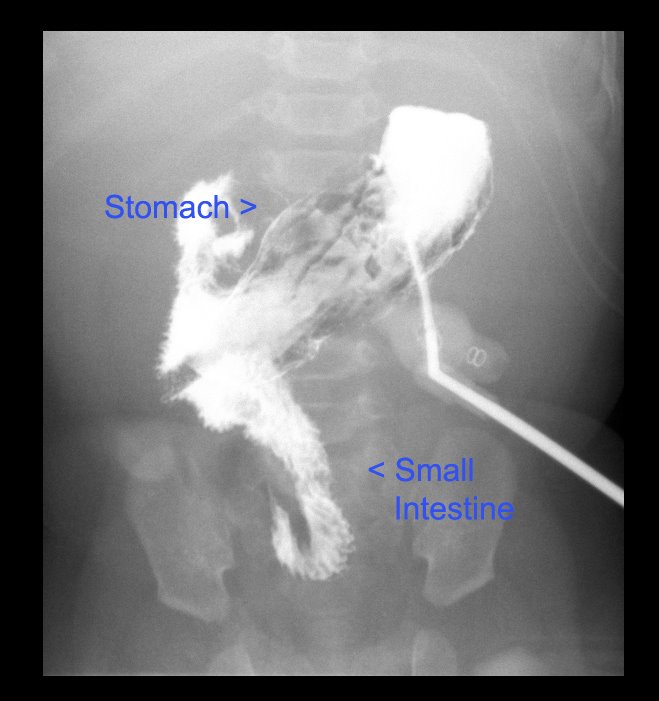
The next morning they wanted to do a floroscope (contrast X-ray) of his intestines. This was to be done in two parts so they could see the top and the bottom separately. They showed up early for the first one and took us to radiology where they took a chest x-ray and then strapped him to a board on the floroscope table. The board restrained his arms, legs, and head and also allowed the radiologist to tip and turn him.Patrick didn’t like this at all, but they let Brian and I be close to comfort him (Brian was actually in charge of protecting his head when they turned the board) and Patrick eventually fell asleep during the test

.
They put a contrast solution in through his g-tube and took images showing it move through the stomach and out his stoma. It was interesting to watch it move through and appear on the screen.Then we were supposed to wait and see how long it took for the contrast to clear so they could see his large intestine without the small.

I was sleepy, hungry (they showed up before I could get breakfast) and frustrated at my plans for a mini-vacation being postponed. When the radiologist hinted that they might keep Patrick another night for the next floroscope to be done, that pushed me over the edge a bit… So Brian sent me to get breakfast straight from radiology and went with Patrick back to the room.

When I got back, he informed me that we’d missed rounds… fortunately we didn’t miss his GI, who came in just a few minutes after I did. He promised that they wouldn’t keep us another night, did a quick exam of Patrick, and then left.

Brian had a business lunch he’d scheduled so I stayed in the room and tried to get some sleep… Unfortunately, we got a roommate whose alarms were going off regularly and that was a mostly vain effort. The rest of the day was waiting and more waiting to see if the contrast would clear out of Patrick’s system… When it still hadn’t by 3 p.m. they finally started to work on a discharge plan. We’d come back outpatient the next day for the next test before our flight.

We finally made it out of there sometime in the late afternoon and snuck a nap in before finally getting out to play a bit.

Our friends Lindy & Kelly took us out for some authentic Italian pizza and then for Seattle’s famous Royal cupcakes. It was good to get to visit and spend some time with them. I was impressed by Lindy’s cunning as she excused herself to go to the bathroom and really went and paid both halves of the bill.

Our last morning in Seattle we got up and went to the hospital for the last time. The radiology tech from the day before was there yet again and very excited to see our names on the schedule. I asked if we could take pictures of Patrick on the table for this test and before you knew it, they’d convinced us to pose for this picture, which seems so wrong to be smiling in, but gives you an idea of what room, equipment, and our lovely lead vests were like.

Turned out to be really good we were there because I’d seen previous tests and knew that what first appeared on the screen was not the full length of large intestine and could encourage the radiologist to inject more contrast until we saw the rest. Because this organ isn’t used, it is rather narrow.
We made it away with just enough time to meet Lindy and Lauren and enjoy a nice walk in the park and a delightful lunch before rushing off to catch our plane. Obviously, it wore the kids out.
Security in Seattle didn’t go quite as smoothly as Salt Lake… I think this is because the first person who I was able to tell about Patrick’s pumps was the security agent at the metal detector who I think mistook the backpack with tubes coming out as something scary. We quickly got things sorted out, though, and they didn’t have other problems with the extra search.Patrick and his daddy slept through pretty much the entire flight and we got home without incident… But with very full mind from everything we’d learned and a much better sense of just what a big deal this all really is.

If I can manage a few more days of health in this house, I’ll post a bit more about how much this one little trip and the plan for transplant affects and will continue to affect our little family.

Transplant Pre-evaluation: Day 3

Tuesday morning found us back at Seattle Children’s again bright and early. Our day started in ultrasound. They wanted images of his digestive system and the central-line eligible veins in his neck. With so much to image, we had 3 hours scheduled with ultrasound.

Keeping a 6 month old still for 3 hours while goop is being rubbed around on his abdomen and neck is quite the feat. We went through every toy that I’d brought along… rattles, books, rings. In the end, the only way to keep his head still for images of his neck was to let him watch my cell phone’s media player. It was interesting to watch them map the flow of blood through his veins and to see his broviac line. Patrick was a big fan of the black and white images on the screen.

In the end, the ultrasound took 3 and a half hours, not 3, and we had to run to make our next appointment with the department social worker.

Because the transplant process can turn your life completely upside down, part of the workup is a meeting with the social worker. She asked a lot of questions about us to make sure that we were up for the task. We talked about our coping mechanisms, our family, friends and other support systems. She told us about programs in place that could help us like the Ronald McDonald house (as a place to stay during Patrick’s recovery), Angel Flight (for transportation to and from many doctor’s appointments in Seattle, and the Children’s Organ Transplant Association(a.k.a. COTA, a charitable organization that will create an account to save and fundraise for transplant in). The social worker will be our go-to person for a lot of the logistics of planning and paying for the transplant, which will be invaluable, as this is not easy or inexpensive by any means.

Because we were running late, the appointment with the social worker was divided in two to give us the chance to meet with the surgeon, Dr. Reyes. Dr. Reyes is an expert in intestinal transplant. He’s originally from Brazil but you’d never guess it from talking to him. He explained to us a little bit about how the transplant works. He also explained the difference between an isolated intestine transplant (intestines only) and a liver-intestine transplant. The first would be done if Patrick’s liver were still in good condition. The chances of rejections are a bit higher, but if the bowel were to be rejected, they could remove it and wait for another donor. The latter would be done if his liver is in bad condition. The liver, pancreas, and intestine would all be transplanted at once, still connected to each other. The liver helps to protect the other organs from rejection – but if it is rejected, then the chances of finding another donor before the situation becomes fatal are pretty slim.

We were surprised when he asked us if Patrick’s small and large intestines had been connected. We had been previously told this wasn’t possible because the small intestine was oversized and the large intestine was pencil-thin from lack of use. But Dr. Reyes thinks it would be very beneficial to connect these. Patrick has a good portion of colon left that could help absorb water so that fluid loss would be less of a concern for Patrick and we could perhaps feed him more. This wouldn’t eliminate the need for transplant, but would reduce some problems in the time we’re waiting.

After wrapping up with the social worker, we ran over to neurodevelopmental. There a developmental specialist met with us. She took a quick history while we fed and changed Patrick, then she did her evaluation. This was probably his favorite appointment. Basically, she played with him to see what he knew how to do. The funniest was when she was testing his verbal repetition. She’d say “Aaaa…. Now your turn” and he’d respond by blowing raspberries back, since he’d just learned to repeat that sound and was quite proud of his new skill. In the end, her analysis was that he lacks some muscle tone, but that he is developmentally right on target for his “adjusted age”… meaning you subtract 3 weeks from his age because he was born 3 weeks early and he’s just where a 5 month old would be.

Our last appointment of the day was with Dr. Horslen the gastroenterologist. Dr. Horslen is one of the best known gastrointerologist in the world of short gut syndrome. He is from England and just transferred to Seattle from the very established program in Omaha, NE. He is oozing with British-ness. Patrick was finally napping by the time we got to that appointment so he slept while we repeated Patrick’s medical history again. Then Dr. Horslen examined him and he woke up and gave him a big grin. Dr. Horslen labeled him a charmer from the start.

Dr. Horslen told us that he and Dr. Jackson (our GI in Utah) have known each other since Dr. Horslen first arrived in the U.S. and said he respects him very much. He is very willing for the 2 of them to work together as a team. He did go on and tell us what changes he’d make if he were treating Patrick in Washington. 1) He said he’d reconnect Patrick’s intestines. (Which made us happy to hear… we’re excited about this possibility.) He explained that not only would Patrick have less water loss this way, but that the stoma can start to bleed uncontrollably as the liver fails… something that there’s no real reason to put Patrick or us though. 2) He suggested that we follow some of the suggested changes in diet and TPN. 3) He said he’d replace Patrick’s lipids with Omegaven (a topic I’ll have to cover in another post). They’re doing a study at his hospital and he’s allowed to distribute it in the state of Washington. 4) He’d do a contrast study of Patrick’s intestines… (Also to be explained later)… basically, take some images to see what’s there.

Then he threw in a 4 that we’d been expecting since the social worker ran into us at dinner and accidentally let it slip… He needed to see Patrick’s bloodwork right away to know what else needed to be done… And since Patrick was VERY anemic… He’d admit him to the hospital that same night so he could have a transfusion after the blood was drawn. They had a room ready for us to be admitted that night.

Now, in the interest of keeping this blog readable, for it’s length… and just for the fun of the suspense… I’m going to leave you in that cliffhanger until I find time to write again.

Transplant Pre-evaluation: Day 2


Monday morning I woke up at around 6 a.m. to try to get everything packed and ready for a day at the hospital. Our first appointment of the morning was at 9 a.m. and we needed to arrive early enough to check in and find our way around.Our transplant nurse, Sandy Mitchell, met us in the “Whale” (outpatient) wing of Seattle Children’s Hospital. We had to stop and get badges at a security desk at the entrance identifying us as Patrick’s parents. Then we went to a registration desk in the middle of the main floor and they got us checked in. They gave us a “purple pass” to use to check in for the rest of our clinic visits that day so we wouldn’t have to wait in line again to check in, and then gave us a pager and sent us off to the cardiology waiting area.


Patrick’s first appointment was for an EKG. They stuck probes all over his chest… so many that you could barely find a patch of visible skin and then in just a few minutes had a printout of the electrical readings of his heart. The funniest thing about all this is that we did it all with him still in his stroller. Hooray for whoever at Carter’s thought up the snap front bodysuit. Best hospital clothes every dreamed up for a baby!

Next Patrick had an echocardiogram. This is an ultrasound of his heart and it took about an hour to do. We undressed him this time and I laid on the table with him and kept him calm and entertained. Between Baby Einsteins on the TV and the cool black and white images on the monitor, though, he didn’t need my attention much. Funny the opportunities that life presents you, though. I finally got the chance to see my baby’s heartbeat on ultrasound!

After lunch, we headed upstairs and met with the nutritionist for the intestinal transplant program. She looked over Patrick’s most recent lab results, his output history, and his current diet and then she made suggestions, which I’ll be blogging about in a future post. It was great to hear he say that she was happy with how Patrick’s care is being managed and that she fully trusts our dieticians here.

Our next appointment was probably the most brutal of the day. We spent 2 hours with the transplant coordinator and she went over all aspects of the transplant. She explained what they’re looking for in a transplant patient and how the approval process works. (Basically, after the workup the transplant team meets together and decides if Patrick is a good candidate for transplant and if they’re willing to list him, or if there might be other things they can do to care for him w/o a transplant). Then she explained that Patrick, if accepted, would be followed closely by the team in Seattle and would probably make regular visits back to Seattle pre-transplant so they can monitor his care.

She explained a bit about what to expect when an organ became available. We learned that he will have 6-8 hours max to get to Seattle once we get a call saying that there is a donor organ. He’ll need to be healthy at the time, of course. The surgery will be a very long one, followed by a hospital stay of at least a month.

Most of the talk was about what to expect after transplant, though. First of all, to prevent rejection of the new intestine, his immune system will be surpressed. Because of the risk of rejection and other complications, we’ll need to live close to the hospital so that he can have regular follow-up visits, including biopsies to check for rejection. He’ll be on immunosuppressants for the rest of his life, but in that first year, at least, his immune system will be incredibly weak. We’ll have to avoid public places as much as possible and avoid exposure to any kind of illness, bacteria, or other source of bugs that can cause him problems.. His diet will be limited, and at first he’ll probably still be on TPN as he learns to eat and eventually to get enough nutrition that way, but they’ll work to slowly wean him off of that. He’ll be at risk for a lot of big scary health problems, including rejection, infection, and a certain type of cancer that can develop when the immune system is supressed. Here’s more information about the risks and ramifications of life after transplant.

Our last scheduled appointment was with pre-anesthesiology, which was really a simple one, considering that Patrick’s had surgeries before. They we headed upstairs because they’d ordered a bunch of lab test. We pushed to have labs drawn through his broviac, but they still wanted us to ask at the lab for it to be drawn by just sticking a vein. They told us to ask for their best tech, which we did. He took one look at the list of tests and then at Patrick and said that he didn’t feel comfortable drawing that much blood from a kid this size, especially through a needle, when he has a broviac line. So, he took a little blood for some blood typing, gave us a bag to collect a urine sample and sent us on our way.

We were pretty overwhelmed that day and avoided giving updates because it was so much information to process ourselves. Instead, we went out to dinner and Patrick made our evening for us.

While we were eating, I looked over and noticed that Patrick was imitating my expressions while I ate. He was making chewing faces and licking his lips when I did. Then he started to blow bubbles and, well, I decided to blow bubbles back at him. The next thing we knew, he’d learned to blow raspberries and would happily spit back at us whenever we spit at him. It was a fun game to play for the rest of the evening and week, and definitely helped to lighten the load of a HUGE day.

Transplant Pre-evaluation: Day 1


So the first big question about getting Patrick to Seattle was transportation. With current airport security, how do you get a kid who is connected to running IV fluids through security? And how do you go about transporting a week’s supply of TPN? It has to be kept at a certain temperature and, well, there is just a lot of it. Hauling a cooler and coordinating tubing through the airport just didn’t sound like much fun to us, but neither did dealing with any lost luggage.

So I did tons of research: called the TSA, read every page in the Delta website about baggage, and read websites written by other TPN patients. Finally, I asked the pharmacy if they could ship the TPN ahead of us. Turns out, that’s a free service that they provide. And our wonderful friends Lindy & Kelly helped us find a place in Seattle to ship to and then picked up the shipment and kept it in their fridge until we could get there.

So we were able to travel with just 2 day’s worth of medical supplies in our carryon… which was still enough to fill an entire carry-on sized suitcase, but probably saved us TONS of grief. Patrick’s luggage was by far the biggest and we were probably quite the sight making our way around with Howie hauling 3 rolling suitcases behind him and his carry-on and me with a stroller, a duffel bag, and a diaper bag.

We were surprised by how smoothly things went at security. In Salt Lake a TSA worker came up to us when she saw us getting our stuff ready to go through X-ray. I explained to her Patrick’s IV’s and showed her my suitcase full of medical equipment, including IV solutions and syringes full of saline and heparin. She took over right away. Patrick and I went through the metal detector and (of course) set it off because of his pumps. Then they took us to the little security station and ran their little tests on his medicines. When they were all done, they patted Patrick down and then did a wand/hand search of me. Then they thanked us for keeping things organized and making them easy and sent us on our way.

We were allowed to board the plane first because we were travelling with an infant, which was different but nice, especially since we needed to get his stuff settled so we could get to anything he needed during the flight.

We booked him a seat, not to sit in, but to give us some extra space. His backpack rode there buckled in and Patrick started the flight in his daddy’s arms. He played and he slept and he flashed his bright eyes and smile at the flight attendants and the passengers around us. He was by far the best behaved child on the flight! Whimpered only when he was hungry.

Finally we landed and took our crazy little caravan to the rental car company and checked in at our hotel. We took a much needed nap before heading over to visit Kelly and pick up the TPN shipment.

The day of travel was much smoother than I could have ever expected! Which turns out to be a good thing, as we had a very long week ahead of us

Transplant Pre-evaluation: Introduction

We’re going to have a little series of posts here about Patrick’s transplant pre-evaluation at Seattle Children’s Hospital. I decided to break this up into a series not to extend the suspense for you, but to increase the odds that I would be able to finish a post in a single sitting.

So, we’ll start with an introduction. As you know, Patrick has extreme short gut syndrome. Without intestines, he is completely dependent on TPN for nutrition. And the lipids in the TPN are notorious for damaging the liver. If he had more intestine, there would be the option of adapting Patrick’s intestine, but with so little, he needs to have a transplant before his liver fails if he is going to survive.

Our GI in Utah recommended that we go to Seattle Children’s Hospital where they have a relatively new intestinal transplant program being started by some of the most experienced doctors in this field in the country. So, after some prayer and some research we requested a referral and last week we flew out for an evaluation.

There are several purposes for a pre-evaluation for transplant:
1) It gives us a chance to meet the team and see the facility and decide if we want to pursue treatment there.
2) The doctors can see the patient and have tests done to give them first hand knowledge of the case so they can recommend a plan of action, including deciding if transplant is the only option for the patient.
3) They do lots of tests that check to make sure Patrick is healthy enough for a major surgery, to detect any unknown health problems, and to gather the information needed to match him with a donor.
4) They look at our family’s ability to maintain Patrick’s care financially, emotionally, and physically both before, during, and after transplant.

Once the workup is complete, Patrick’s case is presented to a review board and a decision is made as to whether or not he is a good transplant candidate. When the decision is made, they’ll notify us.

So that’s the purpose of the pre-evaluation. The next few posts will describe our experience and what we learned.

Firsts

We’ve been a very busy little family lately. Patrick is 5 months old now. And in the time since I last posted, we’ve had a lot of firsts. So, here are some highlights.
First giggles
Patrick learned to laugh a while ago, but we didn’t get out and out chuckles until we discovered that the kid who used to scream his head off whenever he got undressed is ticklish and loves to have his clothes off. Dressing and especially weighing are now favorite games… but it’s best when daddy just picks him up without clothes on and tickles his back.

Today we learned that you can also get belly laughs if you squish his cheeks.

First fever
Well, it all started with a cold, that turned into croup. After a week and a half trying to fight it off, Patrick got his first fever. Fortunately, it didn’t go much higher than 100.4 (38 degrees Celsius) and so we were able to have blood cultures drawn at home and his fever was gone in a day. No infection, thankfully. Just a day at home with Mom holding Patrick and taking his temperature every half an hour to make sure it hadn’t hit the danger mark yet.

First necktie
My brother Steven got married at the end of March. Although we were crazy busy working on his wedding cake and pictures, I just couldn’t help taking the opportunity to make Patrick and Brian matching neckties. We bought a tie with a matching handkerchief. Patrick thought his tie was a great toy to hold and chew on.

Oh, and a disclaimer on this picture. Patrick hates bright lights of any kind and we had studio lights on. Someday we’ll get a family picture with him not crying.

First rollover
I set Patrick down and turned my back on him for just a minute. When I turned back, he was on his tummy looking up at me as if to say “Whoa, Mom! What do I do now?” So far no signs of him having any idea how he did this or how to do it again. But we’re having much more play time on the floor to encourage him.
First haircut
After weeks of trying, we finally got time to take Patrick to my Grandpa’s house for his first haircut. In my defense (for those of you who thought I should never cut it), his hair was in his eyes and under his chin. Patrick was ok with the whole haircut idea till we hit the ticklish spot behind his ears. Finally, though, he fell asleep and we were able to finish. It’s a nice short cut.. but we hope that means it can grow for a while again before it needs another cut.

First ER visit
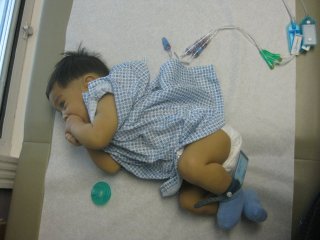
Last Saturday night, I noticed some bleeding under the dressing for Patrick’s central line. The line had shifted and, on closer inspection, we found that it had been pulled. It didn’t pull out, but was far enough to worry us. So – we got to make our first trip to the ER.

We were probably quite the sight there because, unlike the other families, we weren’t panicked. Central line issues are just part of life with Patrick. We’ve been planning and practicing for this trip for a while.

We arrived at 10:30 p.m. and had a bit of a wait in the waiting room because we were definitely not the most urgent case there. They took some x-rays to see the position of the line and about 1 a.m. the surgeon who placed Patrick’s line came into the room. He had been called in for an emergency appendectomy, and stopped in to see Patrick while he was there. He looked at it and said that the line was in a good position and he didn’t think it needed to be replaced on an emergency basis. Instead, we were to put antibacterial ointment on it twice a day to prevent infection, which meant lots of dressing changes, and then get a second opinion on Monday.

We were amazed, but happy, and after teaching an E.R. nurse proper technique for dressing change (yes, us teaching her), we were sent home. We got home at 3:30 a.m., connected Patrick’s feeding tube, and slept in till 11:30 a.m.
First outpatient surgery
So that brings us to Monday. About a month and a half ago we started the battle of the granulation tissue. Patrick had a patch of it next to his stoma that just kept growing back, no matter what we did. We learned to use silver nitrate to treat it, but it just kept coming back. So – we decided that maybe it was doing no harm and we’d leave it as it was.

No sooner had we made that decision than I discovered that his g-tube was surrounded by granulation tissue. A visit with the nurse practitioner in the GI clinic taught me better technique for nitrate treatments and after 10 miserable days of treatments, his G-tube site was clear of it. However, the spot by his stoma was starting to make it hard to keep a bag on and his skin was getting sorer by the day. I tried my newly practiced skills, but the tissue just kept coming back

So, we called and scheduled an appointment to have it electrocauterized. This is a minor procedure, but it’s painful and so they put babies to under so they don’t have to suffer through it. The surgeon we saw in the E.R. told us to as for follow-up at our appointment on Monday. It was still looking sore and red and swollen and the surgeon didn’t like the look of it, so he decided it was best to change the central line.

This means that they took it out of one vein and put it into another one, coming out in a different place on his chest. Again, this is something we’d been warned about, so it wasn’t a complete shock. However, we were a bit nervous and, after an already long weekend, quite tired.

The surgery went well. Patrick woke up and was able to come off the ventilator in no time at all. He was, as always, a favorite with the nurses in post-op. Brian got to reconnect his TPN in post-op, which was kind of funny to do. Our nurse was fascinated with the different equipment. We got some curious looks as Brian drew up vitamins with syringes and injected them into the IV bags.
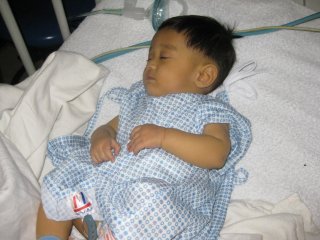
It’s a curious thing to be the old pro parents in the hospital. I often refer to myself as a “hospital mom”. We know the routine. We’re patient with the nurses, doctors, and other staff and, although we are concerned for Patrick, we are not scared or intimidated by our surroundings as we once used to be. It’s kind of odd to feel perfectly at home in a hospital… But makes all of this more bearable.

Patrick was sore and tired for a day and still whimpers if we move his not-quite-healed shoulder the wrong way… But overall he’s back to himself. As for Howie and myself, well, we’re slowly but surely catching up on our sleep and getting back to a normal routine. And preparing for the adventures ahead.

First steps to transplant
And that brings us to the last of the firsts for this entry. We have made the first steps towards transplant evaluation for Patrick. We have appointments for April 27th and 28th at Seattle Children’s Hospital to meet with the surgeon, gastrointerologist and just about anyone else who might have anything at all to do with Patrick’s transplant. Theevalution process is big, long, and very detailed. They want to make sure that Patrick needs and will benefit from a transplant, that he’s healthy enough to have one, and that his home life lends itself to as successful of a recovery as possible. This trip is the first step in that process, and we are excited to go and learn and start building relationships there.

Patrick still has a long way to grow. He’s almost halfway to the 10 kilo weight goal. (He weighs 10 lbs 11 oz.), and so we know this visit won’t end with him on a list. But it’s a start and a step in the right direction.

And so, those are the firsts we have to report for the time being. We’re looking forward to continuing to see him learn and grow. He is so good at using his hands now! And has just started to discover that he has feet. His spirit grows by leaps and bounds every day. Most of all, he amazes us with his incredible patience and optimism.