Allergies

As of yesterday, we are the proud owners of an EpiPen Jr.

A few months ago we started to notice that with some foods, Patrick got little red spots on his cheeks and chin. He also had a really odd habit of sticking his fingers in his mouth after eating. When he discovered french toast, I learned that the spots always came with that meal, so I started watching ingredients. Pasta produced the same results. Scrambled eggs turned his lips, cheeks and chin bright red. That’s when I stopped wondering and knew. Patrick is allergic to eggs.

So I called his dietician, who gave me a simple answer.. don’t feed him eggs. It sounded easy enough, but the spots appeared at other times, too. On top of that, I knew he’d need a flu shot and other immunizations and that those shots are often egg based.

3 weeks ago, when we saw the fabulous Dr. Jackson, Patrick’s GI, I requested a blood test for allergies to confirm the egg allergy.

Not only did that test come back definitively positive for egg white, but also for 9 other foods including egg yolk, wheat, oats, corn, peanuts, milk, soy, and even a trace positive for carrots.

I had heard that kids with Short Gut easily develop food allergies. The weak intestinal walls allow proteins to leak into the bloodstream, just like they let bacteria through. The extra exposure to undigested proteins can cause allergies. I just didn’t expect to be hit with so many positives at once.

I called his dietician again for answers, and she explained that not all the positives represent real allergies. They just represent a probability of an allergy. Therefore, I should avoid feeding Patrick foods that I knew he was allergic to, but there was no need to withhold ALL of the foods.

So I started cutting back on glutens to see if those might be contributing to a recent unexplained bout of stomach upset I was seeing in him. Patrick was pleased to be moving up to grown-up cereal instead of baby cereal, but not so happy with the fact that all the cereals I was now offering were rice. I bought rice noodles so that he could have pasta without eggs.

And I still felt lost.

I sent messages to his docs and dieticians here and in Seattle, but the common consensus seemed to be “we can’t really say.” I wasn’t sure which foods he could safely have, and I didn’t have any answer still about how to give him a flu shot. When you’re waiting for transplant, you’re preparing to be immune suppressed. Therefore, you should have every immunization possible.

Finally, I called Patrick’s pediatrician. (Don’t know why I didn’t try this before.) She said she thought it best for Patrick to see an allergist who could at least determine the safety of the flu shot. She gave me the name of one she knew and urged me to push to get an appointment ASAP.

When I called for an appointment, their version of ASAP was “our next opening is in December.” I tried Primary Children’s Allergy Clinic and was told: “We’re not taking any more appointments for this calendar year, and don’t have a calendar yet for next.”

So, I told Patrick’s practically-magic insurance case manager about the problem and she mentioned an allergy clinic that she knew our insurance covered. She said she’d heard good things about them, including short wait times. I called them on a Thursday afternoon and…drum roll please…scheduled an appointment for the next Tuesday.

That was yesterday at 9:15 a.m.

Over the weekend, Patrick had his most severe allergic reaction yet to banana pudding, which I shouldn’t have given him because of the sugar content, but am glad I did cuz it clued us in to allergies I would have otherwise missed. He also had a reaction to playing with a spoon that had been put into my Traci’s Peanut Butter Cup ice cream at Leatherby’s, even though he didn’t eat any food there.

I got up with Brian yesterday. This is, in itself, an accomplishment. But I knew I’d need time. Getting Patrick ready and out the door before 9 requires near superhuman effort, but we managed it, even with time to spare.

Knowing it would be a long appointment, I came with the essentials: a bag of toys, books, and videos; a diaper bag of medical supplies and emergency kits; their 8 page medical history questionairre; an 8 page “condensed” medical history of my own; my purse; and Patrick.

It took a while for the allergist to appear. I was grateful for the wait, as Patrick started to spit up yellow goo right after we arrived in the room. I dug tubes out of my emergency kit, found that his button had been plugged overnight, and coaxed enough drainage from his stomach to avoid him getting sick in the office… finishing just as the doctor arrived.

He apologized for making me wait, but explained that it took a time to catch up on the history I’d brought. Can’t fault him for that.
We talked about why I’d come and the questions I hoped to find answers for. He went through the results of the blood test and explained that for most of the allergens tested, the blood test does only reveal a probability. For most of the low scores, the probability of a reaction was pretty low. He did his best to assure me that these were most likely not a concern. If I hadn’t seen reactions, he was most likely not allergic.

Then we talked about the eggs, the pudding, and the ice cream spoon. He scratch tested for all of the ingredients I thought might be related – 7 allergens in all, including the specific isolated proteins of milk. They also did a scratch from the vial of flu shot that he was intented to have.
Patrick wasn’t happy with the scratches, but otherwise enjoyed sitting shirtless in the office watching Elmo on TV and playing with his backpack full of farm animals. (Thank you to my neighbor who provided Elmo in VHS.) I sat and watched the reaction.

The nurse explained the two “control” scratches at the top that represented no reaction and his worst reaction. (Scratched with saline and histimine respectively.) And I watched the hives that formed at each of the scratches. Only 3 scratches didn’t react. Patrick is not allergic to banana, lactalbumin (a milk protein), or the flu shot. All the rest, he did.

Patrick is allergic to eggs (yolk and white), milk, peanuts, and corn.

His reaction on all of these was a 2 of 5. This means that at present, the reaction is not deadly, but a 2 today can be a 5 with the next exposure, so we are to assume that all of these are.

Next, they gave a partial dose of the flu shot, watched for a reaction for half an hour, and then completed the dose.

While we waited, we got to talk to the doctor about what the results mean, complete some forms, and watch more Elmo. Since we were the longest appointment of the morning, Patrick also was free to take a pantsless walking tour of the halls of the office.

So, now the punchline… what do these results mean?

Patrick can outgrow all of the allergies, except perhaps the peanut allergies IF he avoids contact with the allergens. So for safety, comfort, and future improvement, Patrick should not be exposed to any of the above listed allergens on their own, or as an ingredient.

This means reading a lot of food labels.Some of the ingredients are listed under different names. For help in interpreting labels, check out this site: https://www.foodallergy.org/section/allergens

It’s also possible that he could have a reaction to something that you don’t expect.. either by accidental contact with one of these allergens or by coming in contact with something we don’t know he’s allergic to. (Like I said, Short Gut can lead to food allergies, so it’s possible there are allergies we haven’t discovered.)

Enter the EpiPen. We’ll make sure to train all you caregivers on how to use it. He’ll also carry benadryl for milder reactions.

And so, the adventure of having a child with food allergies begins. Please feel free to ask questions. Either we’ll help you understand, or you’ll help us know what more we need to learn.

Outpatient

Last entry, I wrote about Patrick coming down with a common childhood illness and how much more complicated that is for him.

Well, as predicted, this illness definitely had it’s impact. The day after that blog entry, Patrick started throwing up. As it turns out, herpangina, better known as Hand, Foot and Mouth is caused by a series of viruses that live in the intestines. Symptoms indicate that Patrick’s was caused by one called “enterovirus.” As a result, Patrick started to lose so much fluid by g-tube that I was having a hard time keeping up replacing the fluid.

By the time Brian got home from work, he was pale and weak, running a fever, and we were worried. I put a call into Patrick’s GI to ask if they wanted to check blood cultures. By the time they called back to talk about putting in those orders, we’d changed our minds and asked if he could just come in for a night of observation. The night went well and Patrick was obviously feeling better with no additional treatment and by morning, we were asking to go back home. (Especially since we’d barely gotten any sleep.)

By early afternoon, we had been officially discharged when we discovered another problem. When I went to connect the TPN, one of Patrick’s lumen’s wouldn’t flush at all. I tried a few times without success. But we were sleepy and his nurse timid. We’ve unclotted lines lots of times at home. He still had one working lumen, so I said “let’s go.” On the way home, I made calls to get the anticlotting agent sent to me.

All night long I tried to work it, getting up every couple of hours to try again. It just didn’t work. By morning, I knew it was a lost cause for my efforts. But by this time Brian was also sick, I hadn’t slept in 2 nights, and Patrick needed rest. So I made phone calls instead of running in. Eventually, we made arrangements to go in to have the hospital staff try to unclot the line. We arrived around 8 p.m., (we asked to wait until we’d at least had Brian’s birthday dinner with his parents)… And the nurse tried all the things I’d tried. Finally, at midnight, we declared it a lost cause and they sent us home.

Patrick’s doctor called the next day to tell me that, as we suspected, Patrick would need a new line. And we went on, finally feeling a bit better, with celebrating Brian’s birthday. We took Brian shopping for a few big wishes, then went out to dinner. That was all the energy any of us had.

I talked to surgery the next day to make arrangements for the new line to be placed. Since Patrick still had sores in his throat and his surgeon was out of town anyway, we scheduled it a week away on Tuesday.

That was a week ago today. The surgery went well. We checked Patrick in at 6 a.m. then talked to the nurses, surgeon and anesthesiologist who’d take care of him. The anesthesiologist said what we all know, “He looks a lot better in person than on paper.” Still, even minor surgeries can be major for Patrick so we didn’t really relax until his surgeon came and told us all was well.

The only complication was that Patrick was bleeding fairly easily. But that seemed to be under control. We came home and I sent Brian off on a business trip to DC the next morning.

His occupational therapist came the next morning as I was trying to find an assistant for the day-after-surgery dressing changes. Since we’ve been specifically trying to help him with those, she volunteered to help. All went smoothly and we were playing with her after when I noticed that I could see blood on the new dressings.

I peeked under his shirt to find that the old line site had bled since the change so much that it had soaked the dressing and was now soaking into his shirt. So his OT made a quick departure as I called the hospital who suggested I change the dressing again and apply pressure. It worked and he went to sleep.

But, come 6 p.m. the same problem came back. I called the surgeon on call this time and got the same instructions. They worked again, but I realized that Patrick needed to be helped to be a little less active until things healed.

Lucky for him, we’d bought a zoo pass the weekend before, so I packed him up and went to the zoo where he’d be strapped down in the stroller for the morning. It worked and we had a great time looking at the animals (I think the zoo deserves a separate post)… He only scratched off his dressing once while we were there, and I was able to get a new one on without any bleeding at all! And I managed to keep the IV tubing away from the stroller wheels until we were exiting, when they got tangled so badly they broke, but fortunately I pulled off a quick tubing change without any incident and we made it home safely and ready to nap.

He seems to be healing just fine from the surgery now… and his sore throat is gone. His tummy even was better for a couple of days. He’s back to losing a ton of fluid again this week which means either the enterovirus is still there… or he’s been exposed to something else… which is possible.

It’s work sometimes to keep Patrick outpatient, but as my next posts will show, it gives him the chance to experience the joys of life, which makes it worth all my work.

Sorry this entry is so long! Between Patrick, Brian and myself being sick at various times and me “playing Florence Nightengale” as Patrick’s case manager put it, this is the first chance I’ve had to catch up stories. I thought I’d start with the medical first so I can follow with tales of fun later.

Attempting a vacation… Line by line

Since Patrick came into our family, we’ve made several attempts at a vacation… and all in vain. For a while, I superstitiously didn’t even want to say the word, for fear that it would end up with another infection. It seemed that the bigger the plans, the bigger the catastrophe.

But.. several months ago, when Brian’s parents suggested a trip to Yellowstone with his family, we couldn’t resist the chance to make another attempt. We booked a room, cleaned our house, packed our bags. With each step closer, I just kept waiting for the hammer to drop.

On the 5th, Patrick’s line sprung a pinhole sized leak. It wasn’t even visible.. but the line pulled air when I tried to draw back and sprayed when we flushed it. So we ran up to the hospital to have it repaired. All went smoothly, especially for 5 p.m. on a holiday. We even made it to a family dinner, just a little late.

Patrick with line newly repaired modeling some of the sterile gear required.

The next day, just after I connected the TPN to the repaired side of the tubing, Patrick stepped on the tubing. The glue used to repair a central line takes 3 days to fully cure, and the tug from stepping on it was just enough to undo the repair. It set back my packing several hours, but we ran up to the hospital and got the repair done.  We were still going to make it, darn it!

I stayed up late packing, then the next morning got up at 7 to drive Brian to work. All day long, I worked to get ready and was stunned to find myself actually loading up the car.

Patrick had an appointment with his GI in the afternoon. The plan was we’d go to the appointment, then pick Brian up from his office, and head north to Yellowstone. I was grinning ear to ear as I left the appointment, knowing we were on the road at last. I was so anxious to go that I even did Patrick’s TPN tubing change in the back seat as Brian drove so we’d get out of town before rush hour.

An hour and a half north of Salt Lake we stopped at a rest stop outside of Malad. Patrick needed a diaper change. As I was taking him out of his carseat, his tubing caught on the buckles. The repair came apart, again.

We had to decide what to do next. It was an hour and a half back to Primary Children’s. Or, it was a little more than that to the hospital in Idaho Falls. I’m not sure what possessed us, but we decided we didn’t want to turn back. We’d gone to great lengths to get a spare repair kit to bring with us, just in case. Surely the repair could be done at another hospital.

So, we made the quick but nervous drive to the hospital, arriving around 8 p.m. Eastern Idaho Regional Medical Center is one of the best hospitals in Idaho. But it is an adult hospital. Which meant an adult waiting room with scary things like chest pains and seizures, broken bones and more. They were kind and willing to help, but got slammed with these difficult cases all at once, so they asked if we’d mind waiting in the waiting room.

Around 10, they finally invited us back to a room. The doctor came in and we tried to explain what was wrong. He seemed a bit stumped about what we were trying to explain about one lumen of a double lumen line being broken. Finally, Brian spoke up and said, “We have a repair kit and know how to do the repair, but we need some supplies and a sterile environment.. and maybe some help.” The doctor agreed to let us do the repair.

The nurses did their best to gather up the extra supplies that we needed. they were a bit different than what I’d seen used, but I knew how to use them. They also offered a nurse to be my assistant as we worked.

The process of repairing a broken line is a simple one, but must be done just right. First, the people doing the work puts on full sterile gear, including mask, gown, and cap. The line is clamped off so it won’t bleed. Then, the line is sterilized. Using sterile scissors, the broken part of the line is cut off. This cut must be perfectly straight. The repair piece is then connected. It has a tiny metal tube inside you slide into the remaining original line. You test to make sure it flushes and draws without leaking, glue the two pieces together, cover the repair with a protective plastic sleeve, then fill that sleeve with a sterile glue to seal the work. It’s delicate, sterile work.. but not really complicated.

Or so I thought.

It was so strange to be gowning up to do this. I was nervous, but pretty confident. I’d seen this done at least a dozen times.. and twice already this week.

Once I started, though, I got scared. Because the line had been repaired (and trimmed) twice in the week already, it was too short to repair just one side. A double lumen line is made of two tubes encased in one that branch out a couple of inches past the insertion point. I had to cut the line where the two tubes were still one.. meaning we had to shut off the TPN for at least 4 hours from when I finished the repair. That added some pressure.

Repairing this section is harder, too, as there are two little metal tubes to fit into the two sides of the double lumen tube. The work was more delicate and the fit was more essential.

As I worked, I felt like a bumbling idiot. I was guiding the repair. The nurse assisting me had never worked on a line repair before, so she had to follow my instructions. Brian was talking me through it, but had to work to keep Patrick restrained. My first cut was a little crooked and leaked when flushed. The second cut fit. I slid the sleeve on and tried to fill it with glue, only to discover that the glue was slippery! I’d seen nurses struggle with this before, but never imagined that that was the problem. I’d insert the needle into the sleeve to fill it with glue and it would slip out of place. I probably spent 10 minutes or more trying to put the glue in.

Finally, it was done. We tested it, dressed it, taped it down as securly as possible, filled the line with heparin so it wouldn’t clot… And the reality sunk in.

My repair seemed really sloppy and if I’d screwed up, we were hundreds of miles from home or anywhere that knew how to fix my mistake. And Patrick’s TPN was shut off… couldn’t be restored until the line was fixed and the glue dried for at least 4 hours!

I kept my calmest face on as they did a quick discharge… then went to the car, buckled Patrick in, gave him a lollipop to keep his blood sugar up.. then sat down and cried as the impact of what I’d just done sank in.

We drove to Rexburg, arriving around midnight. Brian checked us in and we moved the luggage. Patrick loved the hotel room… a suite, so we’d have a fridge for the TPN. He stayed up playing till about 1, when I finally succeeded in singing him to sleep. Then I said some very urgent prayers for help that my feeble attempt would be good enough, and that I would regain a sense of peace and confidence. Then I fell asleep, too.

I dreamed all night of broken lines and taking lifeflight to Utah because I’d made a mistake. At 2:30 it was supposed to be safe to use the line again. I got up flushed it slowly… no leaks. Then I started the TPN. I sat up for the next half hour and checked again.. still no leaks.

In the morning, we all slept in.. exhausted. I’ve never been so grateful for room darkening curtains in my life! Patrick had slept soundly… no whimpering like he does when TPN isn’t running. I pretty well expected to find him soaked in leaked TPN when I got him up, but the dressing was still dry.

The repair held well and is still holding.

We ate breakfast, packed our bags, and got on the road again. I can’t describe the feeling of relief and joy as I watched a very happy, healthy Patrick walking along behind the luggage cart on the way out of the hotel.

We arrived in West Yellowstone early that afternoon. We’d made it!

I’m afraid the stories from the rest of our trip will have to wait for me to write them down in the morning. Needless to say, it was a wonderful week! I am so grateful to a Heavenly Father who understands the importance of small things like finally taking a family vacation and hears and answers prayers to the effect… who helps and guides and sends the Comforter when needed… Who helps to qualify a sometimes awkward, impulsive and anxious mother, with the help of a calm and constant father, to do unimaginable but necessary things – all for the good of her family and child.

http://www.facebook.com/v/1424011274297

An evening to remember

It’s been two weeks since Patrick’s Hope Concert and I haven’t blogged about it yet because, well, how do you even try to capture something like that? It was something we’ll never EVER forget!

Friends, families and even strangers came together in amazing ways.

Brian met the sound crew and musicians at 1:00 p.m. I think he had a great time tagging along during sound checks.

Meanwhile, our wonderful friends and family worked to set up the silent auction.

It was after 5 when I got Patrick’s afternoon medical care taken care of and got back to the school where the concert was being held. What I found was amazing! All the auction donations displayed on tables looked so different than they have sitting in my basement. The community was so generous! There was far more there than I’d realized had been given.

The auditorium seemed to have been transformed. When we toured the school months ago it had seemed like a shabby school auditorium. Now, with instruments on the stage and Patrick’s image filling the wall, it looked like a concert hall.

Before long, volunteers and guests started arriving. Soon the lobby was shoulder to shoulder with people we love. Our adoption caseworker was there. So were some of Patrick’s favorite nurses. Co-workers. Friends from church. Family. His doctor. I wish there had been more time so we could have visited with all of you.

We decided to watch the concert from the balcony. (It wasn’t officially open).  We wanted Patrick to have lots of room.. and to watch the concert where it wouldn’t matter if the applause scared him or if he was too sleepy. This was a good thing because his only nap was 11 a.m. and the concert started just half an hour before bedtime.

We owe a huge thank you to Paul Cardall for all he did to put together an amazing concert! He had me crying from the start. The other musicians deserve a thank you, too.. For giving their time, talent, and even equipment to make the night work. So thank you Charley, Sam, Mindy, Steven, Marshall, Kevin.. and to the other musicians who I may not have met but who came and shared their time and talents.

It was so fun to see everyone in Patrick’s “Got Guts?” t-shirts! Just one more thing that made us realize that this night really was for our family!

A big thanks is also owed to Seth Mitchell who worked miracles in getting us a concert quality sound system, donated no less, and a crew of very talented engineers who mixed sound, ran lighting, and otherwise put together the look and feel of the concert. We couldn’t have done it without you!

While I’m expressing thanks..Thank you to my mom who put so much time and effort into pulling this event off! Neither one of us knew what we were doing, but you certainly stepped up and figured it out. Thanks to the rest of our friends and family. Dad, Dick, Phyllis, Jill, Cindy, Michelle, Jay and friends Kirstie and Tifanie who came to meeting after meeting and worked to pull everything together. Thanks to the many friends and family members who came to staff the event. Thanks for keeping me sane!

Thanks to the businesses and individuals who gave to the silent auction. I was touched with each donation that would show up. I wish there was space to put all the stories here.. as almost every item has a story behind it.

And finally.. thanks to all of you who came to share the evening with us! In that big auditorium, we looked few in number.. but there were several hundred of you there. The event definitely made a difference! We more than doubled the donations received thus far. I don’t dare publish a number, because my doorbell still is ringing with people giving more.

Beyond helping with Patrick’s transplant fund, though… You helped us a lot by heart, too! Knowing that there are so many of you who would give up a Saturday evening to come and celebrate Patrick’s life with us was means so much!

This has been a tremendous journey with Patrick. Each day with him is a miracle. I feel as though he’s outlived his expiration date time and again. It was wonderful to be able to take a night and celebrate that miracle with the people who mean the most to us.

Who needs sleep?

There’s a song by the Barenaked Ladies called “Who needs sleep?” Here’s a line from that song: “With all life has to offer, there’s so much to be enjoyed. But the pleasures of insomia are ones I can’t avoid.”

If you’ve been waiting for an update on the concert, I need to apologize. See, Patrick’s been having a hard time sleeping this week. It seems every few nights something goes wrong and wakes him up. First it was diaper rash. (When his prescription strength creams fail him, the result is massive skin breakdown that makes me want to cry just looking at it.) Then, I accidentally turned off his TPN pump and had to monitor glucose and hydration in the middle of the night. And my little happy-go-lucky optimist responds to these discomforts by trying to cheerfully play through them. So instead of being up crying, he’s up jumping and playing until I pinpoint the cause of discomfort and get him settled.

So – my good intentions of writing earlier in the week were thwarted by extreme exhaustion. And then a series of coincidences landed us in the hospital for about 36 hours.. not helping sleep, but helping to remind me not to procrastinate.

Here’s a rundown of the other events of the week.

Wednesday, Patrick had an appointment with his GI, Dr. Jackson.  Patrick’s central line was a bit slow to heal this time around and was a bit weepy even 2 weeks after placement. So I asked the doctor to look just to make sure there was no infection there. Since we were looking for infection, he checked his temperature and it was 99.3. So – Patrick and I hung around for an extra couple hours in the hospital. Dr. Jackson came in and we took off his central line dressing so he could examine it up close and take a culture of any fluid that was there. It looked healthy, just healing, so I went ahead and put the dressing back on. Then we went down to the lab and had blood cultures drawn. Those cultures were all negative.

That night, I got that getting sick tickle in my throat and started to run low-grade fevers.. kind of like when you get a flu shot. Never sick, but not quite right. Since the cultures were clean, I said “Ok, he has a virus, too” and didn’t think more of it.

Friday, Brian came home early from work and since we’d all missed a lot of sleep, we all laid down for a nap. I got Patrick up to put on his afternoon TPN around 4. Only when I tried to draw ethanol out of his line, I just got air. Tried again, got air again. Finally, 3 syringes full of air later, I looked and found a hole in Patrick’s central line.

So away to the E.R. we went. They’ve implemented a new policy that sent us to the Rapid Treatment Unit (RTU) for the repair which, by the way, is WAY preferrable to the E.R. Many fewer bugs and much quicker, more attentive care. The RTU is set up to give basic medical care that takes 24 hours or less.

Well, part of any admission is to check a temperature and Patrick’s read about 100. They rechecked it rectally and it came up 99.8, so we could justify not automatically being admitted. I explained the viral symptoms, but they decided to check cultures anyway. Then they repaired the line and sent us on our way.

The next day, Patrick woke up feeling great! No fevers. So since it was memorial day weekend, we packed up and headed out to Tabiona – a small town in Eastern Utah – for a family reunion. He loved the car ride.. playing in the back seat, singing with the radio, napping, and even trying to figure out how to whistle. Had a great day with cousins, aunts and uncles.

That evening, we got home to find two messages on our answering machine. The blood cultures they’d drawn were showing a staph infection.

Now, in case you haven’t noticed this, I’ve spent a lot of time learning from infectious disease over the past year. And one thing they’ve taught me is that 1 in every 20 positive cultures is a “contaminant”.. that is, something that grew in the culture that didn’t come from the blood sample taken. And staph, although it lives on all of our skin and can get into central lines, usually isn’t one you pick up at home. It’s most often contracted in the ICU. Every positive “staph” culture Patrick has ever had has been a contaminant.

So – I called the doctor and made my case that Patrick wasn’t sick and that this was likely a contaminant. We decided to recheck the cultures on Sunday.

Well, Monday morning rolled around. For once, we were planning to be home for Brian’s day off and had a big to-do list.. And at 8 a.m. the phone rang. Sunday’s culture was positive for staph, too. Patrick’s still healthy, but we’d better go in.

So, just to be safe, that’s what we did. We got there at 9:30. Because it was a holiday, things took longer than usual.. but by early afternoon they’d drawn a new set of blood cultures and by 4:00 p.m. had started some antibiotics. Meanwhile, Patrick’s nurses got to run to try to take care of all of his basic daily needs.. a slow process when doctors have to write for them and pharmacy has to fill them before it can happen.

A quick soapbox moment. One of the most frustrating things about going into the hospital is how difficult it is to maintain the same quality of care and quality of life as at home. There are so many more steps, so many more people, and so many more lawsuit-prevention policies that it is exponentially more difficult to accomplish the same things that I do at home in the midst of daily life. In a short 36 hour stay, I think the nurses had to call the pharmacy at least 10 times about administration questions, late medications, and my ever-hated argument about whether or not they’ll let Patrick have his home TPN. (I usually lose this battle and they hang something with sugar, water and electrolytes but none of the good vitamins, minerals, and fats that he’s used to.) They started him out on a super high dose of antibiotics. (I won’t let that happen again. I’ve seen it done 3 times now with the same result and I’ll speak up next time.) And they accidentally ran his TPN at a 5% of it’s prescribed rate for the night. ( Thankfully, this only resulted in a grumpy, sleepless night as Patrick got hungrier and thirstier. They caught it in the morning and there was no other harm done.) I can’t really fault the nurses here. They work their tails off trying to get everything right within Patrick’s first 24 hours. The fact of the matter is that he’s a complex kid who has a lot of special care. For me it’s routine.. but in the hospital, it’s the exception. In fact, there are some things that require special permission every time because it doesn’t match hospital policy. Still, it’s frustrating to me to have to work so much harder to maintain the status quo. I much prefer to just do it myself at home. Ok. Getting off my soapbox now.

Yesterday morning, Dr. Jackson came on service. I ran into him at the nurse’s desk looking up info to find out why Patrick was in the hospital. We talked about the 4 sets of blood cultures that had been drawn. By then, the cultures drawn in the hospital Monday were still negative for infection. Looking back, it was looking more and more likely that we’d had two contaminants in a row. So Dr. Jackson said the words that we love him for saying so often: “I think you can do this at home. Would you like to go home?”

He helped sort out a few more questions and then set the wheels in motion for us to go home. Because they’d started Patrick on an extremely high dose of antibiotic, we had to stay till 4 to have them check his blood one more time to make sure that he’d been able to get it back out of his system. Brian got off work and up to the hospital by 5:30 p.m. and we made it home shortly after that.

Patrick will be on antibiotics for the next 2 days at least and then they’ll check cultures again to make sure that he doesn’t have a real infection. And then hopefully things can go back to our at-home normal again for a while.

Whatever happens, we’re resolved to made better use of this time at home. Procrastination isn’t really an option when you can’t tell where you’ll be hour to hour. I would hate to get the transplant call and leave my house in the condition it’s in right now.

And – I’ll be getting that blog entry about the concert up hopefully before the end of the day tomorrow.

Oh – the best news of all? With us healthy and at home, Patrick slept a blissful 11 hours last night! Which meant mom and dad got some sleep for once, too.

Home Sweet Home

We were able to bring Patrick home again yesterday afternoon. My apologizies that it comes as such a surprise. Patrick’s surgeon was out until last Thursday, and we didn’t see him till Friday. The other surgeons led us to believe that we’d need to stay in the hospital until Patrick no longer needed his stomach drained to compensate for his too narrow large intestine.

When Dr. Rollins, the surgeon, came in on Friday he said he’d like to get us out of the hospital as soon as possible. However, weekend discharges are difficult and don’t often happen.

Dr. Rollins called Patrick’s GI, Dr. Jackson, in to give his recommendations and, well, Dr. Jackson always wants us home whenever possible. Despite all these recent infections, Patrick has a pretty good track record of staying healthy at home. So Dr. Jackson always prefers that he be here, especially with RSV and flu season upon us.

And so, much to everyone’s surprise, including ours, we brought Patrick home yesterday.

He is on erethromycin (don’t know that’s spelled right), which causes the stomach to contract… the idea is that it will help improve motility through the intestines. And he has a g-tube extension attached to the button in his stomach. This gives his stomach a sort of release valve for when his stomach contents build up too much. We put it to drain periodically throughout the day, though the goal is to keep that at a minimum.

So – my care of Patrick has changed, but is still very time intensive. And as he gets better and has more diapers to change and is allowed to eat, I expect to get even busier.

He’s doing great! It’s amazing to me to see him willing to play on his stomach now that the ostomy is gone. He’s also become quite good at sitting. It will be different to experience this new level of activity here at home.

The surgery went smoothly

According to Patrick’s surgeon, the procedure went as well as could be expected.

We got up at 4:30 this morning to be able to make it to the hospital by 6:00 a.m. We discovered as we were getting him ready that his TPN pump had malfunctioned and did not run overnight. Amazingly, though, he was doing ok. I learned to use his glucometer just the day before and confirmed that his blood sugar was low, but as soon as we gave the TPN, it picked back up. When we got here, the surgeons weren’t overly concerned, since things had normalized.

We checked in as usual, put Patrick in little hospital pj’s (he’s now big enough to wear the pants!), and then waited to talk to the surgeons.

Dr. Rollins, the surgeon, came first and we talked about the plans for the day. As we discussed things, we decided that in the interest of not wasting places for a central line to go, that we would leave Patrick’s PICC line in until it becomes medically necessary to pull it. Then we visited a bit with the anesthesiologist, who looked an awful lot like Shaggy from Scooby Doo.

Then it was off to the surgery waiting room. Urology was scheduled to see him first so,  although we were tired and starving, we hung around till we talked to them. They were able to get a catheter in with minimal difficulty so they didn’t do any other procedures. They gave us written and verbal instructions to prevent future problems and then went on their way.

We grabbed a quick breakfast, then went back to waiting. Dr. Jackson, Patrick’s GI, stumbled across us in the waiting room and was excited that he could go in and see Patrick’s anatomy firsthand.

Then we had a long, long wait. We didn’t hear much over the next 3 hours. But about 12:30, Patrick’s surgeon came in smiling. Since we had a lot to talk about, we got to go to one of the consultation rooms for the very first time.

The surgery went relatively smoothly. The only thing unexpected was that the adhesions (severe scarring) that he had were worse than they’d anticipated. They had to take extra time to remove them and find the ends of his intestines.

They put the two pieces together, although they are a less than perfect fit. Dr. Rollins held up his fist and touched one finger to it and said that it looked proportionally about like that. As it turns out, he does not have any jejunum.

He has 17 centimeters of duodenum, measuring from the base of the stomach. This means he doesn’t really have any of the absorbative portion of the small intestine. He does have the left side of his large intestine, the descending colon. It is pretty apparent from what is left that the cause of his short gut was probably that the blood supply to the intestines was lost because they twisted. None of this is really new to us… but it was nice to have it finally confirmed.

They also did a liver biopsy. Dr. Rollins said that on visual inspection the liver looks relatively healthy. It is generally a good color and only a little more firm than normal. This is VERY good news for Patrick right now.

So – where do we go from here? Because the large intestine has never been used, it will need to stretch out and get used to being used. First, though, the point where the intestines were stitched together needs a chance to heal. Right now it is most likely swollen closed.

Until that point, Patrick has a tube going through his nose into his stomach that will suction out stomach acid. Eventually, his intestines will heal and adapt and that won’t be necessary.

The main goal before we can take him home is that he be able to pass stool and no longer need the suction. We’ve been told to expect about 2 weeks of recovery before this is possible. Then we can begin again to work with him on feeds.

In the short term, he’ll stay here in the PICU for a little while. Because of the amount of scarring that needed to be removed, he is in more pain. So right now he is still intubated so that he can safely be on a morphine drip. That is the plan through the night, and then tomorrow they’ll talk about extubating.

With all the tubes, though, he looks pretty good. He obviously hurts. But he has woken up and looked at me… and with the morphine, seems to be resting very well.

The rest of our day will be spent getting settled and keeping Patrick comfortable. And then just working on a quick and smooth recovery. I see all good signs here that they think he’s very stable.

I’ve got pictures to post… but forgot my card today. I’ll add them ASAP.

Transplant Pre-evaluation: Day 3

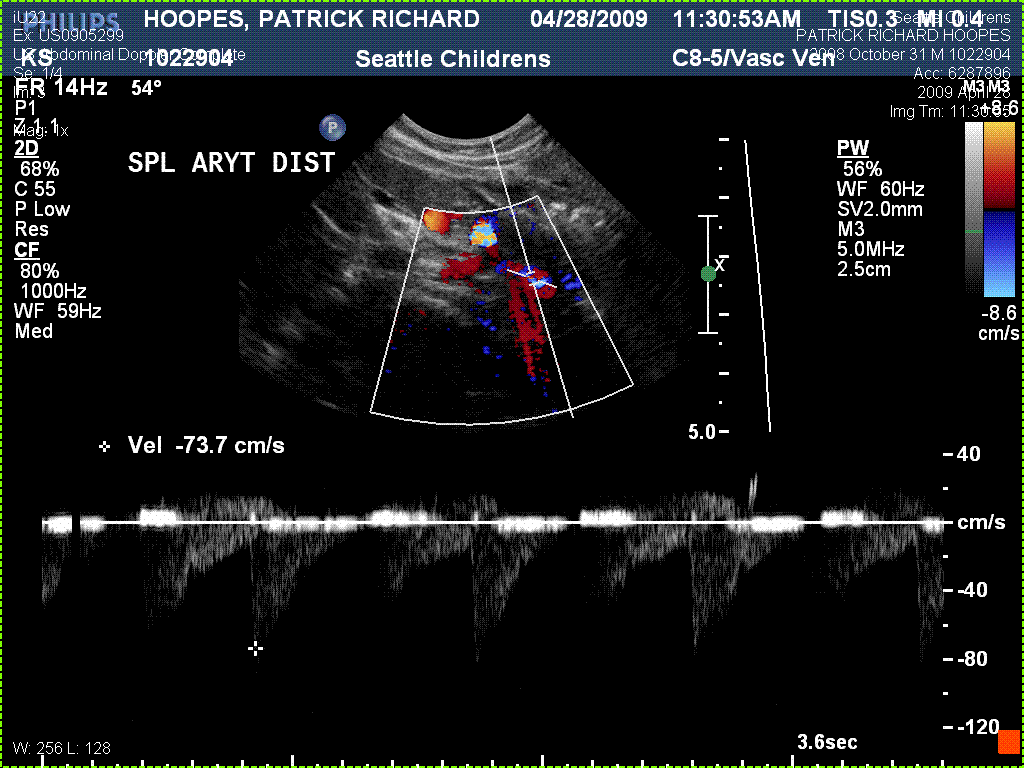
Tuesday morning found us back at Seattle Children’s again bright and early. Our day started in ultrasound. They wanted images of his digestive system and the central-line eligible veins in his neck. With so much to image, we had 3 hours scheduled with ultrasound.

Keeping a 6 month old still for 3 hours while goop is being rubbed around on his abdomen and neck is quite the feat. We went through every toy that I’d brought along… rattles, books, rings. In the end, the only way to keep his head still for images of his neck was to let him watch my cell phone’s media player. It was interesting to watch them map the flow of blood through his veins and to see his broviac line. Patrick was a big fan of the black and white images on the screen.

In the end, the ultrasound took 3 and a half hours, not 3, and we had to run to make our next appointment with the department social worker.

Because the transplant process can turn your life completely upside down, part of the workup is a meeting with the social worker. She asked a lot of questions about us to make sure that we were up for the task. We talked about our coping mechanisms, our family, friends and other support systems. She told us about programs in place that could help us like the Ronald McDonald house (as a place to stay during Patrick’s recovery), Angel Flight (for transportation to and from many doctor’s appointments in Seattle, and the Children’s Organ Transplant Association(a.k.a. COTA, a charitable organization that will create an account to save and fundraise for transplant in). The social worker will be our go-to person for a lot of the logistics of planning and paying for the transplant, which will be invaluable, as this is not easy or inexpensive by any means.

Because we were running late, the appointment with the social worker was divided in two to give us the chance to meet with the surgeon, Dr. Reyes. Dr. Reyes is an expert in intestinal transplant. He’s originally from Brazil but you’d never guess it from talking to him. He explained to us a little bit about how the transplant works. He also explained the difference between an isolated intestine transplant (intestines only) and a liver-intestine transplant. The first would be done if Patrick’s liver were still in good condition. The chances of rejections are a bit higher, but if the bowel were to be rejected, they could remove it and wait for another donor. The latter would be done if his liver is in bad condition. The liver, pancreas, and intestine would all be transplanted at once, still connected to each other. The liver helps to protect the other organs from rejection – but if it is rejected, then the chances of finding another donor before the situation becomes fatal are pretty slim.

We were surprised when he asked us if Patrick’s small and large intestines had been connected. We had been previously told this wasn’t possible because the small intestine was oversized and the large intestine was pencil-thin from lack of use. But Dr. Reyes thinks it would be very beneficial to connect these. Patrick has a good portion of colon left that could help absorb water so that fluid loss would be less of a concern for Patrick and we could perhaps feed him more. This wouldn’t eliminate the need for transplant, but would reduce some problems in the time we’re waiting.

After wrapping up with the social worker, we ran over to neurodevelopmental. There a developmental specialist met with us. She took a quick history while we fed and changed Patrick, then she did her evaluation. This was probably his favorite appointment. Basically, she played with him to see what he knew how to do. The funniest was when she was testing his verbal repetition. She’d say “Aaaa…. Now your turn” and he’d respond by blowing raspberries back, since he’d just learned to repeat that sound and was quite proud of his new skill. In the end, her analysis was that he lacks some muscle tone, but that he is developmentally right on target for his “adjusted age”… meaning you subtract 3 weeks from his age because he was born 3 weeks early and he’s just where a 5 month old would be.

Our last appointment of the day was with Dr. Horslen the gastroenterologist. Dr. Horslen is one of the best known gastrointerologist in the world of short gut syndrome. He is from England and just transferred to Seattle from the very established program in Omaha, NE. He is oozing with British-ness. Patrick was finally napping by the time we got to that appointment so he slept while we repeated Patrick’s medical history again. Then Dr. Horslen examined him and he woke up and gave him a big grin. Dr. Horslen labeled him a charmer from the start.

Dr. Horslen told us that he and Dr. Jackson (our GI in Utah) have known each other since Dr. Horslen first arrived in the U.S. and said he respects him very much. He is very willing for the 2 of them to work together as a team. He did go on and tell us what changes he’d make if he were treating Patrick in Washington. 1) He said he’d reconnect Patrick’s intestines. (Which made us happy to hear… we’re excited about this possibility.) He explained that not only would Patrick have less water loss this way, but that the stoma can start to bleed uncontrollably as the liver fails… something that there’s no real reason to put Patrick or us though. 2) He suggested that we follow some of the suggested changes in diet and TPN. 3) He said he’d replace Patrick’s lipids with Omegaven (a topic I’ll have to cover in another post). They’re doing a study at his hospital and he’s allowed to distribute it in the state of Washington. 4) He’d do a contrast study of Patrick’s intestines… (Also to be explained later)… basically, take some images to see what’s there.

Then he threw in a 4 that we’d been expecting since the social worker ran into us at dinner and accidentally let it slip… He needed to see Patrick’s bloodwork right away to know what else needed to be done… And since Patrick was VERY anemic… He’d admit him to the hospital that same night so he could have a transfusion after the blood was drawn. They had a room ready for us to be admitted that night.

Now, in the interest of keeping this blog readable, for it’s length… and just for the fun of the suspense… I’m going to leave you in that cliffhanger until I find time to write again.