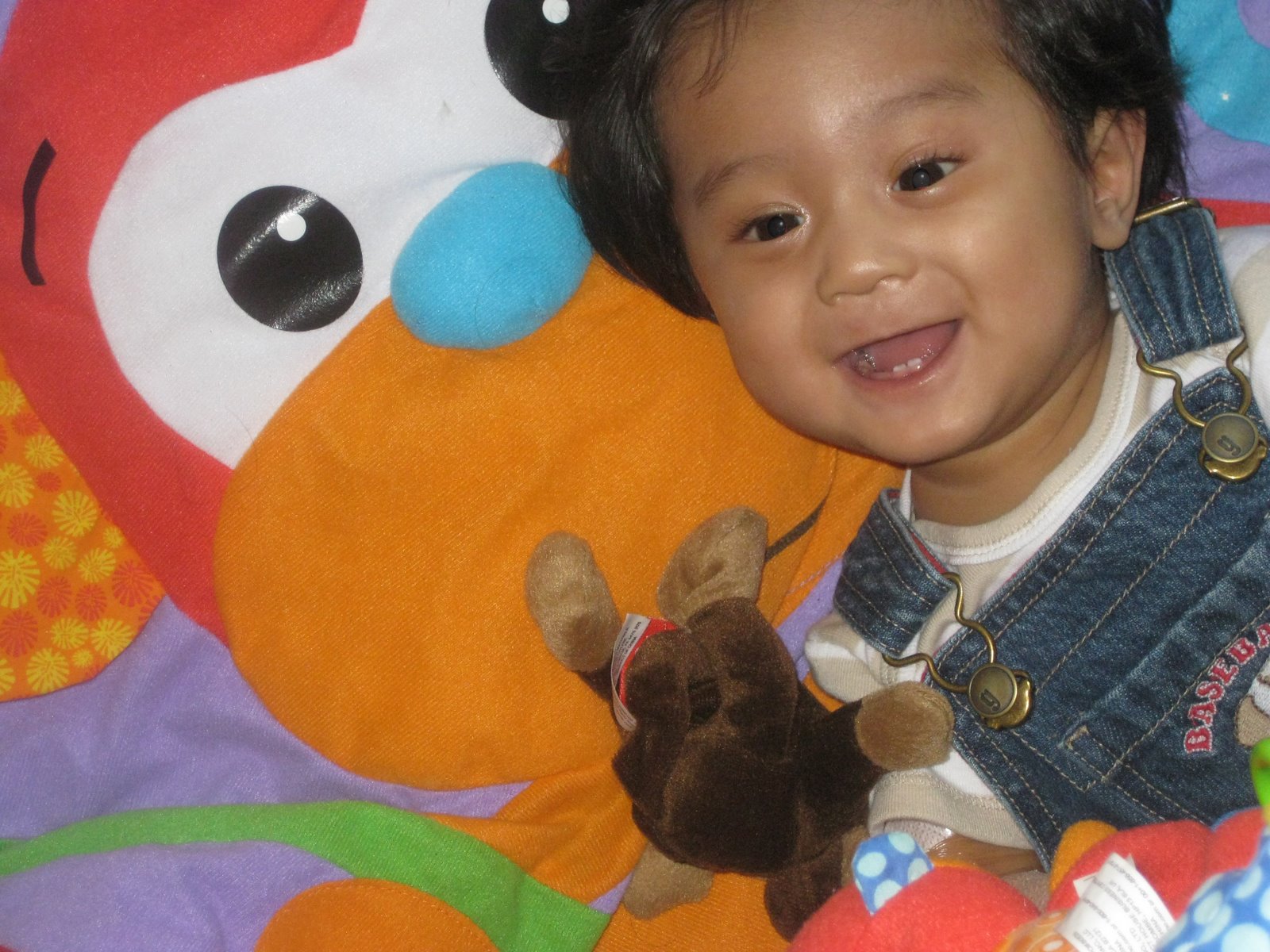
Home Sweet Home

We were able to bring Patrick home again yesterday afternoon. My apologizies that it comes as such a surprise. Patrick’s surgeon was out until last Thursday, and we didn’t see him till Friday. The other surgeons led us to believe that we’d need to stay in the hospital until Patrick no longer needed his stomach drained to compensate for his too narrow large intestine.

When Dr. Rollins, the surgeon, came in on Friday he said he’d like to get us out of the hospital as soon as possible. However, weekend discharges are difficult and don’t often happen.

Dr. Rollins called Patrick’s GI, Dr. Jackson, in to give his recommendations and, well, Dr. Jackson always wants us home whenever possible. Despite all these recent infections, Patrick has a pretty good track record of staying healthy at home. So Dr. Jackson always prefers that he be here, especially with RSV and flu season upon us.

And so, much to everyone’s surprise, including ours, we brought Patrick home yesterday.

He is on erethromycin (don’t know that’s spelled right), which causes the stomach to contract… the idea is that it will help improve motility through the intestines. And he has a g-tube extension attached to the button in his stomach. This gives his stomach a sort of release valve for when his stomach contents build up too much. We put it to drain periodically throughout the day, though the goal is to keep that at a minimum.

So – my care of Patrick has changed, but is still very time intensive. And as he gets better and has more diapers to change and is allowed to eat, I expect to get even busier.

He’s doing great! It’s amazing to me to see him willing to play on his stomach now that the ostomy is gone. He’s also become quite good at sitting. It will be different to experience this new level of activity here at home.

Update: Two weeks (and a day) after surgery

Well, it’s been another week. Most people are surprised to learn that we are still at the hospital. Well, we did think that the recovery would be no more than two weeks.

But here we are.

It turns out that Patrick’s large intestine is needing much more time to adapt than was anticipated. The problem is that, never having been used, first it had to wake up, and then it has to stretch back to a normal size.

They did a contrast enema today. That means they squirted contrast in Patrick’s bottom and then watched on X-ray as it moved up through his large intestine, and then his small intestine.

The good news is that it moved through without problems. There are no obstructions or strictures. The bad news is that, well, it still resembles a long noodle more than a colon. And it’s fitted to a small intestine that is quite stretched out.

So the stretched out, and therefore weaker, small intestine is trying to push things through a super tight large intestine (imagine a balloon that hasn’t yet been inflated). And it’s just not working very well.

I’ll talk to Patrick’s surgeon tomorrow about the study and see if there is anything more that can be done. So far, though, the answer I’m given most often is that we just need to wait. Hopefully time and use will balance things out.

In the meantime, we just keep waiting here. I don’t know quite what to do with myself. Without feeding, ostomy, IV’s (I’m not allowed to touch them), or even diapers really, there isn’t much in the way of my normal nursing duties to do. So I’m trying to spend my time just being a mom… playing with Patrick and helping with the basic things like sleep, comfort, and cuddles.

The good news is that Patrick actually feels quite well, as long as we don’t let too much build up in his stomach. And this lends itself to fun new adventures like baths in a bathtub and learning to sit.

It’s not the easiest thing being cooped up in this tiny crowded room together with nurses going in and out all the time. We get a bit bored of each other sometimes. But we’re doing the best we can and just praying that Patrick’s body is up for the challenge it’s been given.

Lines

Patrick just got a new PICC line.

PICC stands for Peripherally Inserted Central Catheter. It’s “peripheral” because it is put in through his arm (or sometimes leg) but “central” because the line then runs up through that vein into his aorta (a.k.a. into his heart).

Central lines are very important. Because they run into the bloodstream closer to his heart, they are able to put things like TPN or medications into it that would damage a smaller vein because they are too thick.  Also, because they are in a main vein, they can draw blood from it to run tests rather than having to poke him every time he needs bloodwork. (Which for Patrick is sometimes done several times a week.)

Because Patrick needs TPN to survive, he needs to have a central line. Sometimes he has a PICC line in his arms. Other times he has a “Broviac” or “Cook” line in his chest.

Lines can be lost to infection, to damage, to clotting, or to accidents that dislodge them. But every line lost is dangerous for Patrick. One of the biggest factors if his survival is continuing to have veins to put lines into and so it’s not uncommon to find us discussing what semi-heroic measures to use to make a line last just a little bit longer.

This line placement went remarkably smoothly. The procedure took less than half an hour, following by a half hour nap. Now he’s awake and happily playing in his bed. Still a bit shaky from the anesthesia, but trying his best to sit up. He must be feeling ok.

Well it’s now been a week since Patrick’s surgery. Patrick is doing really well so far, considering. His incision is healing nicely. It doesn’t seem to hurt him anymore. He’ll sit and play and jump pretty much the same as if he were at home.

This is pretty amazing to me, considering that he still has staples and the area around the incisions and especially where the stoma was look bruised and ugly still. The staples will come out sometime in the next week.

He’s finished his round of post-op antibiotics, too. We were afraid he’d run a risk of infection at the surgical site because a stoma isn’t exactly a clean thing, but Patrick seems to be healing up nicely, regardless.

A few days ago, we started to see little traces of stool in Patrick’s diaper. It’s hardly anything at all, but quite miraculous for him, since his colon is so narrow right now. Pretty much all we’re waiting for here is for Patrick’s colon to have time to stretch out and start working. Until then, his stomach has to be suctioned, which is why he’s got a tube in his nose. At the rate things are going, there’s probably still another week ahead of us, though.

With as little as is there, though, Patrick’s poor little bottom is already red – despite the heavy duty diaper cream I’m using on it. This will be normal for him, though. So we’re just trying to get a good start.

So things are pretty calm here. Of course, nothing is ever 100% simple. In addition to post-op concerns, we’re watching a rash that appeared under Patrick’s central line dressing a couple of days ago to make sure it doesn’t lead to complications and infection. And… as Patrick likes to do to stump us, his heart rate has been low when he sleeps. So we’re watching, as always, to make sure that all stays well. This, for Patrick, is pretty routine… even if it does cost me some sleep.

Well enough to leave the PICU

About 2 hours ago, Patrick was transferred out of the PICU into the infant unit. He’s doing SO well! We’re just past 48 hours post-op and he is already awake and playing most of the day.

He’s got so much energy in fact, that he needs reminded that he can go to sleep. The poor thing is used to being rocked to sleep, but it hurts too much to move him to get him out of bed right now. So I end up putting down the siderails and snuggling my cheek up to his till he falls asleep.

They turned off his morphine drip and he’s getting by on a dose every few hours instead. The funny thing is that right now what helps best to calm him down when he is crying because something’s happened to cause him pain is if I pretend to make a beanie baby bull named Snort that was given to him yesterday talk. I don’t know if it’s the bull or my funny bull voice, but it usually is enough to at least settle him a bit until the pain eases.

The surgery went smoothly

According to Patrick’s surgeon, the procedure went as well as could be expected.

We got up at 4:30 this morning to be able to make it to the hospital by 6:00 a.m. We discovered as we were getting him ready that his TPN pump had malfunctioned and did not run overnight. Amazingly, though, he was doing ok. I learned to use his glucometer just the day before and confirmed that his blood sugar was low, but as soon as we gave the TPN, it picked back up. When we got here, the surgeons weren’t overly concerned, since things had normalized.

We checked in as usual, put Patrick in little hospital pj’s (he’s now big enough to wear the pants!), and then waited to talk to the surgeons.

Dr. Rollins, the surgeon, came first and we talked about the plans for the day. As we discussed things, we decided that in the interest of not wasting places for a central line to go, that we would leave Patrick’s PICC line in until it becomes medically necessary to pull it. Then we visited a bit with the anesthesiologist, who looked an awful lot like Shaggy from Scooby Doo.

Then it was off to the surgery waiting room. Urology was scheduled to see him first so,  although we were tired and starving, we hung around till we talked to them. They were able to get a catheter in with minimal difficulty so they didn’t do any other procedures. They gave us written and verbal instructions to prevent future problems and then went on their way.

We grabbed a quick breakfast, then went back to waiting. Dr. Jackson, Patrick’s GI, stumbled across us in the waiting room and was excited that he could go in and see Patrick’s anatomy firsthand.

Then we had a long, long wait. We didn’t hear much over the next 3 hours. But about 12:30, Patrick’s surgeon came in smiling. Since we had a lot to talk about, we got to go to one of the consultation rooms for the very first time.

The surgery went relatively smoothly. The only thing unexpected was that the adhesions (severe scarring) that he had were worse than they’d anticipated. They had to take extra time to remove them and find the ends of his intestines.

They put the two pieces together, although they are a less than perfect fit. Dr. Rollins held up his fist and touched one finger to it and said that it looked proportionally about like that. As it turns out, he does not have any jejunum.

He has 17 centimeters of duodenum, measuring from the base of the stomach. This means he doesn’t really have any of the absorbative portion of the small intestine. He does have the left side of his large intestine, the descending colon. It is pretty apparent from what is left that the cause of his short gut was probably that the blood supply to the intestines was lost because they twisted. None of this is really new to us… but it was nice to have it finally confirmed.

They also did a liver biopsy. Dr. Rollins said that on visual inspection the liver looks relatively healthy. It is generally a good color and only a little more firm than normal. This is VERY good news for Patrick right now.

So – where do we go from here? Because the large intestine has never been used, it will need to stretch out and get used to being used. First, though, the point where the intestines were stitched together needs a chance to heal. Right now it is most likely swollen closed.

Until that point, Patrick has a tube going through his nose into his stomach that will suction out stomach acid. Eventually, his intestines will heal and adapt and that won’t be necessary.

The main goal before we can take him home is that he be able to pass stool and no longer need the suction. We’ve been told to expect about 2 weeks of recovery before this is possible. Then we can begin again to work with him on feeds.

In the short term, he’ll stay here in the PICU for a little while. Because of the amount of scarring that needed to be removed, he is in more pain. So right now he is still intubated so that he can safely be on a morphine drip. That is the plan through the night, and then tomorrow they’ll talk about extubating.

With all the tubes, though, he looks pretty good. He obviously hurts. But he has woken up and looked at me… and with the morphine, seems to be resting very well.

The rest of our day will be spent getting settled and keeping Patrick comfortable. And then just working on a quick and smooth recovery. I see all good signs here that they think he’s very stable.

I’ve got pictures to post… but forgot my card today. I’ll add them ASAP.

So what is tomorrow’s surgery, anyway?

We’ve had a lot of questions recently about Patrick’s surgery. Seems that there’s some questions about what exactly is going on. I’m going to attempt to explain what is happening in this blog post.

First, though… This is not his transplant, nor does it eliminate the need for his transplant.

Patrick is scheduled to have his small and large intestines reconnected tomorrow. To understand why this is necessary, let me tell you a little bit about his anatomy. While the average small intestine is about 20 feet long, Patrick was born with just 10-15 centimeters of small intestine. He has under a third of his large intestine. Because the large intestine has never been used, it is pencil thing. In contrast, the small intestine has been trying to adapt, which means it is larger in diameter than it would normally be. Here are a couple of images taken in April that might help you to visualize what that means.

From The Hoopes’s’s
From The Hoopes’s’s

The small intestine has three parts with 3 different roles. You can read about them here. Patrick only has the first part, the duodenum, which is very short, and an equal portion of the second, the jejunum.

The surgeons at the hospital where Patrick was born were not comfortable trying to put two pieces that were so very different in size together. Instead, they opted to create an “ostomy”, or “outward hole”. They made a whole in his side and brought the end of his small intestine out through it.

This option has it’s advantages. It’s easier to keep his skin healthy. (Patrick’s small intestine ends before stomach acid is reabsorbed so his stool can easily burn the skin.) And it’s easier to track fluids lost so that we can replace the water and electrolytes he loses. (The small intestine also ends before water and electrolytes used in digestion are reabsorbed.)

However, Patrick’s transplant surgeon and GI have asked us to take down the ostomy and connect his intestines. There are risks in having an ostomy. As his liver begins to scar, it will start looking for other ways to send blood away from it. The result is that smaller vessels will carry more blood than is usual (hyperportal tension) and a stoma could start bleeding uncontrollably.

Furthermore, the colon, while it doesn’t absorb nutrition, does absorb some bile and water and electrolytes, so in the end Patrick might lose less. This would mean he could eat more without it becoming dangerous for him.

Finally, Dr. Reyes says that he’s learned over the last 20 years that patients whose colon is in use, rather than having an ostomy, fare the wait for a transplant better. The body is happier when all the organs that can be working are. And the colon sends bile and water back to the liver, which is the liver’s version of job satisfaction. It will work better because it’s getting a positive response from it’s work.

So… the next questions you ask me are these.

1) Does this mean he won’t need a transplant as badly? No. Although the intestine does a fabulous job of adapting when it’s shortened, Patrick still is missing the vital section called the ileum where all the nutrition is absorbed. Without it, he is TPN dependent, which is where the risk to his life lies.

2) Will his diapers be normal? Well, yes and no. He will poo now. But it will still be mostly water and bile, kind of like a severe case of diarreah. We’ve been told we’ll change at least 12 diapers a day and need to use heavy duty diaper creams in order to keep the skin from breaking down in diaper rash or worse. We will also probably have to do some form of “double diapering” to prevent against explosive leaks that are common in kids with short gut and to be able to continue to monitor the fluids he loses so they can be replaced.

3) What will his recovery time be? We’ve been told to expect at least a week of recovery. He’ll go first to the PICU because he failed extubation in July. The critical care doctors will then be able to wean him off of the ventilator at a pace that is better for him. Once he can breathe on his own, he might be transferred to the infant unit… or he might stay in the PICU. It all depends on how his recovery goes.

4) Is this a risky surgery? Well, yes. With the run of infections Patrick has had lately, they are operating with him not quite as healthy as they would normally ask. There are risks of the connection leaking, or losing even more of his intestine, of the wound not healing because the skin where they are operating is so frequently exposed to stool. It’s also risky to reintubate Patrick right now. But, the risks of bleeding from his stoma are worse and Patrick is the healthiest he has been all summer, so it’s a chance we need to take.

5) What will happen on surgery day? We’ll get the time for surgery this evening. Tomorrow Patrick will fast. We’ll be admitted through outpatient surgery because Patrick’s surgeon was scheduled to be off tomorrow and added Patrick on because it was the time that was best for Patrick. The wait for surgery itself is always a bit nebulous. We’ll meet a surgery nurse and an anesthesiologist, and then finally Dr. Rollins will come talk to us.

In addition to the intestinal surgery, Patrick will have a liver biopsy, have his PICC line removed and a new broviac line placed, and have a scope done by urology to look for scarring from the catheter he had placed in July while he was in the PICU. The total OR time scheduled is about 3 1/2 hours.

We’ll wait in a parent’s waiting room where they’ll come to keep us up to date. Then instead of going to recovery, he’ll go straight to the PICU.

6) Are you nervous? It’s always hard to take your child who is healthy and happy and playing to a surgery knowing that there are risks involved… and even in best case scenario, knowing he won’t feel well for several weeks afterwards. However, we’ve been praying about this and feel calm that things will go as they’re meant to.

So – there you go. All you could hope to know about tomorrow’s surgery. We’ll do our best to keep you updated as soon as we know what’s happening. Most of the time, we’re waiting for answers, too.

Thanks for your continued prayers and support.

Another infection

I’m writing from Primary Children’s hospital again. Tuesday afternoon, Patrick started to act as though he had an upset stomach. I got him settled and he took a nap, but before long woke up upset again. So, as I always do, I took his temperature and lo and behold, he had a fever.

I made a call to the GI on call, Dr. Pohl, and he made arrangements for us to check in to the hospital directly, without going through the E.R.

It was strange to come in without the E.R. routine, but kind of nice, too. The infant unit was full, so they put us in a room in the Children’s Medical Unit just down the hall. As usual, the first few hours were chaos as I gave history, got meds and supplies ordered, and generally got acquainted with the medical staff.

Typical protocol is to draw blood cultures to look for and identify the infection he has. So they call IV team and they draw blood from a vein while the nurse is responsible for drawing blood out of Patrick’s PICC line. They also draw blood to check levels of other important things like blood sugar and electrolytes through his PICC.

Well, Patrick’s PICC line has been tricky and occassionally with clot and not draw back. In this case, neither lumen would draw back. So about 11 p.m. they started soaking it in something to break up clots… but it still wasn’t working.

Finally at midnight things were pretty quiet, even though they didn’t have labs, and I decided I’d better try to get some sleep.

About 2 a.m. things got exciting again. First, his diaper leaked. Right now, Patrick’s ostomy doesn’t have a bag on it (that’s a story in and of itself) and so I had to get up to change it because the combination of creams and powders required to protect the skin against what is essentially stomach acid is pretty complex and not your standard nurse’s experience.

While he was awake, they took his blood pressure and it was frighteningly low.  They checked it about 20 times over the next stretch of time and even though he was awake and uncomfortable, which should raise blood pressure, his was low.

So they finally got his PICC line to draw back and drew some emergency labs to look for dangerous things like low blood sugar, drew blood cultures, and called the ICU to come look at him.

A doctor from the PICU came and looked at him and checked his blood pressure and said that he needed to go downstairs so they could give him medicines to bring his blood pressure back up.

So, at 3 a.m. we packed up and transferred to the PICU. It was odd to be there in my PJ’s giving his medical history. Finally at around 5 things were pretty stable and they recommended that I go get some sleep. So I went and crashed on one of the beds in the parent waiting room.

The next day they explained that sometimes infections cause your blood pressure to drop. Patrick responded very well to the medicines they’d given him, though, and was pretty stable. However, everytime he went to sleep, it would drop again.

Finally after being in the hospital for a full day, the antibiotics started to work. He started to act like he felt better, and his blood pressures came back up.

Thursday afternoon he was doing well enough that they moved him back from the PICU to the Infant Unit. Which is where I’m writing from tonight.

Patrick obviously feels MUCH better! He’s been back to trying to sit and stand and he’s getting stronger and more coordinated all the time.

The tentative plan right now is for us to go home Saturday. As always, when we leave the hospital, all of the nursing duties fall back on Brian and myself, with help from friends and family where possible. He’ll be on two antibiotics and an antifungal because of a diaper rash developing that is most likely yeast. (Antibiotics create the perfect environment for it to grow). With meds every 6 hours at least, sleep will become a very rare commodity again. Of course, as I’m posting this in the middle of the night, you’ll see that it already is.

We’re grateful that this bug seems to be one of the less scary ones. It’s called enterococcus, which lives inside the gut. It most likely either translocated (leaked) into the bloodstream from his gut or got in by accidental contamination of his IV tubing. Any way it goes, it required just 2 antibiotics to treat and Patrick’s central line so far can stay in. In those regards, we consider ourselves very lucky.

Of course we’ll do all we can to keep you updated on what happens from here. Thank you again for all of you do for us.

Re-evaluation at Seattle Children’s

Sick boy on beanbag

You may have heard that Patrick had a day of office visits scheduled at Seattle Children’s hospital last week. After his cardiac arrest and the many complications that followed, they wanted to see him again to see if anything had changed that would affect his transplant status. They also wanted to look to see if he needed to be listed for a liver transplant.

Daddy & Patrick in the ERWhat you may not have heard is that Patrick was hospitalized Sunday night with another infection. This time it was a staph infection which, if caught early, can be treated through his central line and clear easily or, if more established or more resistent, could become a very persistent infection that can hang on for months.

I called Seattle Children’s and tried to reschedule our appointment. However, Dr. Horslen was going to be away for the next several weeks and they didn’t want him to stay inactive on the transplant list for that long. After a few days and some discussion, we made the decision on Tuesday to have Patrick admitted at Seattle Children’s so they could both treat the infection and do the evaluation.

We got the final go ahead late in the day Tuesday. I was up till 1 a.m. packing.  Wednesday he was discharged from Primary Children’s with just time to go directly to the airport. The flight went well. They only real difficulty was that Patrick’s ostomy bag started leaking at takeoff. Well, and that I got a tad bit lost in the airport because we landed in the international terminal and airports aren’t as well marked when you have to take the back elevator routes.

Nevertheless, we arrived at Seattle Children’s around 6 p.m. – just as they were changing shifts. We met part of the medical team that would be following him and, as usual, wowed them by giving them in writing all the information they really would need. It took some time to get orders written, so we had another late night as labwork and meds came trickling in. It was about 2 a.m. before we made it to bed again.

Smiley in SeattleThe nice thing about being inpatient is that it gave me a sense of what things will be like during his recovery after transplant. We started with an early abdominal ultrasound, specifically a doppler. Yes, this looks a bit like the weather map images, only it shows the flow of blood through the veins. They were looking to see if portal hypertension was developing. (As the liver scars, it starts to send blood through other vessels creating extra blood pressure through them. It can cause lots of complications.)

The team rounded about 10 a.m. It was a big group, about 15 people, including his GI Dr. Horslen, his transplant coordinator, nutritionist, and others who specifically follow him. They had looked at the ultrasound and the labs from the night before and at his labwork. Both looked as good or better than they had in April.

Dr. Horslen came back later in the day to talk to me and said he was very glad we’d come. He’d imagined he’d find Patrick in much worse shape after the reports he’d been getting. He did a physical examination, too, and then said that he didn’t think Patrick’s liver was really in bad shape yet. He said that the problems with his spleen were probably mostly due to the many months of infection that Patrick has been through, meaning that hopefully when he’s healthy, his spleen will improve, too.

We discussed other goals, too… including taking down Patrick’s ostomy and replacing his PICC line with a broviac line when he could have surgery. We’ve been going the rounds on the question on whether or not Patrick should have his g-tube removed, too, before portal hypertension makes it bleed and be more difficult to close. However, Dr. Horslen said he was under the impression it was unused when he recommended that, and that if we were using it, he’d be ok with us leaving it in.

It was great to talk to him and to watch him play with Patrick. Not only is he brilliant, but he has a wonderful bedside manner. It made me happy to remember that there was at least one big reason why we chose Seattle Children’s for transplant.

We also had visits that day from the nutritionist and a care coordinator. And then in the afternoon we got to have a little bit of lazy time. Child Life brought Patrick some bubbles and it was fun to watch him experience those for the first time.

When the nurse came on the night shift and Patrick was playing with her while she took vitals she frowned and said “Do you really have to go home tomorrow?” I was surprised because I’d expected to need to be there at least through the weekend… But before midnight they had me making lists of what would be needed for me to be able to go home on the 5 p.m. flight the next day.

Rounds in the morning confirmed that they felt Patrick could go… assuming that we made sure he got a visit from Dr. Reyes, his surgeon.

The rest of the morning I packed and kind of waited for word that we were really going. A volunteer came to play with Patrick so I’d have hands free. About noon, I still hadn’t heard one way or another, so my nurse started making calls for me. I looked at flights and now there was only 1 left and the price had doubled. But – the insurance company agreed they’d rather pay for extra airfare than another night in the hospital – and so I started working on booking a flight home.

Dr. Reyes came in about 1. We talked again about the importance of taking down Patrick’s ostomy. He told me a bit about starting intestinal transplants in Pittsburgh 15 years ago. (He was on the team that did the first ones.) And he explained how they’d learned that the surgery wasn’t really effective without a strong GI team behind it to make sure the patients stayed healthy. He also explained that one thing they’d learned in that time is that survival rates are better without an ostomy.

I ran our other surgical plans past him (liver biopsy, broviac line, and possibly g-tube.) He looked at me and said, “Leave the g-tube in. He’ll need in later.”  So I guess that settles that.

He left and I immediately went back to booking a flight. Meanwhile, the care coordinator came and brought me a cab voucher. My nurse got Patrick ready and booked the cab while I got the ticket. And I literally hung up the phone, put away a few things, and walked out the door.

Flying HomeThe flight home went smoothly. Howie was there to meet us. We had some adventures waiting on the way home including a flat tire, a broken jack, and eventually a tow home. But at last, we are home.

They discussed Patrick’s transplant status in their meeting yesterday. They were ready to move him back to status 1 for a small bowel. They will not yet list him for a liver. When they checked his labs, though, they found a blood culture positive for infection… so the doctors are discussing what to do now. He’s not sick and it could have been a contaminated sample. But they have to work that out before Patrick’s listing is made active again. Time will tell.
Recovering at home


I’m happy to announce some tremendous news! Patrick made a miraculous and quick recovery after my last post. The day after my last post, after much fasting and prayer by friends, family, and even people we don’t know, we walked into the ICU to find Patrick smiling and playing in his crib. He turned his head, saw Brian and me, and smiled. Over the next couple of days he continued to make steady improvement.

They gave him some steroids which helped reduce the swelling in his throat and his breathing became much less labored. Ear, nose & throat came and looked at his upper airway and determined that his vocal chords were ok and that, although he had swelling below them, that there wasn’t any evidence of scarring or other permanent damage. The only limitation that they placed on him was that he not be reintubated except for life-saving procedures for the next 6 weeks.

Neurology also came by several times in that day and watched as he progressed, began interacting with me, focusing his eyes, moving his arms and hands more normally… and in the end decided that there didn’t seem to be any evidence of a problem there that would merit further attention.

Next, they scheduled for him to go back to Special Procedures and to have another PICC line placed. Because his antifungal medications aren’t compatible with TPN, he needs two points of access. Amazingly, they were able to get a double lumen PICC placed. This means that there are essentially two tubes wrapped into one and placed in the same vein… instead of having a line in each arm. With that in place, they removed all of the other lines in his body.

The PICC made him sore, but by Thursday that was their primary complaint and they decided to transfer him out of the ICU into the infant unit.

Also Thursday he had a swallow study done. This means that they mixed contrast into apple sauce and put some him a bottle and had me feed it to him while they watched it go down his throat on floroscope. Having fasted or been fed by G-tube for 2 weeks, Patrick thought this was heaven and was furious when it was done. The end result was that he swallows perfectly… pretty amazing for a kid who is barely allowed to eat.

That confirmed, they started giving him bottles again. However, his gut had gone unused so long that it’s still working on recovering. We started out with just 2.5 cc’s every 3 hours…that’s about 1/4 tsp.

Saturday night Patrick’s PICC line got tugged and the vein started to swell. He woke up in the middle of the night and really didn’t sleep the rest of the night. We worried that it might need to be replaced again… but with some rest and elevation and heat, it slowly started to show signs of recovery.

Finally, Monday his electrolytes, stool output, feeds, and PICC line were all stable enough and at noon that day we were able to bring him home.

You should have seen how big his eyes got when we pulled into the garage! I was all grins and giggles when we walked into the house. As per tradition, once we got business squared away, Patrick and I curled up in my bed and went right to sleep. He slept till 5:30, completely peaceful.

We’ve been home for a few days now and are finally getting back into the swing of things. Family and friends have been great – bringing in meals and coming to sit with him during the day so that I can get things caught up around the house. He’s having a hard time getting used to sleeping through the night again. He doesn’t like being on his back since spending so much time in a bed. And I’m having a very hard time getting used to caring for a double lumen picc. But we are slowly moving forward and today, for the first time, has felt like routine again.

He needs to be seen ASAP in Seattle so that they can determine if he can be put back as status 1 on the intestinal transplant list. They are also looking at possibly listing him for a liver-intestine transplant, as well… since the problems with his spleen could be evidence of scarring in his liver. We have a trip planned from Wednesday through Friday next week… with appointments most of the day Wednesday. This will be my first time travelling alone with Patrick. It’ll be a process, I’m sure… But hopefully well worth the effort. If nothing else, it’ll be good practice for me.

It’s hard to believe that just weeks ago we were sure we’d lost our little boy. He has so much light and life in his spirit right now. He’s pretty weak still and we’re working on getting him back to eating what he had been eating before… And both of us have to get used to that line in his arm. But things in this house are calm and happy. It’s so good to be together… and so good to be home!