So what is tomorrow’s surgery, anyway?

We’ve had a lot of questions recently about Patrick’s surgery. Seems that there’s some questions about what exactly is going on. I’m going to attempt to explain what is happening in this blog post.

First, though… This is not his transplant, nor does it eliminate the need for his transplant.

Patrick is scheduled to have his small and large intestines reconnected tomorrow. To understand why this is necessary, let me tell you a little bit about his anatomy. While the average small intestine is about 20 feet long, Patrick was born with just 10-15 centimeters of small intestine. He has under a third of his large intestine. Because the large intestine has never been used, it is pencil thing. In contrast, the small intestine has been trying to adapt, which means it is larger in diameter than it would normally be. Here are a couple of images taken in April that might help you to visualize what that means.

From The Hoopes’s’s
From The Hoopes’s’s

The small intestine has three parts with 3 different roles. You can read about them here. Patrick only has the first part, the duodenum, which is very short, and an equal portion of the second, the jejunum.

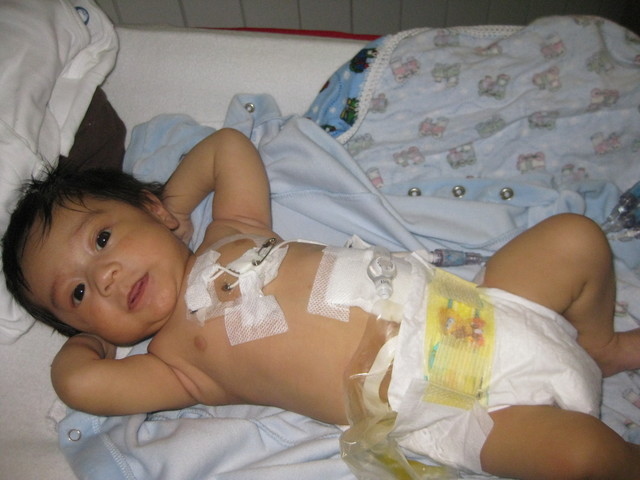
The surgeons at the hospital where Patrick was born were not comfortable trying to put two pieces that were so very different in size together. Instead, they opted to create an “ostomy”, or “outward hole”. They made a whole in his side and brought the end of his small intestine out through it.

This option has it’s advantages. It’s easier to keep his skin healthy. (Patrick’s small intestine ends before stomach acid is reabsorbed so his stool can easily burn the skin.) And it’s easier to track fluids lost so that we can replace the water and electrolytes he loses. (The small intestine also ends before water and electrolytes used in digestion are reabsorbed.)

However, Patrick’s transplant surgeon and GI have asked us to take down the ostomy and connect his intestines. There are risks in having an ostomy. As his liver begins to scar, it will start looking for other ways to send blood away from it. The result is that smaller vessels will carry more blood than is usual (hyperportal tension) and a stoma could start bleeding uncontrollably.

Furthermore, the colon, while it doesn’t absorb nutrition, does absorb some bile and water and electrolytes, so in the end Patrick might lose less. This would mean he could eat more without it becoming dangerous for him.

Finally, Dr. Reyes says that he’s learned over the last 20 years that patients whose colon is in use, rather than having an ostomy, fare the wait for a transplant better. The body is happier when all the organs that can be working are. And the colon sends bile and water back to the liver, which is the liver’s version of job satisfaction. It will work better because it’s getting a positive response from it’s work.

So… the next questions you ask me are these.

1) Does this mean he won’t need a transplant as badly? No. Although the intestine does a fabulous job of adapting when it’s shortened, Patrick still is missing the vital section called the ileum where all the nutrition is absorbed. Without it, he is TPN dependent, which is where the risk to his life lies.

2) Will his diapers be normal? Well, yes and no. He will poo now. But it will still be mostly water and bile, kind of like a severe case of diarreah. We’ve been told we’ll change at least 12 diapers a day and need to use heavy duty diaper creams in order to keep the skin from breaking down in diaper rash or worse. We will also probably have to do some form of “double diapering” to prevent against explosive leaks that are common in kids with short gut and to be able to continue to monitor the fluids he loses so they can be replaced.

3) What will his recovery time be? We’ve been told to expect at least a week of recovery. He’ll go first to the PICU because he failed extubation in July. The critical care doctors will then be able to wean him off of the ventilator at a pace that is better for him. Once he can breathe on his own, he might be transferred to the infant unit… or he might stay in the PICU. It all depends on how his recovery goes.

4) Is this a risky surgery? Well, yes. With the run of infections Patrick has had lately, they are operating with him not quite as healthy as they would normally ask. There are risks of the connection leaking, or losing even more of his intestine, of the wound not healing because the skin where they are operating is so frequently exposed to stool. It’s also risky to reintubate Patrick right now. But, the risks of bleeding from his stoma are worse and Patrick is the healthiest he has been all summer, so it’s a chance we need to take.

5) What will happen on surgery day? We’ll get the time for surgery this evening. Tomorrow Patrick will fast. We’ll be admitted through outpatient surgery because Patrick’s surgeon was scheduled to be off tomorrow and added Patrick on because it was the time that was best for Patrick. The wait for surgery itself is always a bit nebulous. We’ll meet a surgery nurse and an anesthesiologist, and then finally Dr. Rollins will come talk to us.

In addition to the intestinal surgery, Patrick will have a liver biopsy, have his PICC line removed and a new broviac line placed, and have a scope done by urology to look for scarring from the catheter he had placed in July while he was in the PICU. The total OR time scheduled is about 3 1/2 hours.

We’ll wait in a parent’s waiting room where they’ll come to keep us up to date. Then instead of going to recovery, he’ll go straight to the PICU.

6) Are you nervous? It’s always hard to take your child who is healthy and happy and playing to a surgery knowing that there are risks involved… and even in best case scenario, knowing he won’t feel well for several weeks afterwards. However, we’ve been praying about this and feel calm that things will go as they’re meant to.

So – there you go. All you could hope to know about tomorrow’s surgery. We’ll do our best to keep you updated as soon as we know what’s happening. Most of the time, we’re waiting for answers, too.

Thanks for your continued prayers and support.
A day in the life . . .

Things have been pretty calm since we brought Patrick home from the hospital this time. It takes a lot of extra work to keep up on all the new medications he needs, but otherwise life has been calm.

But – it occurs to me that I should state that our calm isn’t exactly the same as others’ calm. Let’s take today as an example. It was a pretty good day.

We got up early today. Patrick woke about hourly through the night because he’s still not used to being at home. I get up and give him a pacifier and put his blankets back on him and he goes right to sleep. I was a bit tired when the alarm went off at 6 to tell me Patrick’s vancomyacin was due. I’d forgotten to take it out of the fridge last night, so I had to run around with it tucked under my arm to get it warm while I got everything else ready.

I prepared a bottle. Disconnected Patrick’s feeding tube, replacement fluids line and ostomy drainage tube. By then he was screaming to be fed so I got him out of the crib and fed him his 1/3 tsp. of formula then rocked him back to sleep. (And me, too). At 7:30 I put him back down to check to make sure Howie was up.

He was pretty awake then, so I went ahead and got him up, changed his ostomy bag and g-tube dressing, flushed his picc line, and got him dressed.

Because we were up so early I decided that it was a good day to go shopping. It’s Howie’s birthday on Sunday so I packed a bottle to give myself extra time to shop. (Patrick eats every 3 hours, which can be a narrow window of opportunity).

I’d been in the store about half an hour when my cell phone rang. It was Patrick’s nurse confirming an appointment for her to come draw blood for labs. It was 11:30 and she wanted to come at 12:15. So I made a mad scramble to focus and finish the grocery shopping so I could get home on time.

At 12 we finally made it out of Wal-mart and I loaded Patrick and the groceries into the car, then shut off his TPN pumps so that the labs would be accurate. (Need to give the blood time to carry off what’s in the PICC line.) I hurried home and just got the groceries into the house and put away and Patrick fed when his nurse knocked on the door.

I gathered up the supplies she’d need for the tests then held him while she drew them. She asked what his last temperature had been, and since I hadn’t taken once since he woke up, she did. It read 99.5.

Any rise in temperature can be an early sign of infection so I stuck a thermometer in my pocket to do temp checks every half hour. Then I took him upstairs to change his diaper only to discover his ostomy bag had leaked. He was pretty mad, but I pulled off a quick change and took his temperature again.. Still high.

I grabbed a quick lunch and put on replacement fluids (saline solution via IV). He needed some anyway and if he runs a fever he needs extra hydration. By then he was getting quite mad and so I piled everything to work on his tubing change around me and snuggled him up in my lap to try to help him sleep.

At 2 I traded replacement fluids for IV antibiotics, and when those were done, started prepping the new day’s TPN. When I opened up the backpack around 2:30 to see what time I had left in the day’s TPN program, I noticed a bad mistake. I’d failed to turn the pumps back on after the blood draw.

Without TPN running, Patrick’s blood sugar plummets, so I hurried and got him a bottle and then gave him a couple of licks of a glucose tablet to help keep him up. I made a record fast tubing change then reprogrammed the pumps to slowly “taper up” the rate of infusion to avoid going from very low blood sugar to something too high.

Finally with TPN running again, Patrick calmed down. But his temp was still between 99 & 99.5. My next option was to try to get him to rest. So we snuggled up on the couch so he would sleep. He’d sleep as long as I was right there holding him. So, while he slept, I talked to his transplant coordinator in Seattle and then sent an e-mail to his GI here to try to get sorted out a positive blood culture that showed up in his labwork last week.

The evening was calmer. Brian worked a bit late which gave me extra time to get dinner ready.

Around 8 we started working on the bedtime routine. One of Patrick’s meds needs to be given on an empty stomach so he gets that around 8:30. Then Brian and I work together to make new formula & bottles for the night and to prime the tubing for the feeding pump that drips formula into his stomach all night. He gets one antibiotic through his g-tube right now. We have to draw it out of a vial with a syringe and then change tips to something that fits his feeding tube and flush it in there.

Then we connect his feeding tube, flush his PICC line to make sure it’s still running well, and change him into P.J.’s. Tonight he gets to sleep in a onesie to help keep his temperature down, though.

At 9, Patrick ate and then curled up and went to sleep. Because Brian was home, we stayed up watching T.V. while we gave antibiotics. He gets 3 at night, plus more replacement fluids. We have to switch medicines and flush lines at 9:30, 10:00 and 11:00 p.m.

And that is why I’m up blogging right now. His last antibiotics are just finishing up, so I need to go take them off and make sure that the unused line is “heparinized” for the night. If I’m quiet, I hope to do it without waking him and make it to bed by midnight.

It sounds like a lot, but this has actually been a mostly relaxing day.. except the part in the middle when Patrick’s TPN was off and he felt awful. Last temp was actually low… so I hope that the other high numbers were a result of the heat of the day or the fact that he’s cutting a few teeth.

Transplant Pre-evaluation: Day 1


So the first big question about getting Patrick to Seattle was transportation. With current airport security, how do you get a kid who is connected to running IV fluids through security? And how do you go about transporting a week’s supply of TPN? It has to be kept at a certain temperature and, well, there is just a lot of it. Hauling a cooler and coordinating tubing through the airport just didn’t sound like much fun to us, but neither did dealing with any lost luggage.

So I did tons of research: called the TSA, read every page in the Delta website about baggage, and read websites written by other TPN patients. Finally, I asked the pharmacy if they could ship the TPN ahead of us. Turns out, that’s a free service that they provide. And our wonderful friends Lindy & Kelly helped us find a place in Seattle to ship to and then picked up the shipment and kept it in their fridge until we could get there.

So we were able to travel with just 2 day’s worth of medical supplies in our carryon… which was still enough to fill an entire carry-on sized suitcase, but probably saved us TONS of grief. Patrick’s luggage was by far the biggest and we were probably quite the sight making our way around with Howie hauling 3 rolling suitcases behind him and his carry-on and me with a stroller, a duffel bag, and a diaper bag.

We were surprised by how smoothly things went at security. In Salt Lake a TSA worker came up to us when she saw us getting our stuff ready to go through X-ray. I explained to her Patrick’s IV’s and showed her my suitcase full of medical equipment, including IV solutions and syringes full of saline and heparin. She took over right away. Patrick and I went through the metal detector and (of course) set it off because of his pumps. Then they took us to the little security station and ran their little tests on his medicines. When they were all done, they patted Patrick down and then did a wand/hand search of me. Then they thanked us for keeping things organized and making them easy and sent us on our way.

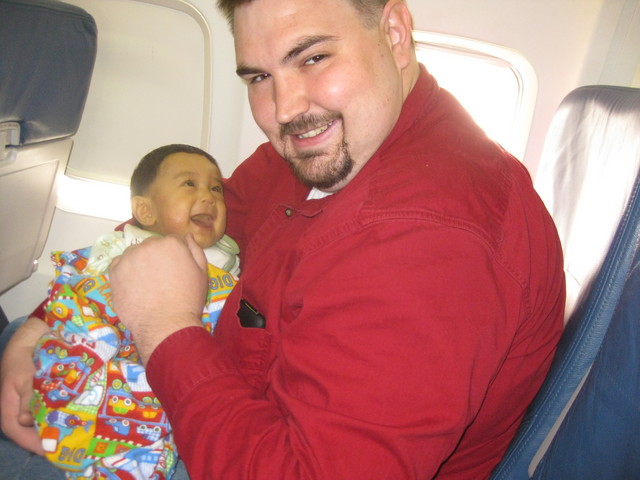
We were allowed to board the plane first because we were travelling with an infant, which was different but nice, especially since we needed to get his stuff settled so we could get to anything he needed during the flight.

We booked him a seat, not to sit in, but to give us some extra space. His backpack rode there buckled in and Patrick started the flight in his daddy’s arms. He played and he slept and he flashed his bright eyes and smile at the flight attendants and the passengers around us. He was by far the best behaved child on the flight! Whimpered only when he was hungry.

Finally we landed and took our crazy little caravan to the rental car company and checked in at our hotel. We took a much needed nap before heading over to visit Kelly and pick up the TPN shipment.

The day of travel was much smoother than I could have ever expected! Which turns out to be a good thing, as we had a very long week ahead of us

Transplant Pre-evaluation: Introduction

We’re going to have a little series of posts here about Patrick’s transplant pre-evaluation at Seattle Children’s Hospital. I decided to break this up into a series not to extend the suspense for you, but to increase the odds that I would be able to finish a post in a single sitting.

So, we’ll start with an introduction. As you know, Patrick has extreme short gut syndrome. Without intestines, he is completely dependent on TPN for nutrition. And the lipids in the TPN are notorious for damaging the liver. If he had more intestine, there would be the option of adapting Patrick’s intestine, but with so little, he needs to have a transplant before his liver fails if he is going to survive.

Our GI in Utah recommended that we go to Seattle Children’s Hospital where they have a relatively new intestinal transplant program being started by some of the most experienced doctors in this field in the country. So, after some prayer and some research we requested a referral and last week we flew out for an evaluation.

There are several purposes for a pre-evaluation for transplant:
1) It gives us a chance to meet the team and see the facility and decide if we want to pursue treatment there.
2) The doctors can see the patient and have tests done to give them first hand knowledge of the case so they can recommend a plan of action, including deciding if transplant is the only option for the patient.
3) They do lots of tests that check to make sure Patrick is healthy enough for a major surgery, to detect any unknown health problems, and to gather the information needed to match him with a donor.
4) They look at our family’s ability to maintain Patrick’s care financially, emotionally, and physically both before, during, and after transplant.

Once the workup is complete, Patrick’s case is presented to a review board and a decision is made as to whether or not he is a good transplant candidate. When the decision is made, they’ll notify us.

So that’s the purpose of the pre-evaluation. The next few posts will describe our experience and what we learned.

Button, button, he’s got a button

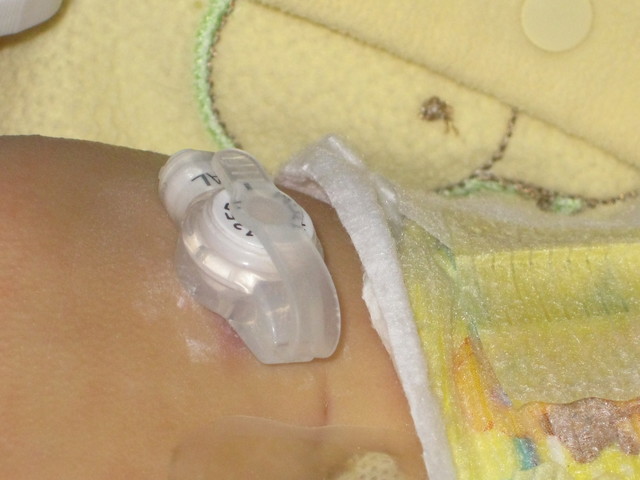
We finally were able to trade in that long, awkward g-tube that Patrick liked to get caught in his toes. On the 13th, Patrick’s GI replaced it with a mic-key button. This is small port with a tiny tube that goes directly into his stomach. We can snap a tube into the button to use for feeding or any other needed access to his stomach. But, when it’s not in use, he has only the much smaller button to worry about.

Tummy time, wearing pants, and zerbets are all now much easier.

You may be asking, well do you use his button? What’s it there for? Well, the goal of an “enteral feeding tube” is to put food or medicine directly into Patrick’s stomach without him needing to take it orally. Now, anyone who knows Patrick knows that he loves to eat. However, we’re hoping someday to be able to use this tube to feed him overnight so he can sleep through the night. There’s a pump that will pump formula from an iv-style bag into his stomach at a nice slow rate.

We tried doing just that over the past couple of weeks. However, we’ve learned that Patrick so far doesn’t sleep soundly enough for it to be worth the extra effort. Because food is going directly into his stomach, we were giving him smaller oral feedings during the night… but Patrick didn’t think that was enough and was quite vocal all morning most mornings letting us know he wanted more.

So – right now we’re not using button. However, we’re hoping someday to use it and finally let Patrick sleep a whole night long.

Broviac Line

I wrote earlier that Patrick was going to have a broviac line placed after his infection had cleared. However, since he has tiny, tiny veins it’s really hard to get a peripheral IV into him and equally hard to keep him there.

Because he doesn’t have enough of his bowel to be able to absorb nutrition or medicine that he takes orally, Patrick depends on an IV to give him the nutrition that he needs. Also, as he’s recovering from this most recent infection, he needs IV antibiotics.

When I arrived at the hospital this morning, they told me that they’d be placing his Broviac line today instead of waiting a week. He’s been stuck just so many times trying to place an IV that they were running out of places to look – and he was running out of patience for it. He went to surgery this morning to have the line placed. It goes in through a vein by his neck and is “tunneled” under his skin. A catheter, or IV tube, comes out of his chest. This is a more durable IV line that should last him several months. In fact, one requirement to take him home was to have this more durable line put in.

Patrick went into surgery a little before noon today and was in recovery by 12:15 p.m. So far he’s been sleeping quite peacefully. We expect a quick and easy recovery. As soon as he’s awake, he should be able to go back to his normal routine.

If you’d like to know anything more about the line, this link will take you to the info sheet that Primary Children’s Hospital gave to me.