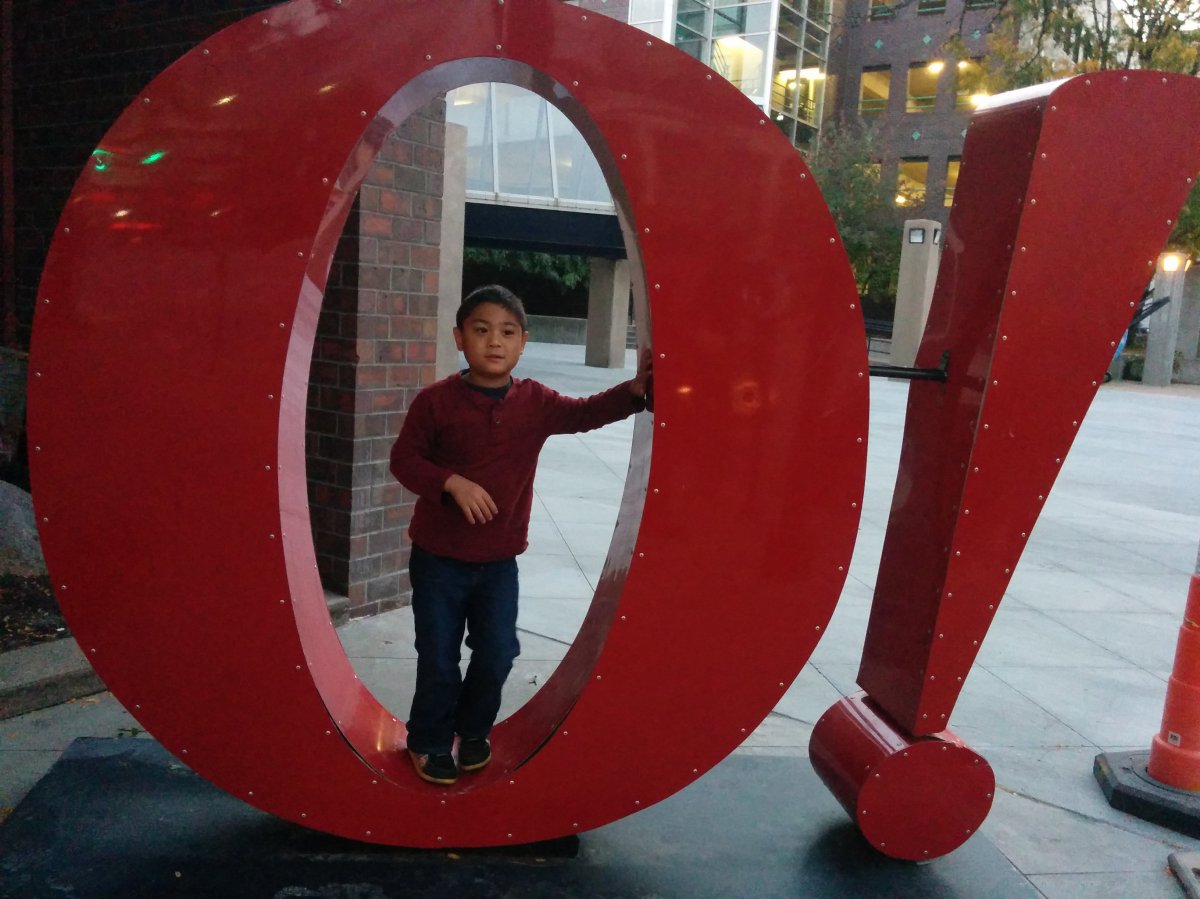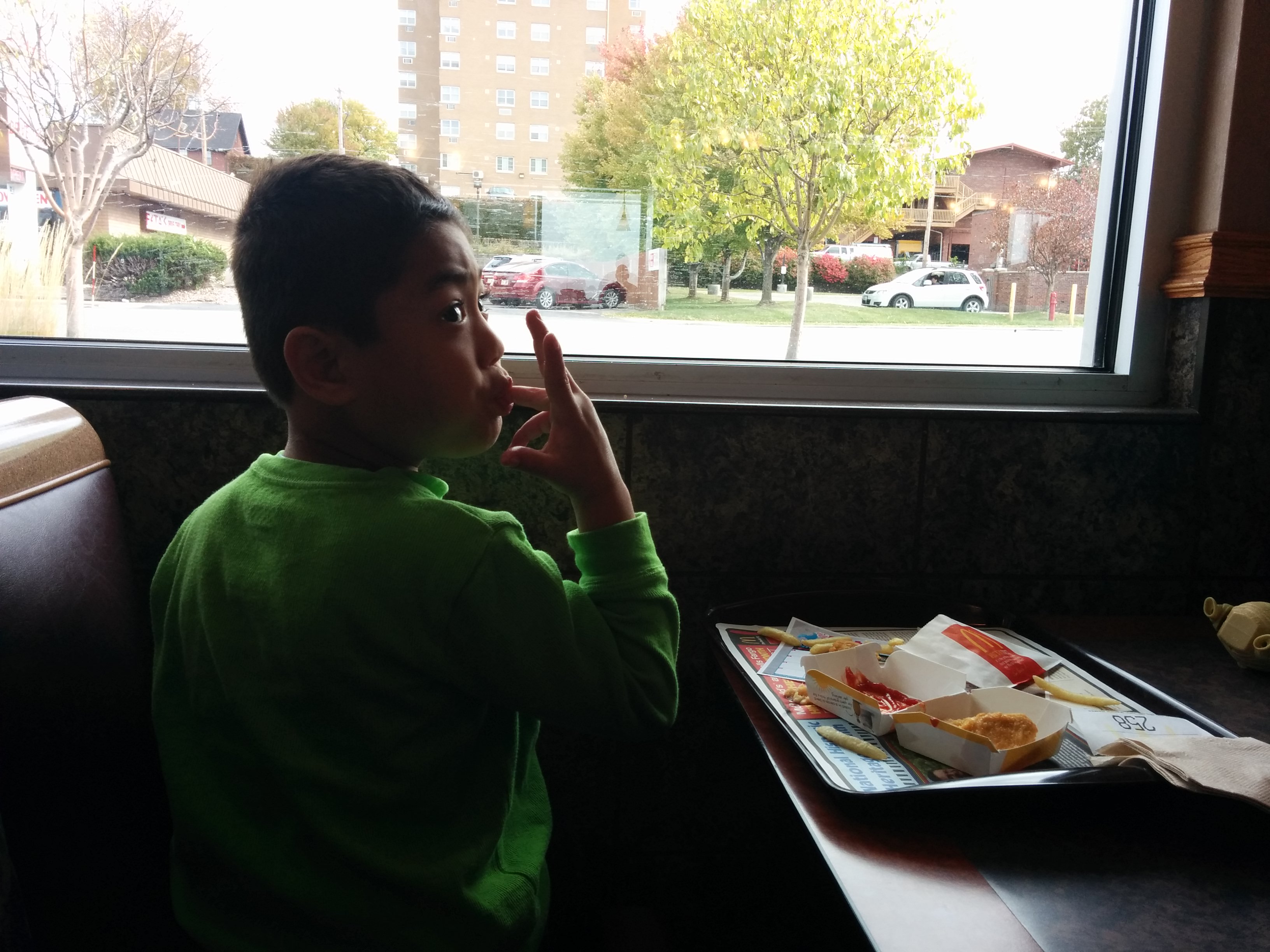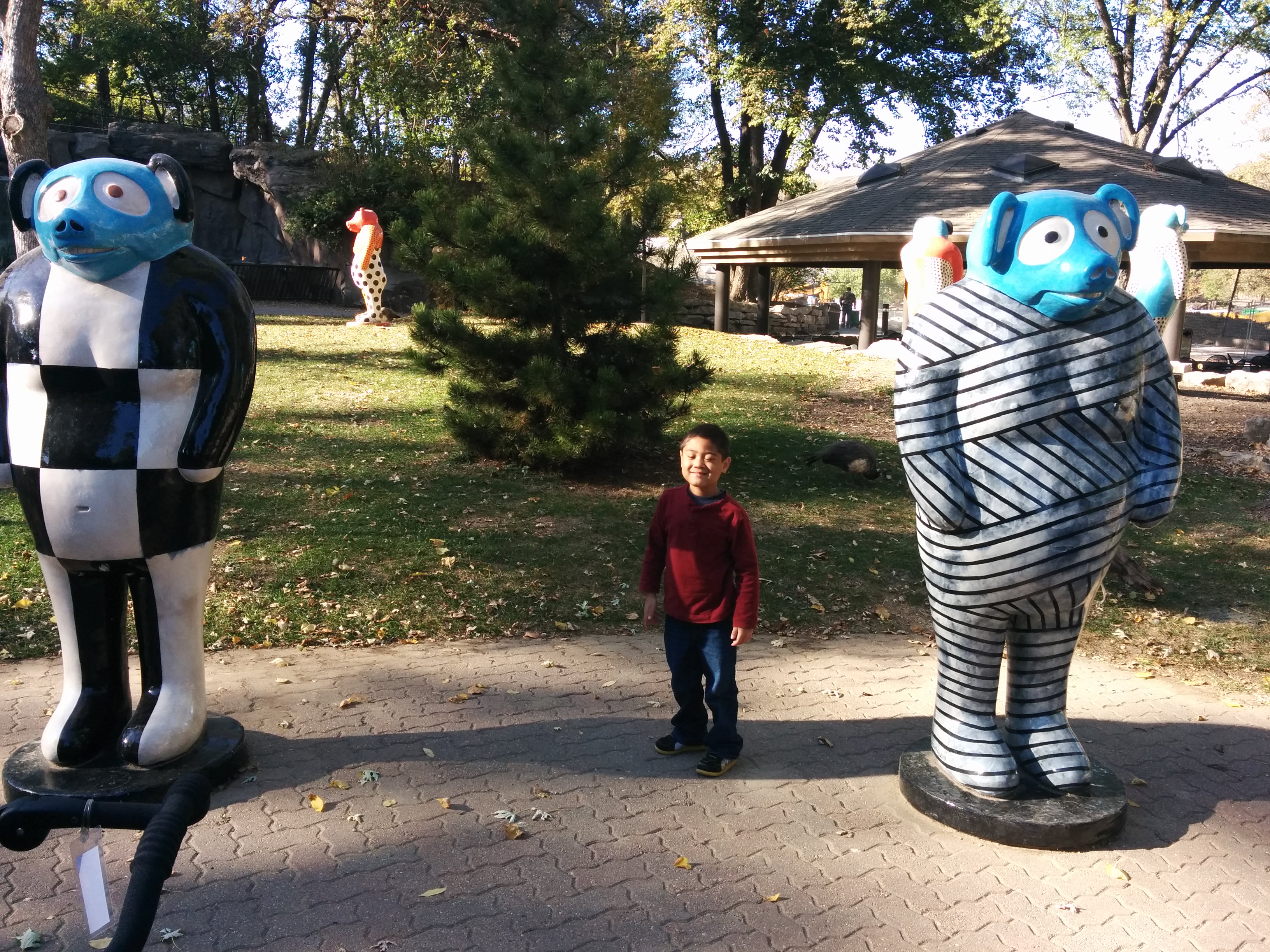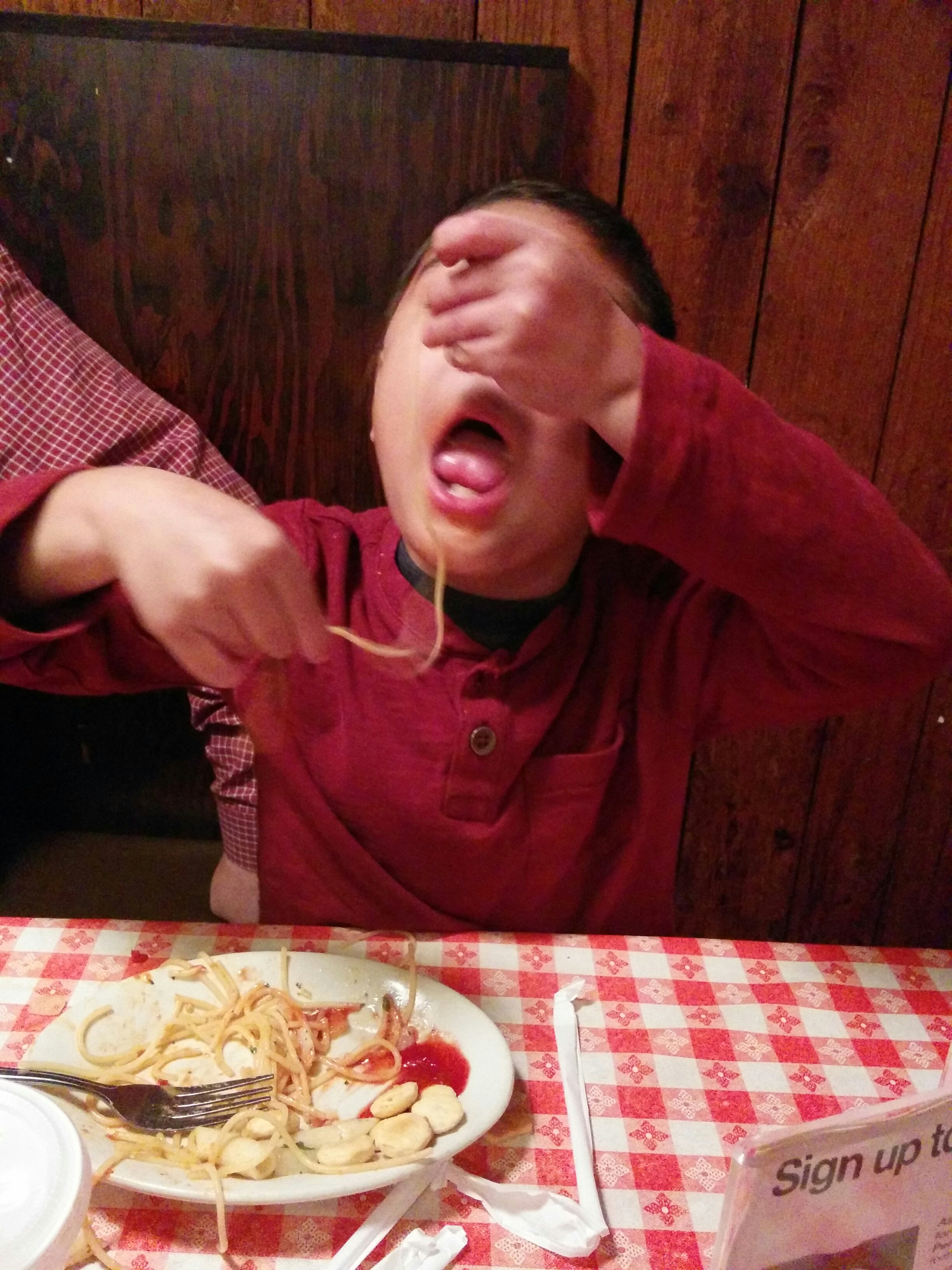
Transplant Day 3,653 – That’s Ten Years!!

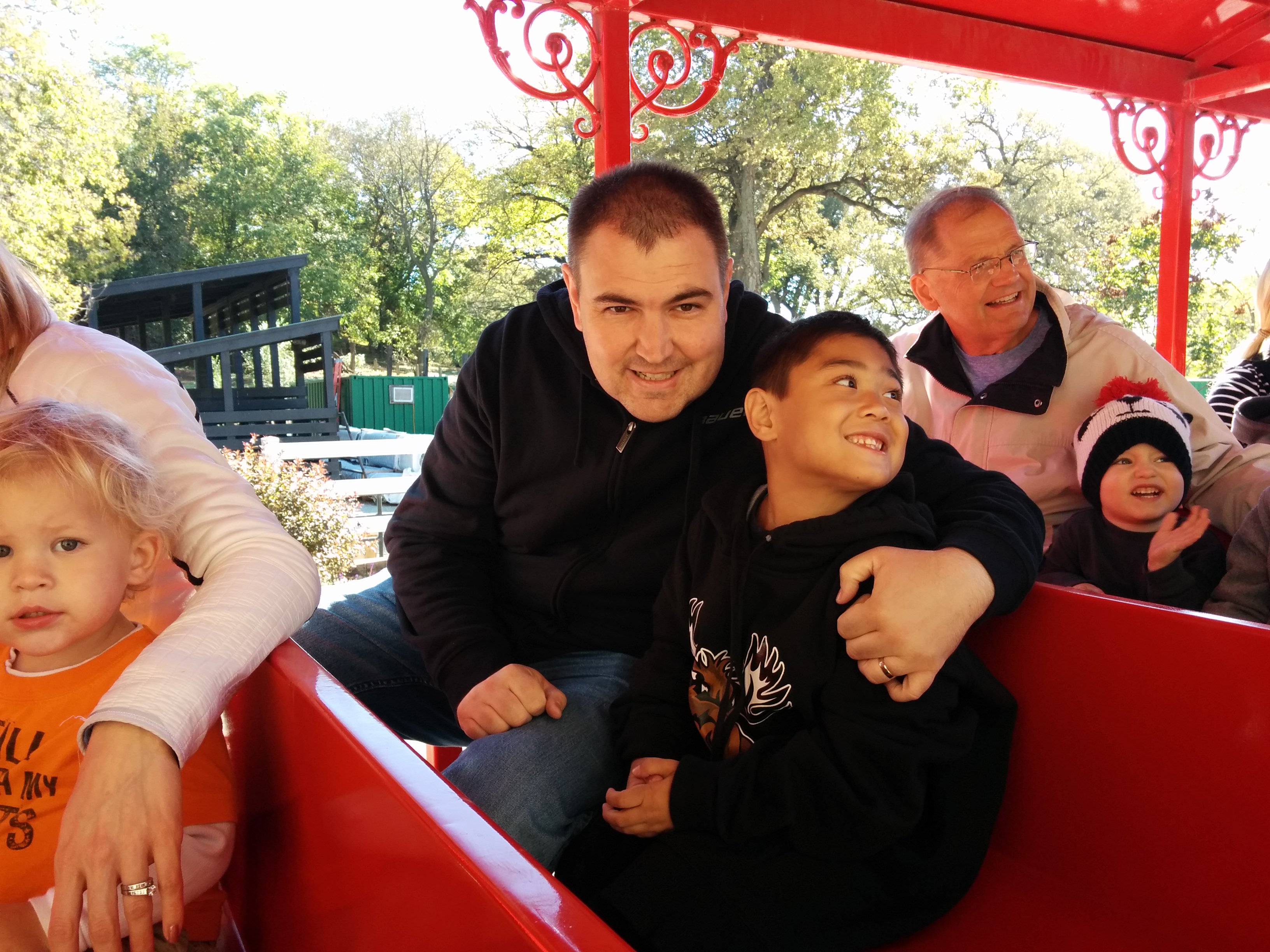
Ok. Technically, this is being written several days after day 3,653. That’s because we just got home from a week celebrating in Disneyland. That was Patrick’s pick, but there really isn’t any better place to celebrate magic, dreams, wishes.

This has been a really emotional week… month… fall?..!!

I always get nostalgic in October. This year, even more so, however. That has a lot to do with transplant. We took Patrick’s trip for his annual checkup early because we wanted to celebrate his transplant anniversary over his birthday. It just happened that we were there over the same week he’d taken his wish trip ten years before. Then, just a few weeks ago, my niece had a baby boy who spent 20 days in the NICU, so we have spent a lot of time in and out of that familiar setting again.
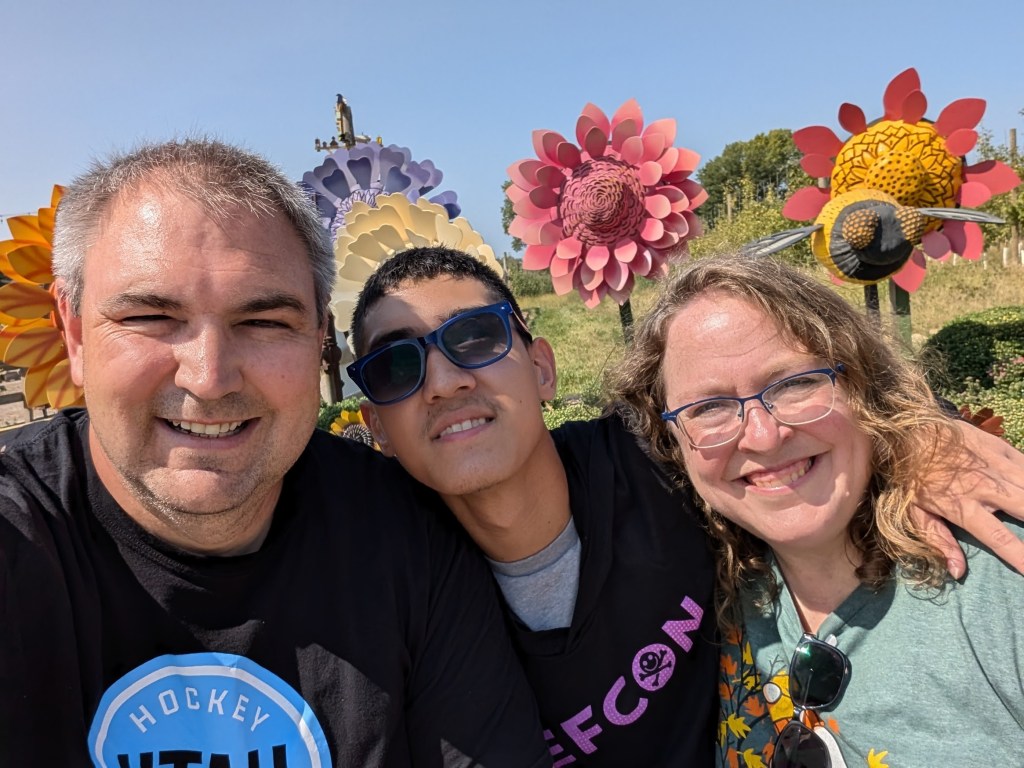
There have been a lot of reminders around what was already bound to be a very nostalgic anniversary.

Getting ready for our trip, I stayed up late wrapping Patrick’s birthday presents so he could open then in the morning right before we left. We’ve been so busy with work, school, family, and getting ready that I just ran out of time.

I try not to put off wrapping the presents. The night before Patrick’s transplant, I also stayed up late wrapping his presents because the week had been busy and I hadn’t gotten to it. I’d just wrapped those presents, gotten in bed, and switched out the lights when my phone rang and the caller ID lit up with the number of the transplant hospital. That number at 10 p.m. could only mean one thing… And I didn’t want to take that call on my little boy’s birthday eve.

Still, we packed the presents that could travel and we went.

I was so afraid to take that call. It was so scary to say yes, to pack our bags, to wake our little boy, and to fly all night to turn our little boy over to an uncertain fate.

Family photo taken just before Patrick went for transplant October 2014

One of the hardest things about intestinal transplant was that, with TPN, you aren’t actively getting sicker. You don’t see a child who is getting visibly sicker the longer they are on the transplant list. In fact, Patrick seemed so healthy. He was having one of the best years of his life. He was loving kindergarten.

Health doesn’t decline gradually with short bowel syndrome. The scary moments ambush you. Patrick would be fine, then suddenly, he’d have a fever and we’d be rushing to the hospital to be treated for sepsis. Or he’d catch his line and it would break. Or a clot would form so we couldn’t use it. We could go months in peace, but when things went wrong, we were rushing to the emergency department. Behind the scenes, he was running out of central venous access and the situation was getting worse. We knew one day, he’d run out of veins for the IVs that were feeding him, and that would happen with no warning. It was like living with a ticking time bomb. One that would alarm at random to remind us time was running down.

When he was not quite 5, Patrick ran out of major vessels above his heart where central lines could be placed. It happened suddenly. A doctor wrote the wrong concentration of ethanol lock. A line clotted. A nurse flushed too hard. Patrick went to surgery to have the line replaced and he came back without one. Upon hearing the news, the transplant team made him status 7 on the transplant list — on hold. Without access, he could not have a transplant. Two days later, we flew to Nebraska to have an alternative central line placed by passing a sheathed needle through his femoral vein and through his heart and out through his superior vena cava.


That’s when we knew that without a transplant, Patrick was unlikely to survive many more years.

A year later, just before Patrick’s 6th birthday, he was granted a wish by Make-a-Wish Utah and we took him to Disneyworld and Give Kids the World Village in Orlando. He’d been listed for a year and a half in Nebraska by then – 5.5 years total – with no match. He was on his second alternate line.

A month later, Patrick got THE call. A donor had finally been found.

That was ten years ago.

This picture was taken as we arrived in GKTW village for Patrick’s wish trip.
Our villa and rental car are in the background.

We just celebrated Patrick’s sixteenth birthday. I never imagined sixteen. I hadn’t really imagined a ninth birthday.

This life has made us a bit shy about looking too far into the future. On the other hand, we are very good at living in the moment and very grateful for every milestone.

Sixteen and ten years since transplant are big ones.

Most of the published data about transplant stops giving numbers after 10 years. Way back when we first listed Patrick for transplant, the procedure was still extremely new and borderline experimental. It was a little more mainstream 6 years later when we finally found a match and Patrick was transplanted, but the fact of the matter is that the procedure was still both new and rare at that point. That means that there really was no reliable data set for us going into this. Patrick and other transplant around the same time as him are still pioneering — writing the book for others, if you will.

The good news is that the story Patrick is writing is a good one. At his checkup, the GI was on his case ten years ago and knew him well. It’s been at least five years since he’s seen Patrick and he got a bit emotional talking about how much he’s grown and how well he’s doing.

I marvel at the fact that Patrick vaguely recognizes but doesn’t remember having TPN. His memories of hospitalizations, surgeries, and transplant are only distant memories. He has only hints of memories of living in Nebraska or the Ronald McDonald House. Those things are all familiar and sometimes he’ll even be triggered by something, but he doesn’t know why.

For Brian and myself, however, those memories are still very poignant.

In September, we when we were in the hospital for his checkup, Patrick hadn’t eaten much lunch and was hungry, so we stopped into the cafeteria to get him a slice of pizza before the appointment. There are so many memories still in that place. I could see the table I sat at the call Patrick’s wish granter to tell her we needed to cancel his star-raising party because he’d received his transplant. Across the room was the table where we ate Thanksgiving dinner with Brian’s brother’s family, who drove in from Colorado to cook for us.
Just past the cafeteria, there was the door that used to lead to the dingy outdated section of family hotel rooms in the Leed Tower (I don’t think that even exists anymore), where we rented a room for the first week until they had space for us in the Ronald McDonald House. I remember the sagging mattress and the 70’s era carpet and the chip in the sink faucet and the fridge we stocked with sandwich fixings so we could pack a lunch to eat in the ICU break room.

It seems like just yesterday.

On our way out of the building, we showed Patrick the lobby where he met Santa Claus with Toys for Tots at Christmas and therapy pets every Wednesday and — most memorably of all — where he went trick or treating the morning before transplant in a too-small borrowed Buzz Lightyear costume.

What a contrast between that year and this one. Don’t get me wrong. Both years, he was spoiled beyond belief. He may have received almost as many toys, pencils, bubbles, and more from the staff at UNMC in the lobby in 15 minutes as he could get an entire night trick or treating.

Ten years later, Patrick was trick or treating at Disneyland. How amazing is that? He has sacks and sacks of treats and has been eating them since he got home. And that’s OK!!
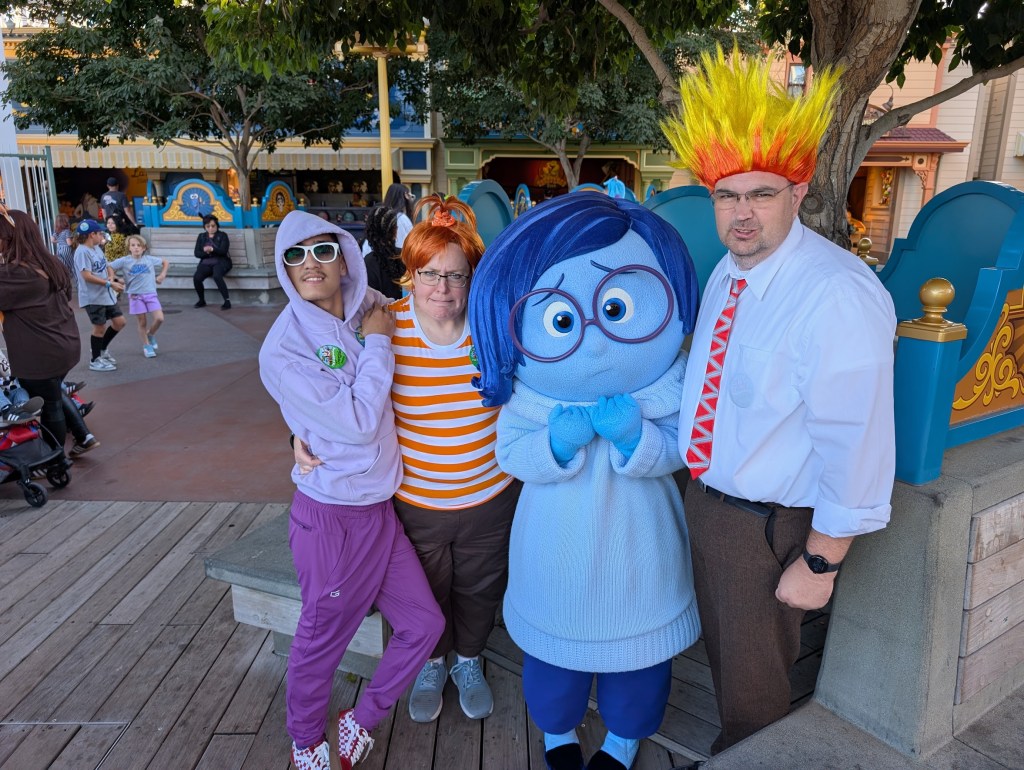
We celebrated Patrick’s first transplant anniversary at Disneyland, too. I remember it being such a big deal that we laid only about ten pieces of candy and he chose one to eat because he couldn’t handle the sugar.

The aftermath: Trying to choose which candy to try first.

This week, Patrick made Brian run him from one roller coaster to another all week. (And because he’s spoiled, his dad does just that.) I couldn’t help thinking of that visit where we asked if it was safe for Patrick to ride the upside down rollercoaster. How big of a decision that was. How scare I was. And now he rides it over and over again, and it’s us whose bodies can’t take more.

We splurged a bit and treated him to Goofy’s Kitchen this trip. He ate macaroni and cheese and chicken tenders until he was too full for dessert. I should maybe have warned him they were bringing a cupcake, but I didn’t want to ruin the surprise. It was worth it anyway because Minnie Mouse came when they sang to him. She’s his favorite.

When he isn’t chasing roller coasters at the park, Patrick’s’s chasing characters. He loves to see names written and so he loves collecting autographs. I can’t help but contrast the way he made sure every nurse, CNA and doctor who entered his room wrote their name on the whiteboard when he was little. He’s always loved names. I think I prefer chasing autographs in the park, though.

Patrick doesn’t remember his wish trip. He doesn’t remember wishing. One of our regrets in his making that wish was that he was too young to understand it. We were so sure that if he didn’t wish, the opportunity would pass.

So ten years later, we offered him a chance to wish. Actually, first we offered to take him back to Disneyworld and show him where he’d gone for his wish trip. But Patrick didn’t want to relive a wish he didn’t make. He wanted to wish for himself, and his wish was Disneyland.

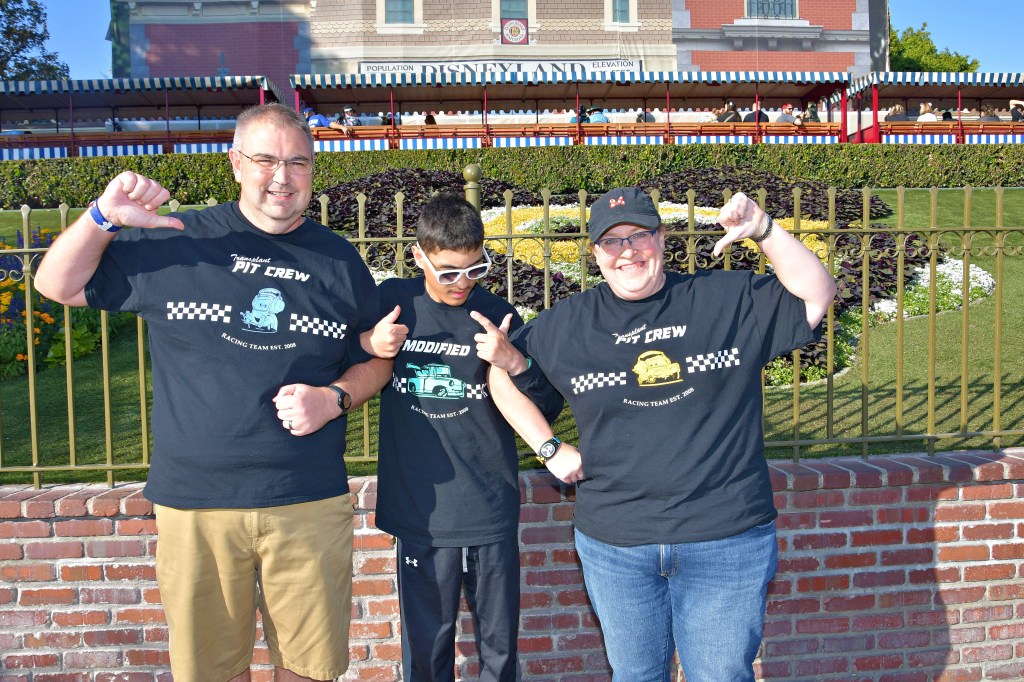
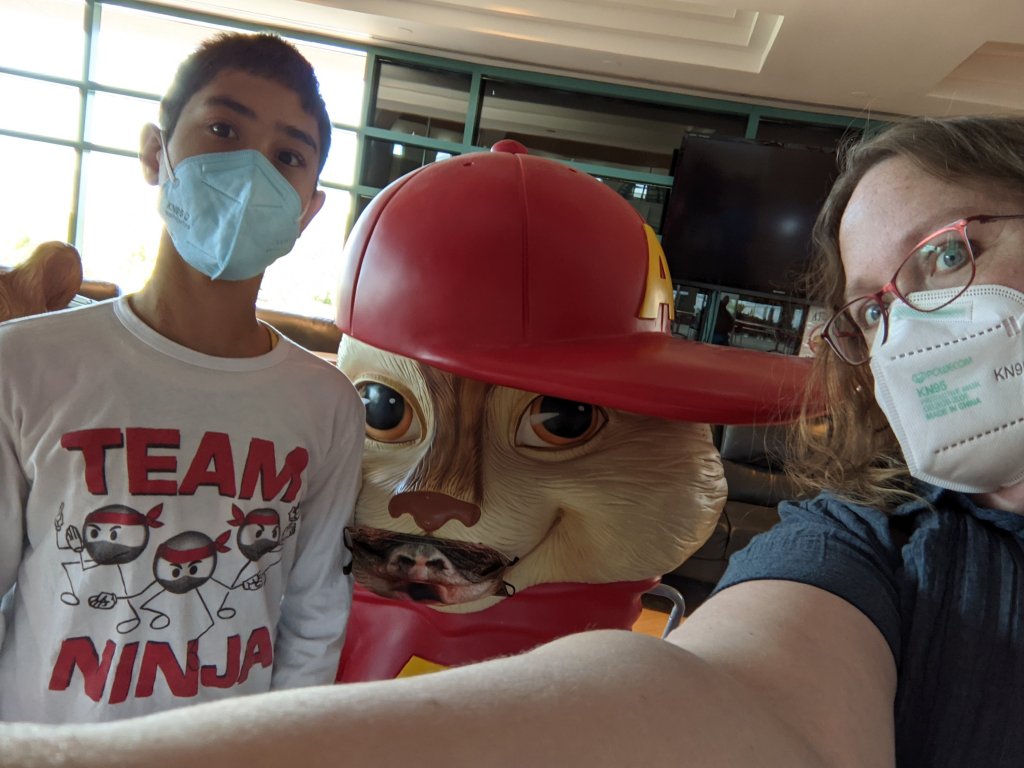
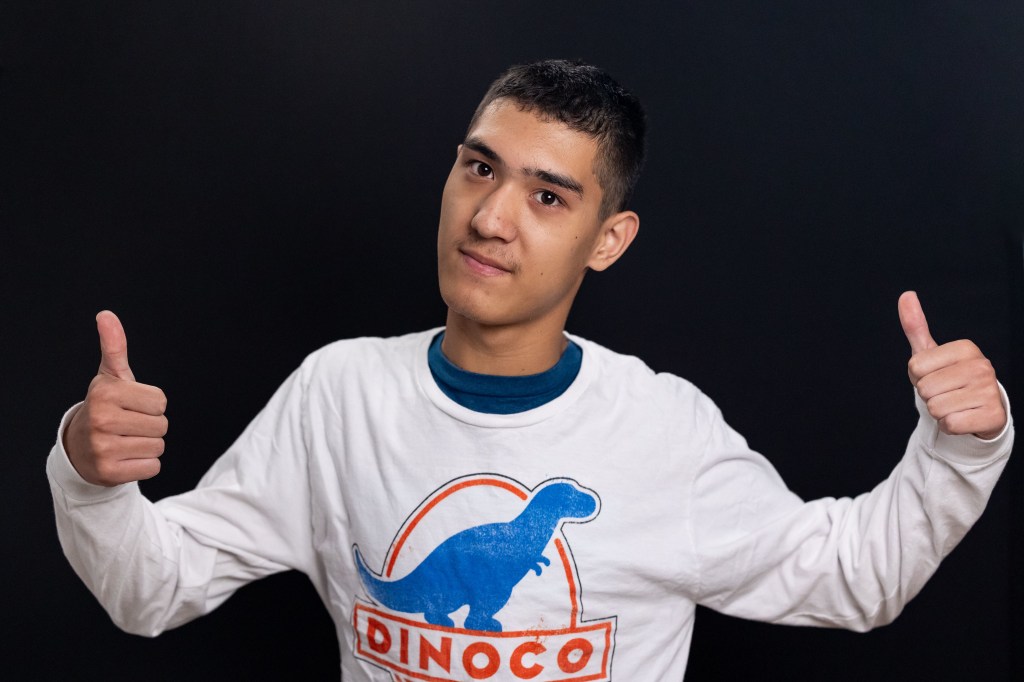
Yeah, Patrick isn’t looking at the camera. This photo is all about the shirts.

It’s been ten years and he’s looking forward — Living forward.

We have had some good moments this year for looking back. Through the support groups I work with, Patrick’s been starting to connect with other patients with short gut and intestinal transplants this year. He’s nervous about it, but I can tell it’s helpful for him to be a part of that community, too.

I also had a very tender moment at the Oley Conference this summer where I talked with an adult transplant patient. She told me about her relationship with her donor’s family and I had a chance to express to her my deep gratitude for Patrick’s.

There really are no words for that. My heart is all tangled up in the depth of their loss and the magnitude devastation turned to beauty. Every additional year, I marvel more at that gift of life. Patrick’s life and ours are forever changed and we are forever grateful.

What an amazing ten years it has been!

From hospital regular to completely lost in hospital halls. From a backpack full of TPN to pockets full of art supplies. From unable to eat to snacks scattered all around the house. From time is running out to we can’t wait to see what the future holds.

And also – when did I become mom to a sixteen year old?
Fed is best

I don’t post very often because, well, I’m parenting a teenager now. As he has gotten older, his privacy has taken priority. He is entitled to create his own digital identity.

However, you’re going to see a couple of posts from me over the next couple of months. We are coming up on 10 years post-transplant. I don’t think you often get a chance to hear from patients in this phase of the journey.

I’m going to dedicate an entire post to transplant annivery soon.

But today, I wanted to talk a bit specifically about feeding. That’s because one area in which Patrick tends to be an outlier is that he weaned to 100% oral feeding within a year after his transplant.

I want to be real for just a minute about that. Because that is such an unexpectedly good outcome that we paint over a lot of the challenges that come along with it. I am absolutely thrilled that my son can eat an entire cheese pizza by himself like a teenage boy with a growing appetite.

But in celebrating that success, I think we sometimes do a disservice to him and to others with short gut and other digestive disorders by glossing over the very challenge that eating is every day — even if they are able to take all of their nutrition orally.

For Patrick’s entire school career, he has needed accommodations specifically to be not just offered opportunities, but also reminders to eat and drink throughout the school day. He can quite easily go an entire day without remembering that he needs to stop for food or water.

This may sound unusual to you. However, it is really not uncommon in people who have had complex health issues, especially those who have had prolonged digestive disorders and enteral or parenteral nutrition. Occupational therapists have begun to discuss an 9th sense called interoception. (Feel free to Google why there are nine, not five senses). This sense describes your body’s internal cues of hunger, thirst, fullness, hunger, fatigue, temperature, etc. The ability to recognize and interpret these signals is altered by our experiences. It is very common for children with medical complexity to develop oral aversions. Or in other words, to have impaired interoception.

I mean, think about it. For the first 6 years of Patrick’s life, we’d feed him intravenously as much as we could while he slept, and then, in order to give him a break from tubes, he’d go without that nutrition and hydration for several hours during the day. Is it any wonder that he thinks it’s normal to feel hungry and thirsty at school?

There is also an emerging recognition of Avoidant Restrictive Food Intake Disorder, or ARFID, and Pediatric Feeding Disorder PFD. This is a type of sensory processing disorder related eating disorder where neurodivergent people cannot bring themselves to eat certain foods, no matter how hungry they are, because of certain sensory characteristics. People with ARFID &PFD may have very limited diets.

Now, consider that for Patrick’s early years he could not eat sugars, fruits, vegetables, or fibrous textures without severe digestive consequences. Is it any surprise that many children who grow up with SBS show characteristics of ARFID and PFD?

In our house, we have open pantries and stock high calorie preferred foods. And Patrick has been able to eat enough to grow. We have done extensive feeding therapy to expand his diet and I am constantly applying the principles used there to continue to add new foods as old ones fall out of favor.

My son is a foodie. He loves restaurants. He loves treats. He loves trying new foods that meet his very specific preferences.

However, eating has never been easy. There has always been effort to remind him to eat and drink. He only gets the vitamins he needs because we supplement.

One of the things I remember most clearly from Patrick’s transplant evaluation appointments when he was 6 months old was the meeting with the transplant nurse coordinator. In that meeting, she went through everything they thought we should know about life after transplant – from potential complications to what sports he could play. And one of the messages most strongly emphasized was this:

When your child becomes a teenager they will want to become independent. Many teen transplant patients stop complying with their post-transplant care.

Now – we are fortunate. Patrick doesn’t fight against taking his medications. He doesn’t resist seeing his doctors. He doesn’t break safety rules.

He’s fallen into a basic teenage pattern. He is too busy with his social life to want to eat.

I spent his freshman year trying to find ways to incentivize and remind him to eat. But the more I thought about the sum total of what I just outlined above, the less sense it made to keep nagging him to eat.

The phrase we often use to comfort moms trying to accept tube feeding with babies crossed my mind. “Fed is best.” And I started to think, “Why not just ask if he wants to add in tube feeding?”

Of course, there were obstacles. Bolus feeding, where you use a syringe to give an entire carton of formula in just a few minutes, has always made him feel sick. That didn’t seem worth it. Gravity feeding, which we have used for hydration when he is sick, just ties him to a wall for an hour. So I found myself leaning towards a feeding pump . But I wasn’t sure if the doctors would agree to that for as little extra as he needed.

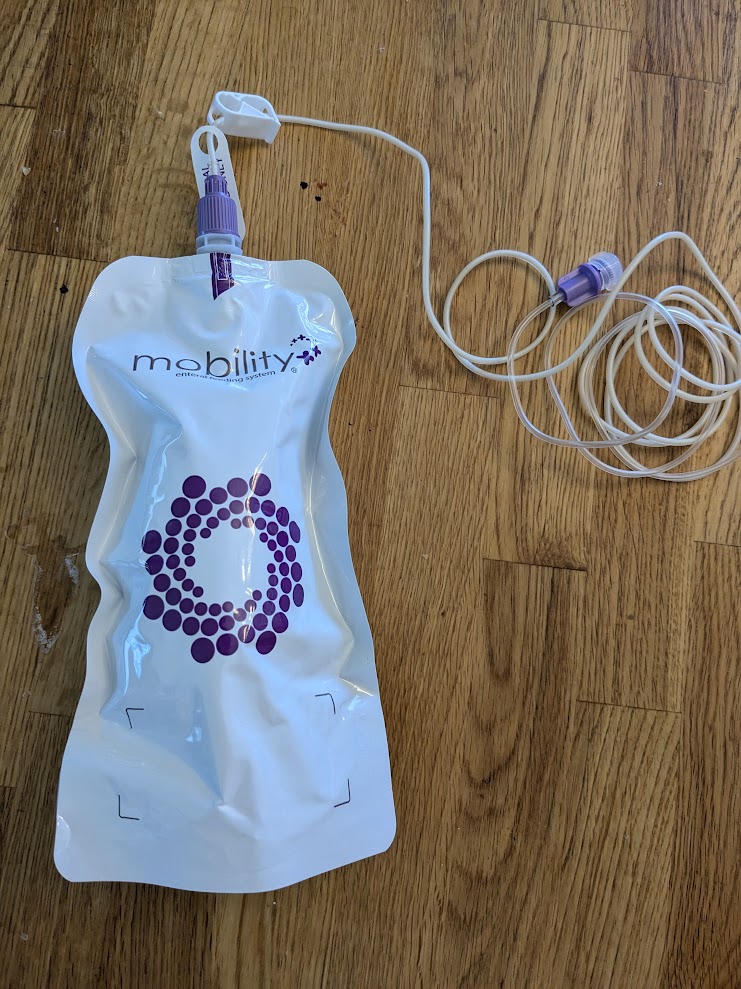
Then, I came across a new product at the Oley Foundation conference – an elastomeric feeding pump system called Mobility +. Kind of a step in-between gravity and pump feeding. There’s no electronic pump, so it’s lightweight and small. It fits inside a crossbody bag. (Fanny pack, for those of us who grew up in the 90’s.) Instead, inside the feeding bag is an elastic pouch that squeezes the formula out at a controlled rate. The tubing comes in different sizes that set the feeding rate. The tubing we use slows Patrick’s feeds down to about an hour, which is just the rate his gut needs to tolerate them.

The bags are pretty easy to use. I use a stopcock valve system to fill the bags in advance. Once that part’s done, we switch to a feeding set that attached to his g-tube extention. The rest is easy enough that Patrick can just come attach the bag, open the clamps, and start the feed himself. The only hiccups we’ve had are sleeping too late to allow time for the feed and occassionally forgetting to open the clamps to start the feed.

Because this is a brand new product, it was just barely approved by the FDA and entering the U.S. market. Patrick is one of the first patients using this feeding system. I wasn’t sure if we’d be able get access to it, but Rockfield Medical has been amazing to work with. We did several zoom calls to figure out the right bags to use and get me trained. They sent me samples to get started while I worked on getting it set up with my enteral supply company.

That took a few calls. At first, the company didn’t understand what the bags were and thought they might be too expensive to be worth the investment. However, Rockfield had already laid the groundwork and the product was available with several larger homecare companies, so my smaller company was willing to follow suit once I got through to the right person and they understood the benefits I was seeing.

It’s been a couple of weeks and it’s already routine.

Please note that this isn’t a sign that Patrick is unhealthy. He eats enough to maintain his weight. But his weight is low and keeping him eating has required constant behavioral support, what they call a “complex feeding program.” There is an emotional and mental health cost that comes with constant pressure to eat .

I have to say that it’s really nice to have the stress taken off of feeding. For example, Patrick got some vaccines this weekend and just hasn’t had an appetite. He took about ten bites of lunch today before abandoning it. In the past, I would have been pulling out timers and offering rewards to try to beg him to eat.

Instead, today, I said, “fine, we’ll put a bolus on.”

One of the first principles of working with an eating disorder is this.. the more anxious the parent is about the child’s eating, the less likely the child is to be willing to eat.

Instead, Patrick is super proud to own the hottest new gadget in tube feeding and can’t wait to set it up and put it on.

He’s excited to be fed.

And fed is best.

Transplant day 2,434: Explaining why

“A child born to another woman calls me mommy. The magnitude of that tragedy and the depth of that privilege are not lost on me.”

Have you seen that meme? It captures my feelings towards birthmothers in general, and Patrick’s birthparents in particularly so perfectly. I feel it to the core of my being.

It also only captures a fraction of the unrepayable debt of gratitude that I owe as a mother.

Another child was lost young in an accident, and that family chose in the face of unimaginable loss to give a piece of the life of their child to mine through organ donation. That is tragedy so vast and privilege so profound I struggle to comprehend it.

The pandemic has pushed this truth to the forefront of our awareness. “Patrick’s a transplant recipient” is a phrase we say so often it sometimes loses meaning. It tells you he has health problems that require extra accommodations. It may even tell you his health is fragile or that he’s been through a lot of trauma.

But in our house, lately, we’ve had a lot of discussion about what transplant actually IS. See, Patrick received his transplant the day he turned 6. He was too young and had far too little language and understanding to know what was happening to him then. But there’s nothing like a pandemic to provide time for questions and answers.

Patrick has some fairly distinct memories of his recovery. The staples itched. The stitches were blue. But many of the memories are fading. (“Mom, what’s an ostomy?”) He’s twelve and a half, more than double his age at transplant. Early childhood memories fade and our minds protect us from trauma. He remembers feelings, but very few details.

This week, he found a memento of transplant: a pillow in the shape of a liver with the hospital logo emblazoned on it that was signed by many of the ICU staff. Patrick loved writing and names, so it was a way he connected and found peace.

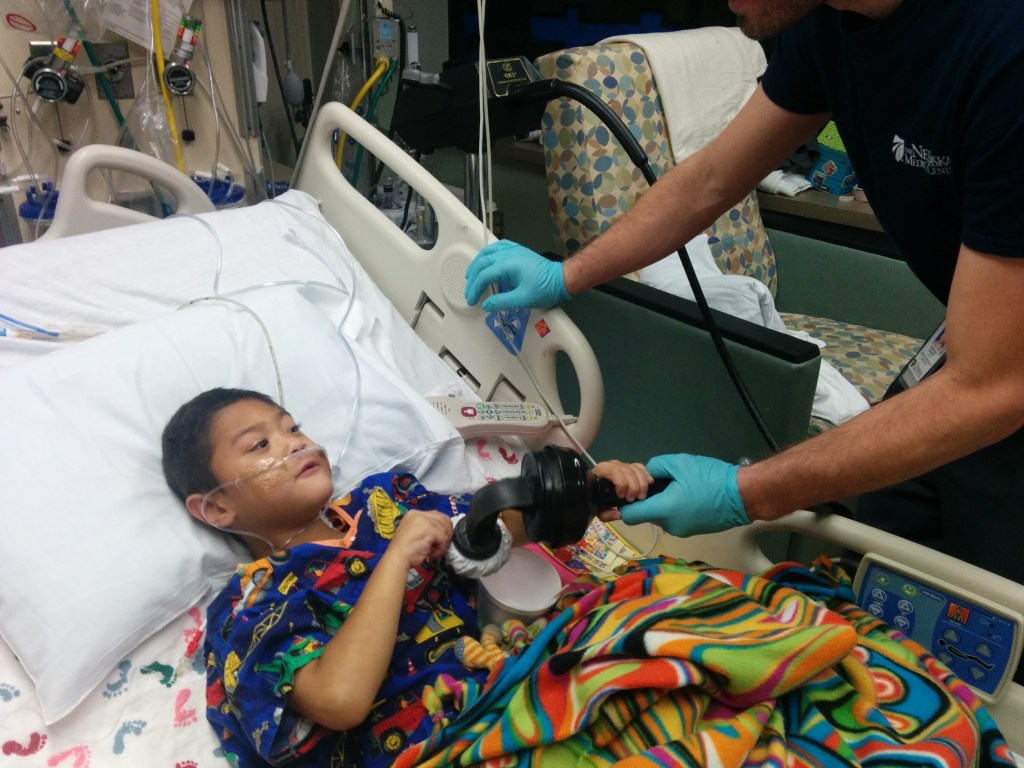
I can’t put faces to most of the names anymore. But as we talked, I pointed out how many of them had written their specialty and that could tell us who they were. Nurses helped with pain and meds and dressings and keeping him comfortable. Respiratory therapy would come to make him take deep breaths and refill his lungs, since it hurt too much to breathe, let alone willingly cough. And child life made sure he had toys and volunteer visitors fun activities and the occasional magic moment.

Respiratory therapy
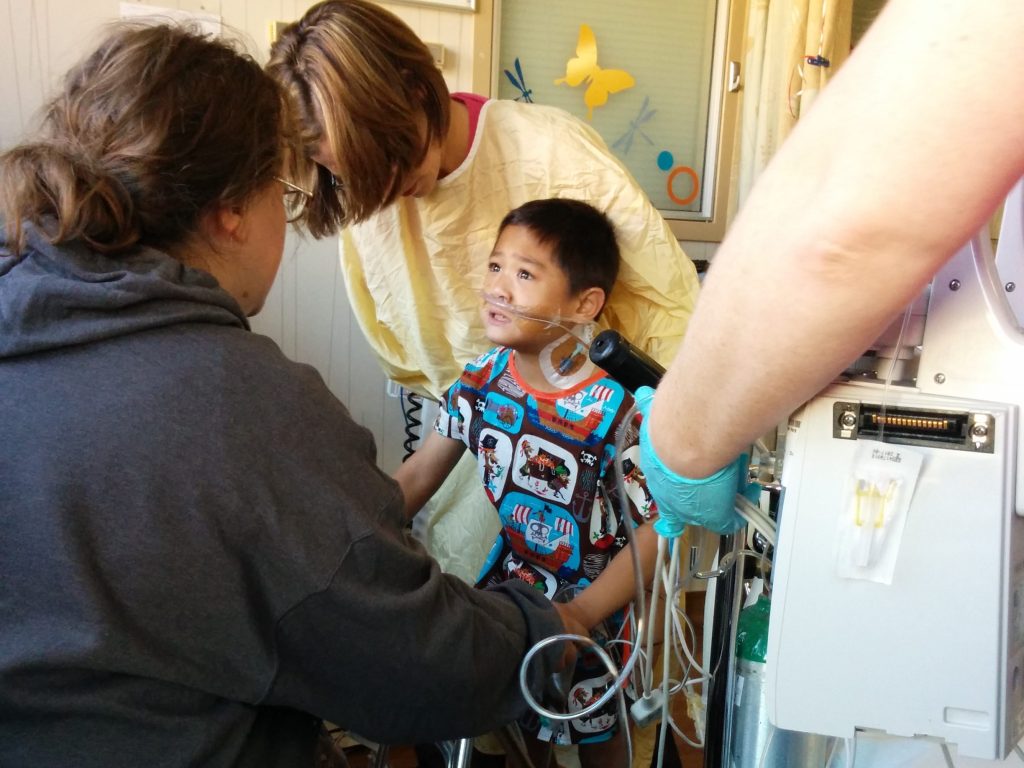
Up walking on day 4 post transplant

One of the signatures was from the physical therapist. She’s one of the only faces I clearly remember. I told him how she came every day to help him learn to walk again and how, at first, that was very hard because it was so painful. (I also told him about how much he loved her because she would hide Blues Clues in the halls for him to find.)

That led to talking about his scars.

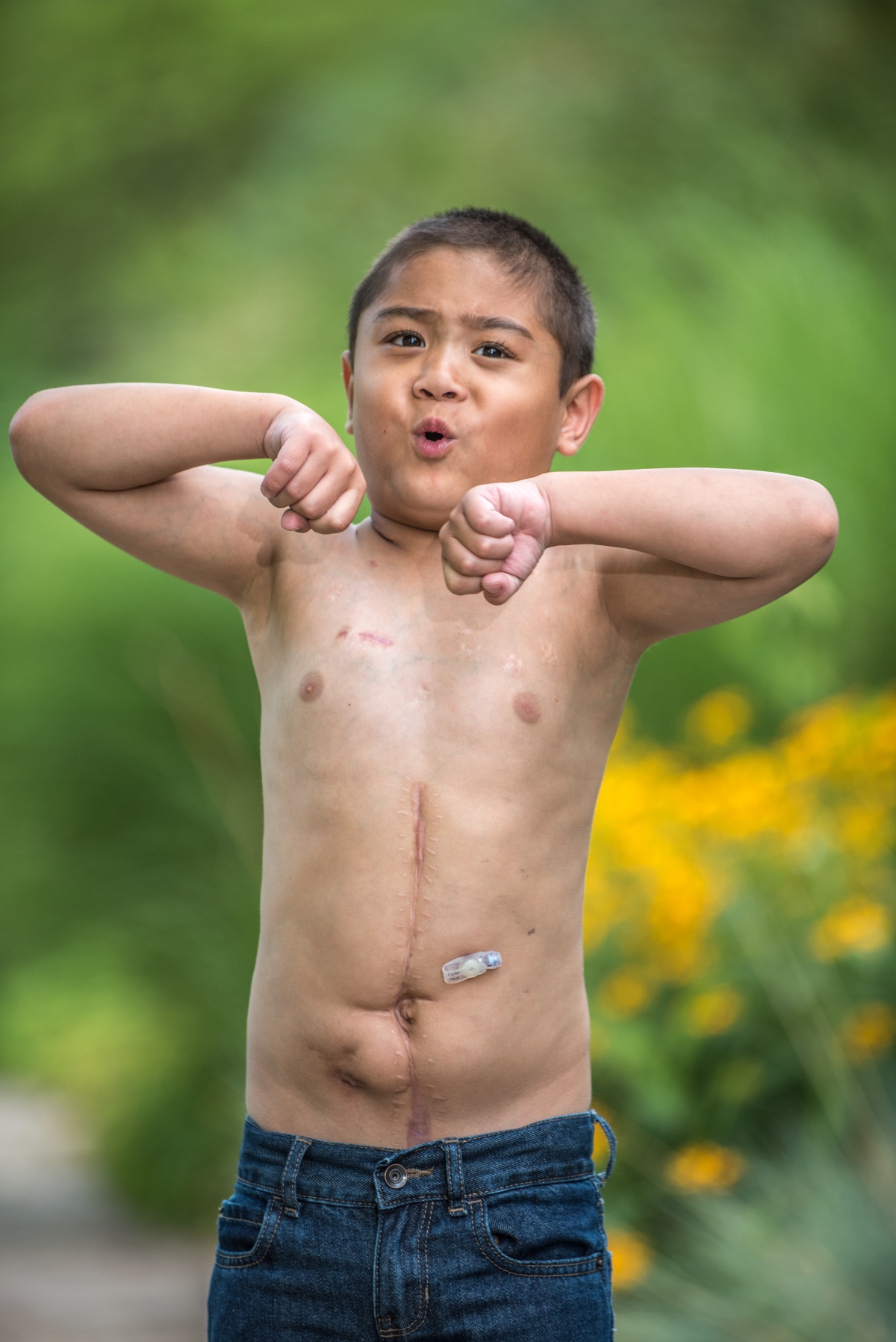
Patrick had a vertical incision that ran the length of his abdomen that was closed with staples and, as a result, he has a very impressive scar. We talked about what he remembered about how that looked and felt. Then he turned his attention to other scars. He has all kinds: from big to small, from straight to round and some that are curvy. Some are surgical, some from his birth defect, and others from accidental injuries. And he made me help him inspect his entire body and tell him how each one got there. Sadly, there really is a scar and a story for almost every appendage.

“Why” has been a big topic of conversation lately. We’ve had to answer a lot of “Why’s” about the COVID precautions we are taking. And a lot of why’s about other people who are not longer taking them. And in the middle of one of those “why” we still wear masks when others don’t, it occurred to me that Patrick knew “transplant” as part of his identity, but didn’t understand what the word meant.

I’ve been thinking that, since we moved and so much time has passed, many of our friends, colleagues, classmates and fellow congregants don’t know the why and how either. So, since we’re already opening the emotional pandora’s box by explaining these things to Patrick, I thought maybe I’d tell you what I’ve been telling him.

Let me take you on a tour of his scars.

(Just a heads up, Patrick is very private about his scars and doesn’t like to talk about what he’s been through.)

First, there’s the short little horizontal one that runs to the right of his belly button. This one’s from his gastroschisis. Gastroschisis is a birth defect where the abdominal wall doesn’t close and the intestines develop outside of the body. This was the start of his troubles. Patrick had complicated gastroschisis. The intestines twisted and died. He was born with a small hole in his belly. The surgeons did a quick exploratory surgery where they found that his entire small intestine and most of his large intestine were missing. They placed some drain tubes (since his intestine was too short and too narrow to reconnect) and closed the hole surgically. They also placed a PICC (peripherally inserted central venous catheter) to give him nutrition by IV as his digestive system was completely non-functional.

A few weeks later, those drains weren’t working. So they pulled the end of his duodenum to the skin’s surface in an ostomy (which means a hole in your body that accesses an organ) and placed a feeding tube in his belly. (That tube is still there, used for meds, not food.)

After his 2nd surgery, age 17 days

We were granted guardianship and flew him from Michigan to Utah by air ambulance. A short time later, he developed his first central line infection while still in the NICU. He has a scar on the back of his right heel where a busy nurse missed that the IV antibiotic being given there had caused the vein to burst. This caused a nasty IV infiltration wound. He also earned his first broviac line scar. (Broviac lines are also central lines, they run to the heart.. but they go in a tunnel through the chest. Patrick’s chest and neck have several pock-mark looking scars from broviac lines.)

The next 5 years were spent waiting for transplant. Beginning in July of his first year and continuing for the next year, he seemed to have constant sepsis. We’d clear one infection, and two weeks later be back in the E.R. with another. It was terrifying, especially when yeast started to grow inside his body. Yeast is sticky and difficult to kill. The antifungals used to treat it are harsh. Eventually, their toll was too much for his little body and his heart stopped.

This left scars you can’t see in the form of an anoxic brain injury, but also a new little one in his thigh from a femoral arterial line. It also left some emotional scars for all of us. We were fortunate that, because the amazing team at the hospital that day performed such excellent CPR, he was revived and has such minor damage. Still I know what it is to have my child stop breathing in my arms. And I know what it is to have arms ache for a baby that isn’t there. We live with the effects of that day constantly.

In the ICU after cardiac arrest

At 9 months old, Patrick’s first transplant team said they didn’t want him to have an ostomy anymore. So a surgeon here in Utah connected his duodenum (the segment between stomach and small intestine) to his large intestine. That incision was a small vertical one next to his belly button. It left his belly looking like a star and we lovingly called him our star-bellied sneech.

Playing in a hospital crib after reanastamosis

Over the next 5 years, he had lots of lines, another surgery, a couple of liver biopsies, and significant scarring inside his major blood vessels from his chronic need for total parenteral nutrition and the accompany central lines. His veins became so scarred that we though he might lose access to IV nutrition and starve, but the interventional radiology team in Nebraska managed to restore access through a very risky procedure than passed a needle tipped catheter up his femoral vein, through his heart and out his jugular.

He had IV pumps in a backpack that he took with him everywhere he went that provided him with nutrition in the form of TPN and lipids. Not having an intestine meant a chronic diarrhea and vomiting, too, so we had one more pump for IV hydration fluids, and the occasional extra pump running broad spectrum IV antibiotics. We carried a diaper bag full of saline and heparin syringes and emergency kits, along with an epi pen (he had several serious food allergies) everywhere we went. We were pros at swapping out broken IV tubing, performing sterile dressing changes, and clearing air in line issues in the dark without waking the child the tubing was attached to. I knew every creaky spot in the floor and could dance through the room without a sound, kind of like a master criminal weaving through security system lasers.

First day of Kingergarten, with his TPN pumps in the backpack

We kept our GI and the emergency room on speed dial. We knew every member of the resident class at Primary Children’s spanning several years. (They made a point to come visit us when they knew we were there.) And I spent more time talking to our infusion pharmacist and insurance case manager than most of my friends.

Meanwhile, Patrick grew up, went on many adventures, attended preschool, started kindergarten, and was granted a wish.

Patrick’s wish was to visit Give Kids the World Village and Disney World in Orlando

At last, Patrick received his transplant. He not only needed an intestine, but also a liver due to damage from the IV nutrition, and since the vasculature is all one package, that came with a new pancreas, too. Remembering how HUGE an intestine is, it might make more sense to know that they also removed his spleen to make space along withhis gall bladder because that way they don’t have to worry about gall stones later. They also did a gastric bypass to help food move into the new anatomy of the gut.

As I explained to Patrick this week, they pretty much just took everything out so it was empty inside, and then put in the new organs and sewed all the parts back together. And that is a LOT of parts when you consider all the blood vessels, nerve endings and splicing back together his lymphatic system.

A couple of hours after transplant

Transplant left the biggest scars: the long one down his tummy with the frankenstein-like staple marks and the one the size of a silver dollar where he had an ostomy for biopsy purposes.

That brings me back to the “why” questions. Because transplant and the journey to get there are why we do most of what we do.

So here’s a question we get a lot.Why are transplant patients more at risk that other people? Doesn’t a transplant cure them?

This answer was one they drilled into us. When you’re being considered for transplant, they sit down with your family and they go over all the risks and precautions that you’ll be living with after the procedure. You also commit to a lot of things to protect the graft like avoiding contact sports, not swimming in rivers and lakes, and being careful about diet.

And then of course, there are the meds. To keep the body from identifying the transplanted organs as a threat, transplant patients must take immune suppressants. Twice a day, every day. For the rest of your life. These have to stay at a constant level in the body.

At first, immune suppressants have to be at a pretty high dose. Eventually, as the body gets used to the new organs, that dose can be reduced. However, since Patrick received 3 organs (including the second largest organ in the human body) his minimum dose is still high compared to, for example, a kidney transplant patient.

Still, with a lower dose, Patrick has been able to live a pretty normal life. He could attend school, except when there was an outbreak of illness in the classroom. (His IEP provides for home learning under these conditions.) He could go to church and play adaptive sports and ride roller coasters. Granted, he and I spend pretty much from November to February sick every year because he catches everything he’s exposed to. Transplant patients get sicker and stay sicker longer, but eventually, he gets over most bugs.

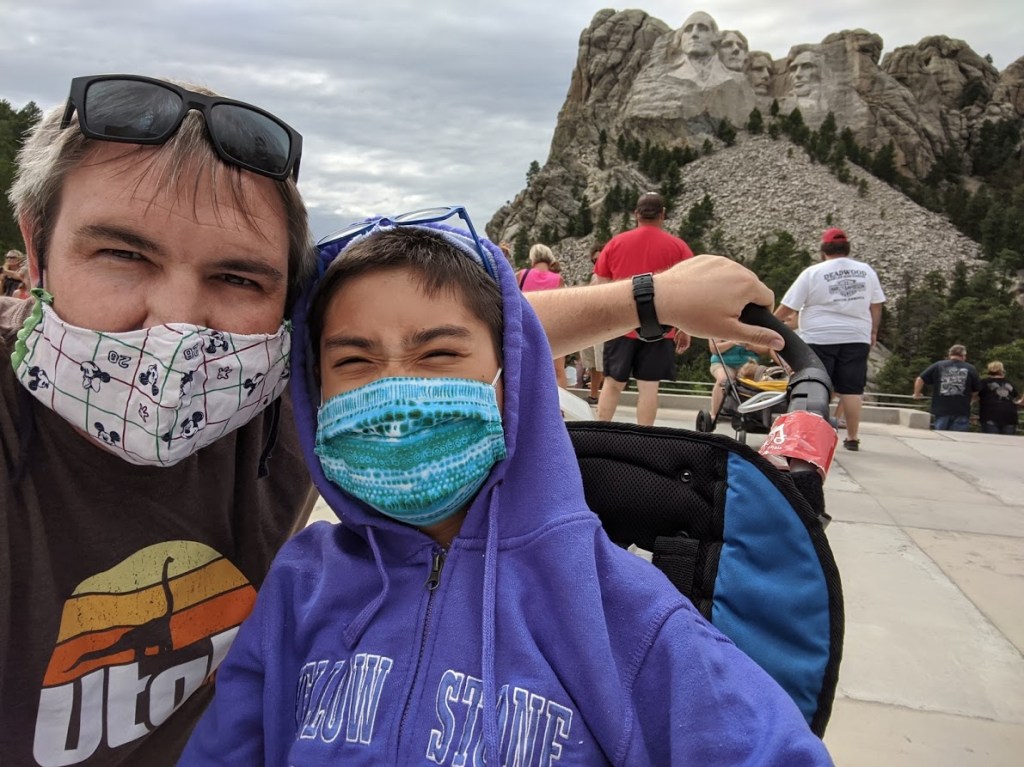
A COVID-style road trip to Mr. Rushmore

But COVID… it’s a different type of virus. It sends the body’s immune system into hyperdrive. That’s what makes it so deadly. Can you imagine the effect of that in a transplant patient?

I wondered if perhaps it was my imagination inflating the risks at first. However, a few months back as they were just about to approve the pediatric Pfizer vaccine, I had the opportunity to join a webinar where researchers shared their current data about COVID, the COVID vaccines, and transplant patients. And some of their numbers were rather concerning.

First, they found that although the general population has a better than 99% chance of surviving the virus, among transplant patients, the death rate is 10%. Those odds are scary.

Even more concerningly, Johns Hopkins, in the absence of data from preliminary studies into vaccines, did a study where they measured the antibody response of transplant patients. As the researcher said in his presentation, they discovered that “we have a problem.” Only around 40% of transplant patients had any detectable antibodies following a first dose of any of the vaccines. After the second dose, only 56% did. They also found that there was a high rate of patients who resumed normal activities after they were “fully vaccinated” who went on to contract the virus.

You know when they say that most people who are vaccinated don’t catch the virus, don’t pass it on to others, and certainly don’t need hospitalization or die? Well, guess who that small percentage who do are? Yup, the people with compromised immune systems.

So EVERY communication I have with Patrick’s transplant team or GI doctor ends with a reminder. “Act like he’s not vaccinated.” “Keep following precautions.” “There’s still risk.” Just this week, Patrick’s GI ended an e-mail about lab results with “don’t let down your guard.”

6th grade was all online, supervised by Max

The thing is, everyone is ready to be done with the pandemic. WE are ready to be done with the pandemic. In fact, the more our community lets down their guard, the harder it becomes for us.

But cases are rising across the world, across the country, and definitely in the state where we live. Vaccination rates are low here and children, though not at risk of severe disease, are still carriers. Add to it that the Delta (now Delta+) variant is more contagious and more deadly. Despite our best wishes, statistics show that the virus is no longer in decline where we live.

Our alternate field trip to the bird rescue with an awesome duckling named Vinnie

We made a commitment years ago. We made it when we adopted him, again when we listed him for transplant, and again when we accepted the offered organs. We promised that we would follow the medicine, keep the protocols, and make the sacrifices to keep him alive.

Patrick’s life is a miracle. Many times over. And that miracle has been contributed to by so many people. His birth family, the NICU teams, his nurses, and pharmacists, the surgeons and infectious disease doctors and interventional radiologists and IV team who responded to emergency after emergency. The nurse who performed CPR and the code team who helped to revive him. The therapists who taught him to walk and talk and write. The family and friends and strangers who helped raise money for his transplant expenses. And most of all, the family who trusted their memory of their child to the future of mine.

In coming to understand transplant, Patrick’s come to know that he has an organ donor. The other night, he was asking me about “the other kid.” Health privacy means we don’t know a lot. But often, when I’m tempted to take some risk, Patrick’s donor and his family cross my mind. I can’t bring myself to take chances with such a sacred gift. Especially when there are so many waiting for donors who will not live to be matched.

We live with a miracle every day. But faith without works, as James wrote, is dead. So we are doing our best to do our part and be patient until we get the all clear from the miracle workers we’ve grown to trust to keep Patrick safe. Some of them are like family, so when they say wait, we listen.

Masking up for physical therapy at Shriner’s

We are hopefully trusting in the promise of vaccines. I was able to enroll Patrick in that same Johns Hopkins vaccine antibody study for kids and we’re watching to see signs of his body reponding to the shot. (With caution, as every doctor emphasizes to us that antibodies do not mean he can’t get sick.)

We are cautiously beginning to dip our toes in. We are visiting with fully vaccinated (and still reasonably cautious) family. I’ve invested in KN95 masks that fit Patrick and am letting him go to in-person physical therapy and occasional uncrowded places in off-peak hours, like the library.

We really want to begin to allow loved ones back into our world and are anxiously waiting for approval of vaccines for younger children.

We want to see you again. Right now, we’re limited contact to vaccinated people. So help us out. Get the shot. Wear your mask indoors and in crowds and around us. Avoid risky behaviors.

Be especially careful with your children. Not only can they spread COVID, but there’s an out of season cold and flu season happening as we come out of quarantine and their risk of catching another illness is higher right now. Please stay home if you have any signs of illness! (Even when we were really counting on you.)

This is an awkward time right now. For everyone. But especially for us. With the political climate and the need for extra caution, we sometimes have to turn down invitations or even walk away when risk is too high. If one of these awkward moments happens with you, please know that we don’t mean to cause offense. We’re not trying to make you feel guilty or sway your choices. (Though we really want you to be safe.) It’s just, with all other precautions taken away, we are needing to be a lot more careful.

We appreciate your patience, your love, your caution, your efforts to keep us included and show us we are remembered. We are eager to be with you again. And we are THRILLED that vaccination has brought some of your back into our lives in person. Patrick’s very best days are when we can say “So-and-so has had their shot. Let’s go do something together!” Hoping for much, much more of that soon.

Transplant Day 1,214 and Tonsils

This is a bit of a catch up post and it may be long. I write today from Patrick’s bedroom. He is lying in bed watching Cars 3 running a Powerade drip into his g-tube on day 5 post tonsillectomy and adenoidectomy.

Patient Zero

How did we get here? Well let’s rewind to the day before Christmas break when I noticed that I had a fever and a horrible neck ache. It likely started with me, though it was Christmas break and I never did get diagnosed with anything more than a virus causing crazy swollen lymph nodes.

The Onset

Mid-January, Patrick got sick. We thought at first it was a cold. He had an ear ache and I took him in to urgent care to be checked with me for an ear infection where we were told it was just one of many viruses, no ear infection. But he got sicker and sicker and on the 3rd day when he refused to eat and I looked and saw the size of his tonsils all covered with white spots, I took him to the pediatrician. She ran a strep test, which came back negative. And we were told again to just go home and wait out the virus.

Sometimes I’m good with that answer. Especially with a kid who’s immune suppressed. But sometimes the mommy spidey sense goes a little crazy. (Ok, ok. It’s actually the extra guidance mothers sometimes get through the Holy Ghost when their children need help.. but we call it mother’s intuition.) Anyway, this time I didn’t feel settled with that answer. So I texted Patrick’s GI and told him what was going on and asked if he had any concerns from a transplant perspective. He called me back almost immediately and told me that he wanted to know what was making Patrick sick so we could stay ahead if it was one of the big viruses that are dangerous for transplant patients.

Diagnosis

So the next morning at 7 a.m. Patrick and I headed up to the hospital’s outpatient clinics where Patrick’s doctor met us and arranged for labwork, an exam, and a viral panel. It was a long morning with a couple of hours of tests. And then we headed home. By evening, all of the preliminary viral tests had come back negative. Despite the brutal flu season, Patrick didn’t have Influenza, RSV, or any of the other circulating respiratory viruses. The doctor said good news. I felt even more at a loss.

Meanwhile, Patrick just kept getting sicker and sicker. We camped out in the basement and I had to start using his g-tube to keep him fed and hydrated. He was miserable. I was exhausted. And I just kept checking for lab results because as the day went on, I became more and more convinced that with everything else ruled out, that Patrick must have the Epstein Barr Virus (EBV), commonly known as Mono.

Sure enough around 4 p.m. the results for that test came back positive. I texted the doctor and said “what’s next?”

Some history

I’m going to take a break in the story here to make a confession. Part of the transplant workup is a very long afternoon where you sit in the room with a transplant nurse and they explain to you in detail all of the risks associated with transplant. You’re aware of a few of them. Of course the risks of surgery. And rejection. Susceptibility to illness. But there is so, so, so much more that comes with immune suppression and transplant. Activity restrictions. Diet restrictions. And perhaps the worst is something called Post-Transplant Lymphoproliferative Disorder (PTLD).

PTLD is caused when a patient who didn’t have EBV before transplant. When they catch this virus the first time while immune suppressed, it can cause the lymphatic system to go a bit crazy. It involves into a form of cancer called lymphoma. So, yeah, transplant can lead to cancer.

And the day that sat us down and talked to us about all of these restrictions and risks, especially this one, we were so overwhelmed by the understanding that the treatment called transplant was much more of a trading in of problems than the cure all the happy ending stories on TV had showed us.. we were so overwhelmed that we couldn’t even stand to talk to anyone that day.

3 years later in another evaluation, we knew this information was coming. But it was still hard to hear and even harder to talk about. So, well, we didn’t. We just warned you that transplant wasn’t a cure.

PTLD workup

Returning to the current story.. I talked to Dr. Jackson in the early evening and he reminded to me that more than my immediate concerns about having a kid with mono, we needed to be thinking about PTLD. I thought we’d set up testing within the next couple of days. But when he called back just after we put an exhausted, sick Patrick to bed to stay he wanted us to come in to be admitted the hospital right away, we were a little caught off guard.

And so we advocated for the value of rest and protection from other illnesses and Dr. Jackson consented to try to set something up outpatient.

But at 5 a.m. he texted and said that admission was the best way to make sure Patrick got in for a CT scan right away. They needed a CT scan of his entire body to check to see if there were signs of PTLD. And he said to prepare to stay for an emergency tonsillectomy.

So that’s what we did. Headed in prepared for the worst and hoping for the best.

Patrick did amazing in CT. We thought he might need to be sedated to hold still. But then decided that he is most cooperative when he’s helped to understand what is going on an given a chance to cooperate. When he feels in control. We got lucky in that we were able to get Patrick’s favorite child life specialist there right on time to go down for the scan with us. And though he was nervous, he was very brave and still.

In the end, the CT scan came back negative for PTLD. (Though it did describe in pretty amazing detail the way that Patrick’s vascular anatomy has changed as a result of his lost central venous access.) So they treated him with an IV antibiotic for a raging ear infection they discovered when he came in. And we got to go home.

Getting better

Patrick actually did get better pretty amazingly from the EBV. His immune suppression is pretty low right now because he’s had no issues with rejection. And so the virus mostly ran its course in a couple of weeks. The blood tests went from virus counts in the tens of thousands to “unquantifable” low levels.  Patrick’s appetite and energy came back. And the doctors agreed that Patrick had had just an acute case of EBV and had fought it off.

However, his tonsils stayed big. Not just a little enlarged. So big that they were touching each other big. So large I couldn’t understand how he could swallow big.

And, well, EBV is a tricky little virus. I’ve learned a lot about it over the past month. And one of the things I’ve learned that there’s a family of viruses that stays forever in our DNA. Chicken Pox, herpes, and EBV. That’s why you only catch them once. That’s why they are sometimes reactivated when we are stressed. (Shingles, cold sores, “mono makes you tired for months!).

And because EBV lives mostly in the tonsils, their not getting smaller was a problem both clinically and because it meant a long-term greater risk of PTLD.

Meeting with ENT

So we scheduled an appointment with an Ear, Nose & Throat doctor who took one look and said there was no doubt. Patrick’s tonsils were huge and even without transplant concerns, they needed to come out.

We didn’t spend the visit discussing the need for tonsillectomy. We spent it talking about the problem of pain control when ibuprofen wasn’t allowed. Because that’s one of those lifetime commitments you make with transplant.

Tonsillectomy and adenoidectomy

So Patrick had his surgery on Thursday. We were told 30-45 minutes for the procedure. That’s what I expected, too. I’ve sat in lots of surgery waiting rooms watching ENT doctors go in and out every 30 minutes as they reported about placing ear tubes and taking out tonsils. I often wished I could be one of those parents whose concerns were as brief and uncomplicated as those parents. I felt a bit arrogant at times that I was the one who knew the waiting room attendant by name. Who came to stay there.

So it was strange to be in that “simple procedure” role. Except that, of course, we weren’t.

The doctor came out after a little more than an hour to finally tell us that the procedure was done. That the tonsils really were huge enough to need to come out and that the adenoids were even bigger. That Patrick was doing well, but there had been some “oozing” that had made the procedure a little more complicated. And that he’d be awake soon.

And then an hour later, when they still didn’t call me back to the PACU, despite our insistence that Patrick needed us there when he woke up of he’d be combative and inconsolable, the phone finally rang for us. It was an OR nurse who explained that Patrick had continued with “oozy” bleeding and they’d spent all that time trying to get it stopped.

So we waited some more and the doctor finally came back out to say that things were finally settled. And he thankfully hadn’t needed a transfusion. In all, the procedure took 2 and a half hours. We were at Patrick’s side to help wake him, and then moved to post-op.

Observation

Patrick was what they call a status A-11. Meaning he wasn’t admitted but he wasn’t discharged. He had 23 hours that he could stay for observation without having to involve the insurance companies for authorization. So we spent the night in Post-Op Recovery.

Patrick was really inconsolable as he first woke up. He just cried and whimpered and wouldn’t talk. Would barely open his eyes. Finally, I left the room to go to the bathroom and as I listened, I realized he wasn’t as much in pain as he was just angry. So I tried a crazy approach where I came in and told him to stop pouting. Then tried to distract him. I made him start taking sips of water despite protest then pointed out that it helped more than it hurt.

It amazingly worked. His anesthesia wore off. His pain meds kicked in. And he woke up sore but pretty happy. We ordered dinner and he wanted some. And soon he’d eaten 3 yogurt cups and drunk some Kids Boost. But the anesthesia made him nauseous and he couldn’t keep much down.

The night was rough. We turned on the movie channel and let it play all night and would doze off and wake again. Eventually as the anesthesia wore off his pain overwhelmed his hunger and he stopped eating. He’d fall asleep but the swelling in his airway made it so his oxygen levels would fall and the monitors would alarm and wake him again. Or he’d start coughing. And his temperature started to creep up very slowly.

But we made it through the night. Post-Op was so very quiet. Our nurse was great. And by morning, I thought we were in pretty good shape. I even though we might beat the odds and go home at 23 hours after all.

And more observation

When ENT came to check in, they decided they’d like to take a little more time to observe. So they moved us to a big comfy room in the surgical unit. And we watched. And what we saw wasn’t exactly comforting.

Not having ibuprofen was proving to be problematic. See, ibuprofen is an anti-inflammatory and inflammation is a big issue with tonsillectomy. It can cause fevers. It can cause airway narrowing. And of course, there’s the problem of finding a balance with pain control when you have to use an opiod.

It took the whole day and night to get a handle on using the g-tube to keep him hydrated and his gut moving, to figure out how to help his cough and keep his saturation up. And to make sure the fever wasn’t getting worse.

They did a chest x-ray to rule out pneumonia. But did advise us that with that long of a procedure, Patrick’s lungs would need help to refill the air sacs.

Home again

But after a second night, we finally reached a stable baseline and headed home. The first day home Patrick was just exhausted. He fell asleep anytime he held still. Wherever he was. They warned us day 3 is the most painful and, well, it was.

Yesterday, he started to perk up a little after a good night sleep. I finally was able to convince him to start sipping some water. And he even ate a little bit of macaroni and cheese. Which wore him out.

But he started to play and tease a little bit. It was good to see his smile back. And our bird, Max, followed him everywhere he went.

He fell asleep by 5 p.m. But that’s good as his cough has gotten worse again overnight. But his pain is a little less, he’s more awake. And before I finished this post, he happily though tentatively ate some KFC mac and cheese for lunch.

This recovery is a slow process. And unfortunately, Patrick’s having to do it the hard way. As caregiver, I am very tired. Sleep, food, and personal care have been hard to come by.

But we’re getting there. And it’s only supposed to last 7-10 days.

And on the other side, my son is acting completely loving and smitten with us, instead of his usual independence seeking self. I’m going to soak up every minute of a cuddly loving boy who just wants to be with me. Because soon he’s going to really be too big to hold on my lap for half an hour.

I hope to post more updates. But remember, as always with this blog. Usually the times I’m quietest are the times that are calm. If I’m not writing, it probably means that we’re busy and happy.

Transplant Day 804 and Look Ma. No lines!

**Composed yesterday in the surgery waiting room**

This is a good news post. But I’m finding myself so very out of practice at writing updates in the surgery waiting room that I am having a little bit of a hard time getting started.

At 7:30 this morning, we kissed a very drugged and giddy Patrick goodbye at the O.R. doors. He is having his port removed today. We haven’t needed it in a while. We left him with a central line because this his veins are so scarred that putting in a new line will certainly be difficult. This port has been so much healthier than any other central line he’s had before. And it saved him trauma with labwork. We didn’t feel any rush to get rid of a line

But this summer Patrick’s bloodwork started to come back so stable and consistent that his decided to switch labs to every other month, the port became more effort and risk than benefit. (They have to be flushed every 30 days regardless of if they were used.) We knew we’d need to have a talk about removing the line soon.

Last October, we took Patrick for his annual transplant checkup. When we raised asked the doctor if we should be considering taking the port out, he was surprised to find it was even still there. There was no question that it was time. Soon… But of course, we still took our time.

We allowed time for the doctors here to talk to the folks in Nebraska and know what would be involved in removing a direct superior vena cava line. We tried to wait for the end of cold an flu season.

But also at Patrick’s follow-up in October, the doctors decided to stop Patrick’s prednisolone, which was a major part of his immune suppression. Within two weeks, he started to have a severe pain in his side. After about a week, a small bump finally formed. And when we took him on a rollercoaster ride, that bump burst revealing a small abscess.

For some reason, one of the dissolvable stitches in Patrick’s ostomy scar never dissolved. It just stayed there as long as his immune system was heavily suppressed. But as soon as the prednisone was gone, his body started to rebel against a foreign body. He’s had a recurring abcess for several months now. Just a little pimple that would rise and fall. But it hurt like crazy. And that’s what finally got us here.

So here we are. An hour after Patrick went back, the surgeon was back out to report that all had gone well. He’ll have a little bit of an open wound where the abscess was an a pretty sore area on his chest until the space where the port was heals.  But overall, this should be pretty easy.

We’ve taken the port for granted for the past year or so. That makes this transition a little bit simpler. But the simple realization that Patrick has IV line for the first time in his life is a little bit disorienting.. miraculous.. scary.. comforting.. umfamiliar.. splendiferous!

Now not every fever could mean sepsis. Now he’ll have to have labs drawn from the shoddy veins in his arms. Now we won’t have to wake up early once a month to apply numbing cream before the port is accessed. Now we may not have numbing cream at all. Now he won’t have to protect his chest to play. Now it matters more if he eats and drinks. Now we won’t have to worry if a clot is forming. Now he may not automatically qualify for nursing. Now there’s one less thing that makes him different from other kids.

But really, it’s about time. Because I keep forgetting that it’s time to access his port. And I keep forgetting to tell doctors he even has one. He really didn’t need it anymore.

I’ll leave you with the words of a song that Patrick is singing or making me sing at least once an hour right now.


“I feel better, so much better
Thank you doc for taking all the ouchies away.
I didn’t feel so good till you fixed me like I knew you would
And I feel better. So much better now.”

March, or in other words, take that MacBeth

On the first day of March, I sat in the 3rd grade classroom where I volunteer and I listened to the teacher, Mrs. H., explain to the children that March is either lion or lamb. I had been thinking it, too. We all have heard it. “March comes in like a lion and goes out like a lamb.” We made crafts about it in school. Only Mrs. H. proposed a different idea. Whichever way comes March comes in, it goes out the opposite way. And that particular first day of March, despite a cold wind, was overall quite warm and sunny. She told the children to watch and see if March would go out like a lion.

I saw a lot of lions and lambs in the last few weeks of March this year. The spring equinox was early this year, and so also was Easter. For school schedules, that meant that spring break came earlier than usual this year, too.  In some ways, it was just on time for our family.

IMG_20160316_190336

March started out a little harder for Patrick. And very busy with work and other responsibilities for Brian. Our lemon of a Jeep misbehaved one too many times for our taste. Actually, its radiator literally blew up, revealing another potentially time-consuming and costly repair. And so we decided it was time to buy a new car. That’s great news. And a lot of fun.

Unless… you happen to have an uncontrollable obsession with cars. Shopping for, purchasing, and then adjusting to a new car proved exceptionally difficult for Patrick and led to him being unable to concentrate at home or even at school.

Brian’s work got especially busy right around that time, too. He crammed a business trip, some off-site planning meetings, and 3 middle of the night system upgrades into a period of about 2 weeks. All while fighting a monster of a cold.

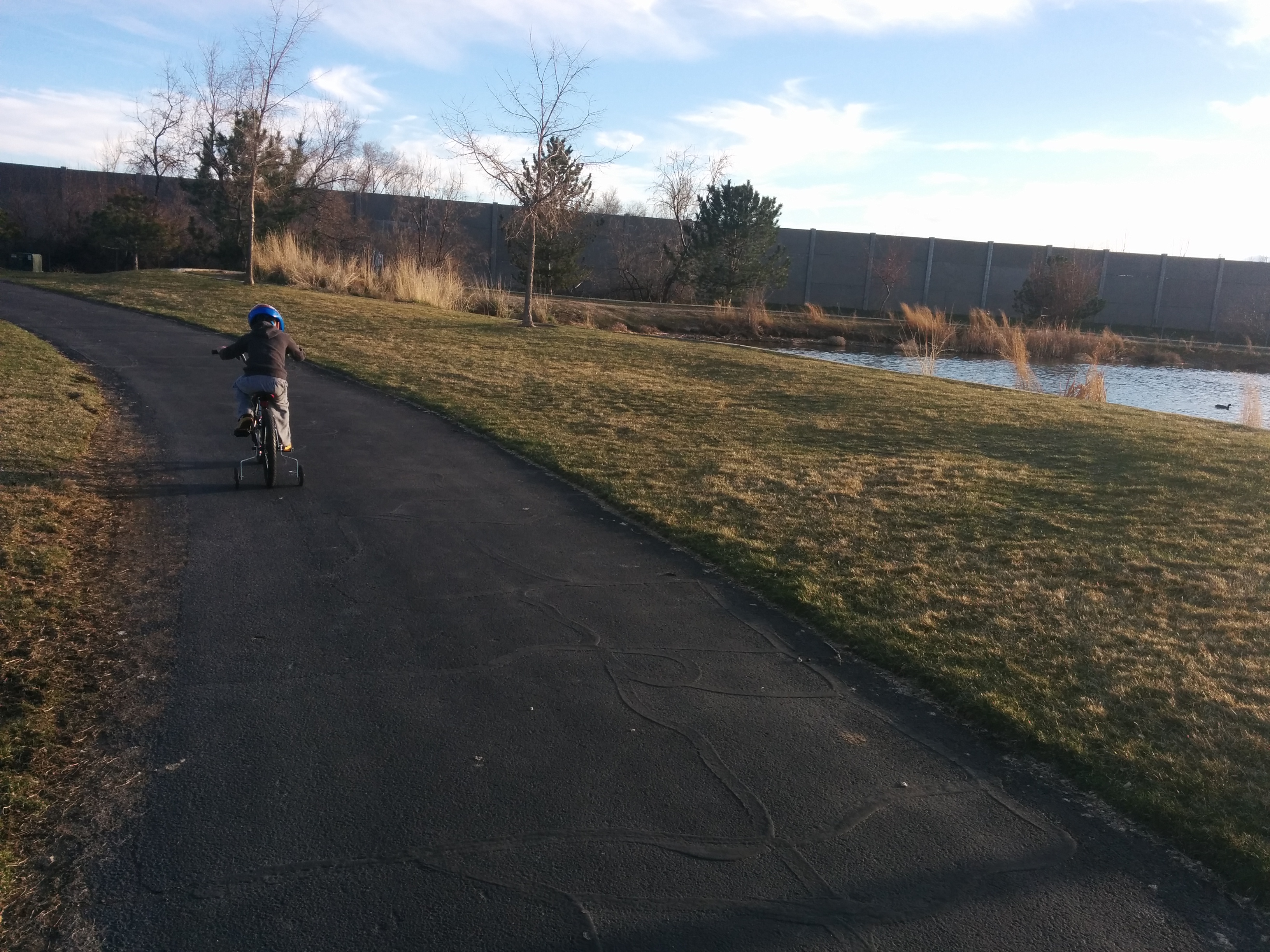
Bike riding around Willow Pond

And so when spring break rolled around, I think we all found ourselves more than grateful for the opportunity to escape. Brian saw the long school break on the schedule and decided to treat our family to a vacation. And, as we really only know how to really relax in one place, off to Disneyland we went.

It was a great trip, honestly. With the newfound attention-span Patrick’s medications have given him, he’s started to enjoy feature-length movies of late. And his favorite of all is Cars. He recognizes scenes in the movie from his trips to Disneyland (instead of the other way around, which is priceless.) And so was extremely excited to get to visit Radiator Springs, eat in Flo’s Diner, dance with Luigi’s cousins, and meet all of his friends in person.

We crammed as many rides into our trip as possible. We splurged on a character dining dinner the night we arrived. Patrick loved having mac & cheese pizza, mashed potatoes, corn on the cob, an a bowl of M&M’s while being visited by his favorite characters. Pluto even let him feed him. As a bonus, we then skipped meeting characters this time around, allowing time for extra rides instead. We stayed in a hotel with a pool and went swimming as a family for the first time since Patrick had his line removed. We watched firework on our walk back to the hotel every night. We didn’t sleep enough at night, but enjoyed early mornings in the park. It was a fun trip.

We came home on Saturday afternoon to give ourselves time to get ready for Easter the next morning.

Oh, what a time for the message of Easter for me. While we were in Disneyland, two babies were born in my family. I have a new niece and nephew. Born just a day apart. So before Patrick returned to school, we went and met the new babies.

He doted on them. Patrick loves babies. He kept asking me if he could bring them home. He hugged them too tight. He kissed them. And he promised them he’d be their friend forever. Oh, how he made my heart ache to let there be a baby in our house.

And, oh how he reminded me that it is anything but possible right now. In all his loving attention, he has no idea how strong he is, how fragile they are. And he just can’t understand that they can’t get up and play or eat or talk the way other people can. So thank goodness for baby cousins right now. Because we need babies in our life, even when we can’t have them in our home.

IMG_20160328_150415

So in the mornings, I kissed and cuddled babies. In stark contrast, in the evening, I said goodbye to a dear friend.

One of the wonderful things about my church is an organization called the Relief Society. Everwhere the church is, the women of the church are gathered together in this organization. And it doesn’t matter how different you may be in age, background, culture, or wealth.. you are sisters. The neighborhood I live in was built new just long ago that many of the people who built the homes originally are reaching the ends of their lives. And so you’d think I’d get used to having to say goodbye to these sisters from time to time.

But sometimes they work their way into your hearts a little more. This friend and I loved many of the same things, despite differences in age. She was a teacher and invited me to translate in her classroom. She was a musician and loved to invite me to sing, and then push my abilities with difficult songs. She was one of Patrick’s biggest fans. And although I’ve known for a couple of months that she had been diagnosed with a terminal illness and that her death was quite merciful, still I think this is one goodbye that will stick with me for a while.

Especially because of timing. In the week after Easter, I greeted two new babies and attended a funeral. In fact, the day of the funeral, I spent the afternoon with Patrick at the 10th birthday party of a classmate. What an interesting sampling of milestones. To see the bookends of life so close together has made me think about the volumes inbetween them.

When I was in high school, we had to memorize a soliloquy from Macbeth. With his castle under attack and everything falling around him, Macbeth receives word that his wife has died. And his reply:

“She should have died hereafter;
There would have been a time for such a word.

To-morrow, and to-morrow, and to-morrow
Creeps in this petty pace from day to day,
To the last syllable of recorded time;
And all our yesterdays have lighted fools
the way to dusty death. Out, out, brief candle.”

I’m not sure exactly why this pessimistic eulogy has been in my mind. Except the knowledge that it is so wrong. Because life is brief, but so much more than “signifying nothing” as Macbeth lamented. In fact, a funeral reminds us that it is, in fact, all the little nothings, all the everyday things. all the tomorrow and yesterdays and todays full of mostly mundane things that add up to what matters.

Because death isn’t the end. It’s not a period. It’s a comma.

Easter celebrates that fact. Because Christ came. Because of his sacrifice. Because he died, and then after 3 days was resurrected, we all will live again.

There is something wonderful to hope for.

However, I feel that being a full-time caregiver is so perfectly captured, though, in the words “tomorrow, and tomorrow and tomorrow creeps forth in this petty pace from day to day.”

I’ve been struggling a bit this month. I have been feeling lost. Invisible. Mundane. I don’t have the hang of this new life. I have more time, but not complete freedom. I’m not fighting for survival every day, but there is still a lot of resistance in our lives.

Every day certain things must be done. I clean the house and do laundry and do the dishes. I sweep the crumbs of Patrick’s snacks. I put the toys back in the toybox. I shop and plan and make dinners. I prepare medications by measuring, cutting, crushing, and mixing, and then make sure they are given on schedule. I help with homework. I encourage reading. I dress and undress my son. I remind Patrick how to wash his hair. I bring in the mail. I clean off the kitchen table. Over and over again. Only to need to do it again the next day. Or the next hour.  I’ve been kept just a little too busy to dare make time for myself but had just enough free time to fret over it.

I’m struggling to get the courage to take time for myself. I’m so used to abandoning what I need to do to take care of Patrick that even though I have a little bit of time, I am timid about branching out. I don’t trust that I’ll be able to finish what I start. And that then I’ll be upset. The problem is that this is kind of a lonely way to approach life. I’m trying to reach out and reestablish relationships that got pushed aside when I didn’t have time to do anything more than survive each day. But that takes courage, too. And although I may sometimes choose to be outgoing, deep down I’m pretty shy.

But, like you, like most of us, I know the best I can do is get up and try again each morning.

We often compared the life we led with Patrick before transplant to a rollercoaster. Thrilling highs and followed by quick plummets. I’d learned to live with that kind of thrill ride. You just hang on tight.

IMG_2269

But in Disneyland this last trip, Patrick discovered a new favorite roller coaster: Goofy’s sky school. Instead of fast ups and downs, this ride is a much more gradual descent. Instead, of hills, it’s full of sharp turns that knock the breath out of you. The track is obscured so you don’t always see it coming. Sometimes that’s what this new version of life feels like.

It’s been a year since Patrick’s last hospital admission. That is ASTOUNDING to me! It’s been a year since we had to drop everything because he was suddenly fighting to survive.

Let me tell you a bit about what the ride is like these days. It’s gentler, for sure, but it’s no “It’s a Small World” cruise.

IMG_20160304_083323
Geared up for a snowshoeing field trip at school. Couldn’t ever get him to look at the camera with eyes open.


Patrick’s been struggling with behavior at home and at school. And every note home or call home has left me feeling helpless because, unlike problems with his health that had prescribed medical solutions, this isn’t straight forward. They turn to me for answers and I don’t have them.

He’s doing ok. We’ve been experimenting with changes in his medication and the changes are helping. He is doing better. But the transition has been tricky. And I don’t know if it’s been that, or illness, or hayfever, or growing, or something else but he has been tired and grumpy and not himself. Medicine is more practice than science and when it comes to brain injury, that’s especially frustrating.

We increased his dose of clonidine to see if we could help afternoons go better, and he started to need a nap every day. He hates naps. But he can’t function sometimes without one. I even had to check him out of school and bring him home to nap last week.

We’ve talked to his psychiatrist and adjusted that dosing and talked about trying some other things. It seems to be helping. But it still feels helpless.

With time to kill between doctor's appointments, Patrick and I stopped in at the museum at Fort Douglas
With time to kill between doctor’s appointments, Patrick and I stopped in at the museum at Fort Douglas

We had a good scare right before spring break. Patrick was knocked off of the playground at school and landed flat on his stomach. It left a bruise where his g-tube hit and so I had to squeeze in an emergency visit with his GI to check to make sure that his graft wasn’t at risk. That’s a possibility with any injury to his abdomen.

Perhaps the most frustrating thing is that out of the blue, his oral aversions have gotten worse. He won’t take his vitamins anymore in the morning. I crush them and mix them in yogurt so they are easier to eat. He sticks his tongue out to block them going in. Or holds them in his mouth and doesn’t swallow. It’s miserable to watch. But they aren’t optional. They’re mandatory. And so we start many days with me pleading with him to do something that he thinks is torture.

He sprained his ankle at the birthday party. He tried climbing onto a bunkbed and fell off. Patrick’s never really had this kind of injury. With his cerebral palsy, he was especially unsteady limping. He also isn’t used to regular illnesses or injuries still, so he was extremely afraid. Asking him to do what little might help.. Elevation, ice, rest. That only scared him more. He needed extra help getting around, getting dressed, bathing, etc. Thank goodness it was conference weekend so it was ok for him to stay home. He’s spent a few days inside at recess at school. But thankfully he’s healing. He’s limping, but can jump and run and stomp while limping.

Breakfast in the waiting room at the Eccles Outpatient Building

I’m grateful to have had a couple of weeks of bookends. A couple of weeks of being shown things to make me think about what I’m putting inbetween. And a reminder that there are often many volumes in our life. We’re put away the one called “Ultra Short Bowel Syndrome” and are nearly done with another called “Transplant Recovery” but this latest volume of “First grade” has certainly had some unexpected plot twists.

I’m sometimes tempted to pen, like Shakespeare, that tomorrow and tomorrow and tomorrow just keep creeping at their petty pace. But that feeling is only a page in the story.

I heard a talk this weekend that’s helping my sentiments for tomorrow. It was shared in the semiannual general conference of the Church of Jesus Christ of Latter-Day Saints this weekend. The speaker was Elder Jeffrey R. Holland, an apostle and a gifted teacher.

Here’s a brief summary.

First, he shared this image that kind of sums up how I sometimes feel when I’m headed to bed and thinking about what I need to do the next day.

Dino-Us-Tomorrow

Then, he gave this counsel about how to proceed.

“If in the days ahead you see not only limitations in those around you but also find elements in your own life that don’t yet measure up… please don’t be cast down in spirit and don’t give up….”

“Please remember tomorrow, and all the days after that, that the Lord blesses those who want to improve, who accept the need for commandments and try to keep them, who cherish Christlike virtues and strive to the best of their ability to acquire them. If you stumble in that pursuit, so does everyone; the Savior is there to help you keep going. . . ”

And then, in contrast to the pessimistic message of Macbeth, Elder Holland gave this beautiful description of the potential for tomorrow.

“If we give our heart to God, if we love the Lord Jesus Christ, if we do the best we can to live the gospel, then tomorrow—and every other day—is ultimately going to be magnificent, even if we don’t always recognize it as such. Why? Because our Heavenly Father wants it to be! He wants to bless us. A rewarding, abundant, and eternal life is the very object of His merciful plan for His children!”

Did you read that? Tomorrow=magnificent. Even if we don’t always recognize it as such.

I’ve got a long way to go. I have a lot to learn about patience. And a lot to learn about humility. I’m finding those lessons are taught in the long, flat, tedious prairies. Not on the peaks.

It snowed the last two days of March. I had to scrape ice off of my car on the last day of spring break. Mrs. H was right. March came in like a lamb and went out like a lion.

It wasn’t an easy month. And April has started out with it’s own measure of sound and fury. We have more milestones: another funeral and a wedding ahead this week. And will still start each and every day with a yucky vitamin.

Snow on spring break of course means a kids meal at Arby's in your PJ's
Snow on spring break of course means a kids meal at Arby’s in your PJ’s

But I’m trying remember Elder Holland’s words:

“So keep loving. Keep trying. Keep trusting. Keep believing. Keep growing. Heaven is cheering you on today, tomorrow, and forever.”

P.S. If you haven’t read or better yet watched Elder Holland’s talk, you really should. It will make you feel happy because it is true.  Here’s a link: https://www.lds.org/general-conference/2016/04/tomorrow-the-lord-will-do-wonders-among-you?lang=eng

Feeding Tube Awareness Week

feeding-awareness-week

Once each February, a week is dedicated to helping raise awareness about tube feeding. I feel like the past 7 years of our lives have been a walking tube feeding awareness ad. If you haven’t picked up on the fact that you can lead a full and happy life while being tube fed, then you haven’t been paying attention. And so I try not to get too vocal during this week.

However, this week, just on time for tube feeding awareness week, Patrick has started to require supplemental feeding. And so I’m going to take a minute anyway to explain what a frustrating blessing a feeding tube can be.

Since last October, we’ve been trialing having Patrick eat 100% of his calories. And he has lost weight ever since. At first it was really rapid. That wasn’t a surprise. He wasn’t used to eating that much and we dropped a lot of calories and hydration very suddenly. We’d fattened him up and he had room to learn.

He really did a marvelous job picking it up. In a couple of weeks he figured out how to drink enough to stay hydrated. And he picked up meal and snack times pretty well. But he just kept losing. We’ve added more snacks. We’ve added more butter and fats to every meal. We started giving him milk at every meal. We added protein shakes.

But months later, he is still losing, even after “doing everything” that his dietitians could think of to recommend.

There just don’t seem to be enough hours in the day for Patrick’s belly to take in enough food. He gets full and uncomfortable and doesn’t want to push more food.

Eating is such an emotional thing. It’s social. It’s bonding. It combines smells and tastes with memories. But what if your memories of food weren’t positive? What if for years eating made you sick? Was always high stress? What if you were expected to dive in suddenly at a level of eating skill than other kids took 7 years to master? And what if the stakes were so high that everyone was watching to see if you did it? And when you felt completely stuffed, you were always being told “just one more bite”?

Patrick was losing weight. And I found that I was pushing too hard. Worrying too much about making sure Patrick got enough calories and then getting really upset when he didn’t eat what was put in front of him. And that pressure was actually causing us to lose ground. Making Patrick not like foods he’d once loved.

So we’ve turned again to the feeding tube. Just a little. A week ago Brian suggested that maybe we should start giving some carnation instant breakfast first thing in the morning when he wakes and last thing before bed. We know it helps his belly wake up. And it would give him extra calories.

The first day that we did it and he wasn’t hungry for breakfast after. I had a good cry about losing breakfast. Losing progress. Not fully achieving the miracle. But Howie convinced me to give it time. And now I see that, this way he’s getting the same morning calories. Plus he’s hungry for a snack and to eat his lunch at school.. something we’d struggled with. In other words, Patrick seems to be better off this way. And maybe I was looking the wrong way at miracles.

I’m finding myself humbled and grateful for medical technology that can help him yet again. I am remembering that just because all struggles aren’t gone, it doesn’t mean a miracle hasn’t happened. Not all healing means perfect health.

Do you know that tube feeding is so new, even in the United States, that Patrick’s GI doctor was the first to place a g-tube (stomach instead of nasal feeding tube) at his our children’s hospital? That it’s so new that there are countries where the technology is only still just being taught?

We take it for granted. This ability to feed patients who otherwise couldn’t eat enough. I’ve even heard people say it’s weird, gross, unnatural. But really, it’s amazing! Minimally invasive. In fact, I often wish every child could have a button. That I could have one myself. I know hundreds of families with feeding tubes. I can count on one hand those who weren’t immensely grateful for them. Who didn’t feel that they exponentially improved their child’s quality of life.

Hopefully, we’ll only need this little bit of help for a while longer. Just enough to take the “Please eat so you won’t die” sort of pressure off of learning to eat. Please note, “Please eat so you don’t need a feeding tube” doesn’t work. Patrick knows from experience that being fed through a tube is exceptionally convenient and comfortable. Fed is fed. And it’s so stress-free he sees no reason to avoid it. I mean, seriously, if you could just keep doing the things you love without having to stop to eat or drink, wouldn’t you choose that too sometimes?

However, we are finding it’s possible to take a bit of the hunger/starvation edge off of learning to eat this way. Just enough feeding to help his belly move. Just enough calories to help him grow but let him be hungry. And hopefully soon, Patrick’s love of food will help him overcome some of his fears. And he’ll need less and less of the help.

But in the meantime, isn’t is wonderful that we don’t have to do it without help?

Tubies of the world unite. Or some other catchy social media phrase meaning tube feeding is awesome.

RLT_0424

“So what can he eat?”

The other day, Patrick asked his dad for a snack. Brian sent him to me and I heard him say, “She’s your dietitian.”

Yup. That’s what it feels like. All day long, every day, I keep a tally in my head of what Patrick’s eaten. What his reactions have been. What nutrients he might still need. What exposure he’s had to challenging foods vs. preferred foods. And all day long, because Patrick is hungry and asks for food all day long, I am planning what he can eat.

In some ways it’s getting easier. Outgrowing his milk allergy is a really big deal that has opened up a ton of possibilities. If Patrick could live on string cheese, he totally would. In other ways, it’s just gotten more complicated.

Last week, I took Patrick back to his allergist. We’d communicated through his assistant and he’d called me at home to go over allergy test results. But in the end, things were still confusing. So he said to experiment for a month and then come in and he’d help me figure out the results.

IMG_20151019_100314

He printed out two copies of the test results. And then we sat down and went through them food by food, comparing the blood test with the skin test and them my own personal experience.

Towards the end of the conversation, he said something about like this. “Patrick is really allergic to a lot of foods. With these numbers, I’d probably tell most patients to avoid them. But Patrick is different. There are two considerations for him: how does he react to allergens? and how does he react because of his transplant? And so we can’t just say he can’t eat any of the foods he is allergic to. For whatever reason, he seems to tolerate a lot of his allergens when they are cooked. So you will keep cooking foods for him with the foods he’s allergic to. And you’ll be very cautious. And you’ll figure out what he can actually eat.”

So in summary. Dear world.. I am very sorry that we are misrepresenting the severity of food allergies in some regards. Really, VERY truly there are people who must entirely all forms of the foods they are allergic to. There are some foods that we still avoid 100%. But if there is some confusion about why Patrick is still eating some things that I have mentioned as an allergy, the simple answer is that if he didn’t, he’d be being fed elemental formula through a tube for the rest of his life. So we are making d0 with a cautious diet.

That said, if you are one of the handful of people still trying to make a sincere effort to cook and/or serve food to include Patrick.. let me give you a rundown of his current diet.

Because of intestinal transplant . . . 

Patrick is on a low sugar diet. This isn’t like a diabetic’s low sugar diet where his blood sugar will swing one way or the other or where carbohydrates need to be avoided. Sugar and some other sweeteners are not easy to digest and sugar can cause Patrick’s gut to not absorb, costing him both nutrition and hydration. In general, I look for 12g or less of sugar on the label. We mostly avoid fruit and fruit juices. And, although Patrick isn’t allergic to cow’s milk anymore, milk is 12g of sugar so I allow him to only drink this in my presence and in small quantities right now.

Also, because transplant didn’t give Patrick the 2/3 of colon that he is missing, he can eat fibrous veggies, but he won’t absorb them. His GI compares this to eating sticks and leaves. Therefore, since these foods are also hard to learn to chew, I haven’t put a lot of effort into teaching him to eat these foods. He loves the softer ones: squash with skins cut off, cooked carrots, mushrooms, cooked onions. We are working on green beans, soft and french style are easiest. He does not like peppers. Patrick is mildly allergic to lettuce, however, and doesn’t digest it at all so I only let him have it when he’s feeling quite left out and insistent. Salads are discouraged.

Because of medication reaction, Patrick isn’t allowed grapefruit. Grapefruit is in fresca. And other fruit drinks. Not that he should have much of those, but watch labels.

As far as allergies go…

Patrick has outgrown his dairy allergy. And if he could have his way, he’d be enjoying an all-dairy diet. He especially loves cheese, though he isn’t a fan of sharp cheddar. He would happily eat sour cream by the spoonful. He eats milk on his cereal. He is getting better with yogurt. I’m still reading labels to pick varieties that are less than 12g of sugar. And we’re doing greek yogurt when possible because it has more protein. His favorite flavor is blueberry.

Yogurt can be tricky, though, because despite not eating much fruit, Patrick does have allergies to it. Patrick is allergic to peaches, oranges, and strawberries. Orange is especially high. Mostly, it’s easy to avoid these as he generally can’t have fruit. I do sometimes give in and let him nibble on a strawberry. In my presence. With benadryl on hand. Also, did you know sweet and sour sauce is made of peaches? We also avoid apricots and mangos because they are similar fruit families. Just FYI.

Eggs are scoring an off the charts 11.7 in the blood test reaction. This number is PHENOMENAL. A 4 or a 6 is considered pretty significant. Therefore, we do our best to keep Patrick away from anything with concentrated egg. Scrambled eggs, crepes, egg noodles, mayonnaise, ranch dressing, tartar sauce, dijon mustard. Be advised that we discovered the vegan brand Just Mayo over the summer, though, and Patrick does eat a lot of “mayo” recipes made from this. He also eats at least a cup of vegan ranch dressing throughout the week. It’s his preferred dip. And he’ll ask for it away from home. The simple answer to this is that he can have only mom’s recipe. He shouldn’t have food cooked on a grill or pan that also cooked eggs.

Nuts are still causing a tremendous reaction in skin tests. Especially cashew and pistachio. And nuts are processed all together in factories. Therefore, we are a nut-free household. We don’t allow them in the door and ask you wash and brush teeth before contact with Patrick if you’ve been around these foods. Peanuts are scoring lower but still high. Therefore, we use sunbutter not peanut butter. And we do still watch out on ingredient labels for “manufactured with peanuts” warnings.

Oats are a pretty low scoring allergy and we’ve opted, based on previous reactions, to avoid them completely in Patrick’s diet. We don’t see a traditional allergic reaction. But they really do upset his stomach. Mostly, you only have to watch out for oats in breakfast food, but really read the labels on cereal.

Corn is also quite high with a significant skin reaction. We have a hard time making heads of tails of this. Corn is so hard to entirely avoid. Therefore, we do entirely almost entirely avoid corn chips, corn tortillas, corn bread, and plain corn. I do let him choose to eat corn dogs as I see little consequence. He sometimes chooses on his own to remove the breading. You might catch me taking mercy on Patrick and letting him splurge on Doritos, Cheetos or corn on the cob. Like oats, Patrick’s reaction is stomach upset and these foods are so yummy and ingrained into our culture that sometimes he and I have a talk about the consequence he’ll pay for eating these foods and then I’ll let him choose. As a rule, leave this kind of spoiling to me. I’m keeping track of what else he’s had in the day and if he can afford the consequences.

Tomatoes also caught me off guard a bit. We tested because I’d seen Patrick react to some spaghetti sauces. But he is usually fine with ketchup. Our best guess that is that the difference is how long the tomatoes are processed. So, when I serve pasta at home, I try to cook the sauce at least several hours. And he seems ok with pizza sauce. Perhaps because it’s baked again before serving? In general, Patrick avoid tomatoes on his own. He’ll choose olive oil over tomato sauce. He’ll choose vegan ranch over ketchup and ranch on his pizza over tomato sauce. I really need to do some exploration into the ingredients of alfredo sauce and I need to let him try besciamella now that he’s allowed milk. But when he has no other option, tomato is another food where I explain the consequences and let him choose. Please know, you can give him ketchup with confidence.

Soy was a surprise to us. Almost. I knew soy milk upset Patrick’s belly which is why we tested for it. But Patrick was eating a lot of other soy foods when we were avoiding dairy. This is a fairly low allergy, but still enough that I see a difference. So we are trying to transition from margarine (still a no no) to butter. (I am finding a big learning curve here.) Patrick’s accepted that it’s ok to eat dairy cheeses but will still check and be nervous about other foods that used to require substitutions. We aren’t avoiding soy all-together. It’s in so many foods. And his score was only a 1. If it’s cooked, like soy sauce or in crackers or whatever, it’s absolutely ok. But if it’s possible to skip it, we do. He had a reaction to canned cream of chicken soup the one time I tried it. Soy is my best guess as to why.

Finally, there’s these crazy little positive results for wheat and barley.  I said, “Barley, no big deal.” Really, I only eat barley like once a year in soup. But wheat? Well, here’s how that conversation went. The allergist said, “He’s allergic to wheat.” And I said, “His diet is over 50% wheat.” He said, “Well, maybe that’s because the wheat is baked.” And I said, “Well, what does unbaked wheat look like?” Him, “Flour. But he wouldn’t like to eat that anyway.” So I said, “So can he bake?” He said, “Of course. Just keep an eye on him.” Me, “And the rest?” Him, “Let him eat wheat.” In other words, don’t feed him gruel. And if you’re baking with him, keep an eye out for inhaled reactions. Otherwise, let the kid eat all the wheat he wants. As long as it’s highly processed. White bread, not whole grain. Since his gut won’t digest whole wheats anyway. That’s a transplant/short gut thing.

So what can he eat . . . 

Patrick’s very best foods are still meat and potatoes. He’s making good progress with oral aversions. But he still has a hard time chewing “grown up” meats, though. So I’m talking about chicken nuggets, hot dogs, corn dogs, lunch meat, fast food hamburger (because it’s super duper soft, unlike what I make, apparently), really tender meats like roast, bacon (because bacon’s good enough that he learned that one). We’re working on canned chicken. We are working on the other meats. It’s slow. But we’ll get there.

Patrick thinks mashed potatoes and gravy are manna sent from heaven. I can’t sort out why he tolerates some gravies better than others. Soy maybe? Or corn starch? I dunno. But I used packaged gravies for him at home and he does great and loves them all. Yes, it is ok to make mashed potatoes with milk now. But not margarine. Plan on Patrick eating at least a cup and a half on his own.

Other potatoes are also really, really good for him because they slow his gut down so he absorbs the whole meal better when he eats them. Plus, they are easy to eat.. Roast potatoes, Potato chips. Tater tots. French fries. The oil which most of us would avoid provides calories for him. Someday we’ll worry about avoiding oils. Right now, we are packing calories.

He’s a big fan of pasta salads. Tossed with olive oil and either italian or ranch seasonings (again, not ranch dressing or real mayo.) I make a big pasta salad every week and he eats it throughout the week until it’s gone. Kraft Macaroni & Cheese has been tested with great results. I make him the old recipe with half a stick of butter in it because, again, I’m packing calories. He really likes to slurp spaghetti noodles and those are always eggless, FYI.

He loves string cheese. He thinks cheese pizza is wonderful, though he’s gaining a taste for ham and mushroom, bacon and vegan ranch, and pepperoni, too. Choose “light” on the sauce if that’s an option. We discovered totinos this week and he would eat it at every meal.

He still loves soups. Progresso’s beef soups are egg-free. They have tomato but it seems processed enough to be ok. Also, the noodles in campbell’s brand shaped chicken noodle soups (goldfish, disney characters, etc.) are also processed enough that they are ok, despite the egg warning on the label. He had his first cream soup this weekend and devoured it. He loves grilled cheese and saltine crackers with soup.

He really enjoys stir fry with rice noodles. Especially if you put zucchini, mushrooms, and onions in it. He’s getting better at eating rice and rice-a-roni.

Other favorite foods include hummus, ham and cheese on their own or in sandwiches, as lunchables, etc., goldfish crackers, cheez-its, and veggie thin crackers, pretzels, chips, rice krispie treats, little smokies, pancakes and waffles, popcorn, cake, donuts, cookies, guacamole (but check the label), Arby’s roast beef sandwiches and curly fries, sunbutter, bananas, apples (though he’s still learning to chew them, black beans, refried beans. We are working on fish sticks, salmon, and other fish.

He wants capri sun, but can only have the low-sugar waters like Roaring Waters. He wants anything other food that is restricted extra exactly because it is restricted. He will do almost anything to earn a tootsie roll or starburst so those, since candy is very restricted, must follow very specific rules. He can have powerade zero and gatorade’s g3, but is kind of tired of them and mostly chooses to drink water.

And dislikes? Well, he doesn’t like stuffing. He doesn’t like peppers. He doesn’t like crust on his bread or skins on anything. He isn’t a big fan of melons. He’s undecided about biting cucumbers. He only sometimes likes pickles. He doesn’t much like foods that are hard to chew. And otherwise, he follows most of the same rules of “gross” that other kids his age abide by.

We went over some of this with the transplant surgeon last week and he said, “Butter, cheese bacon, potatoes. He’s got what he needs to gain weight.” So, although I know this goes against what most people would call an ideal diet, it will work for now while we work towards better.

This summary is long. But I hope it helps. At least to explain what’s going through my head when mealtime rolls around. As I’m trying to turn this list into at least 1600 calories consumed every day.

Transplant day 349 and the one-year follow-up

We just got back from Omaha again. It was a short trip. Barely more than 48 hours. In some ways very routine and unexciting. In others, very eventful.

About a month ago, I remembered to ask Patrick’s transplant team if he was supposed to have a one-year follow-up appointment. They said yes.. and then I asked if it really had to happen right on the transplant anniversary. After all, remember, Patrick’s transplant happened both on his birthday and on Halloween. We didn’t really want to spent October 31st at a doctor’s appointment.

They said it didn’t matter, and so we decided to take advantage of Patrick’s fall break. We checked him out of school on Wednesday at lunch and hopped on a plane to Nebraska.

He was crazy excited this time. Or may anxious. I can’t decide. He was happy about the idea of seeing his nurses and couldn’t seem to let it go. We tried to explain that this was just a checkup. But he didn’t settle down until after the appointment. I think because then he knew it was all ok.

Wednesday night, because Patrick was bouncing off the walls, we checked into our hotel but then headed down to the riverwalk to try to burn off some of his nervous energy with a stroll along the Missouri. It was really dark. And it took a really long time for Patrick to settle down. But eventually, he did. And it made him tired enough to sleep pretty well that night.

The next morning, it was cold. Especially for us, coming from Utah’s record-breakingly warm fall. We tried to go to a playground but got too cold. So then we went for a drive just because. We decided we were hungry and Patrick asked for chicken nuggets. So we drove to McDonalds and Patrick discovered McNuggets. I discovered that Sweet and Sour Sauce is made with peaches and so there really are no Patrick allergy-friendly dips available and we settled for ketchup.

IMG_20151015_122642

Finally, it was time for the appointment. Patrick hadn’t finished lunch so we brought it along and as the team came in, Patrick was munching on french fries. He then decided he was still hungry, and we added on a lunchable.

The appointment was mostly routine. They recorded his vital signs and growth, went over his medications, asked if anything big had changed. Then the surgoen joined us and looked Patrick over. He said Patrick looked great. He said to go ahead and discontinue one of his antibiotics. And we talked about when and how to decrease his immunosuppression one more level. Then I asked some questions I had. Patrick played with the doctor and his cell phone. And then they went on their way.

Posing with some statues at the zoo

The dietitian came in to talk to us next and we decided to go ahead and stop Patrick’s tube feeds and see if he can keep up with his nutrition orally. That doesn’t mean that for sure this will work. It means a really focused effort to make sure he’s eating and drinking enough. But it also means some new comfort and freedom for him.

Not doing tube feeds means having to figure out some other things. Like teaching him to take a chewable multivitamin instead of giving a liquid. It also means that we have to figure out a way to give him 1 teaspoon of baking soda in divided doses throughout the day. Right now, that can go along with his meds in his g-tube. But one day, they’d like a goal of him not needing anything by g-tube. They’d even like to remove his g-tube. And so eventually we’ll need to find a way to get him to take baking soda in food.

A few weeks ago, the hospital’s PR department called and asked if we would be willing to let a news crew come to Patrick’s appointment. So there was a cameraman there filming the whole time. (Well, except when the dietitian came in. She is camera shy.) And then we went and did interviews afterwards. It’s so hard to capture this big story in just a few words. I hope we did it justice. We tried taking them upstairs for Patrick to visit with some nurses. That just ended up being really awkward. Oh well. One day, the story will air and I’ll share it here. We hope it gets people talking about organ donation. And maybe express our thanks to Patrick’s donor’s family and also the amazing medical team who got him this far.

IMG_20151016_111133
Couldn’t resist this photo op.. given that these two missed wearing their matching minion costumes last Halloween.

We stopped tube feeds that same night. Patrick was really restless in his sleep, too. I don’t know if that was because of the missing tubes. Or if it was because I snore. Or because he discovered how truly heavenly comfy sleeping in down pillows is and spent the whole night trying to figure out if he wanted to sleep in the down pillow more or sleep snuggling with me more. I finally told him I didn’t mind him sleeping on the pillow. He said, “You won’t get mad?” And I said, “No. It’s a soft, soft pillow” and he snuggled down and went to sleep. He’s asked for a down pillow for his bed at home.

After the appointment, we had 24 hours before our flight home. So we did our best to find some family fun. We went to the zoo both days. The first, Patrick wanted to just play outside. We got jumbo pretzels that we ended up sharing with some very demanding peacocks.


And we let Patrick play on the zoo’s playgrounds that we’ve mostly shied away from in the past year. Then, we went to find dinner in Omaha’s shopping district called Old Market. We ended up at a family italian restaurant called Spaghetti Works where Patrick got to experience his first salad bar. He ordered grilled cheese, which turned out to be a very disappointing sandwich made of two pieces of cheesy garlic bread stuck together. So instead, he ate my spaghetti.

IMG_20151015_182928

The next morning, we packed up, ate breakfast, did laundry. Finally, we had to check out and so we went back to the zoo. Brian splurged a bit and bought all-day ride passes and instead of looking for animals, we spent the day riding stuff. We rode their steam-powered train. (Makes all other zoo trains seems like a huge disappointment.) We rode the carousel. We rode the “ski-fari”, in other words, one of those ski-lifts made amusement park ride.

The ride passes included admission to the stingray encounter which actually turned out to be awesome! They have trained their stingrays to take a piece of fish from the back of your hand with a certain command. And therefore, because they know this command, if you put your hand in the water they right way, they’ll swim over and put their mouth over your hand and suck. They call it a kiss. Also, because guests feed them, the stingrays will come to guests looking for foods. So instead of gathering hoping to snag a quick touch, you have stingrays coming up and reaching out with their fins to get your attention. It was really cool.

It took us all day to figure out how the zoo tram worked and we happened to go exactly opposite the most efficient way. However, that did earn us nice walks through the aviary and lemur island exhibit, which we didn’t do much of in the winter. And then we had a nice long ride to end our day at the zoo.

IMG_20151016_112902 IMG_20151016_113147

We went back to Old Market for lunch. Brian remembered that I’d heard of and really wanted to try a restaurant/bakery called Wheatfields. They have a reputation for being really allergy conscious. We caught them 5 minutes before close so we made a hurried lunch decision. But it was delicious, nonetheless. I ordered Patrick his first cream soup. (New option without a dairy allergy.) He had the creamy chicken and rice. Ok. We both did. I ate about half of it because it was huge. But he did great with it, which gives me courage to try more. If you have a great cream soup recipe, sent it my way.

And then, we caught the flight home.

I am super, duper proud of Patrick who made it the entire trip in underwear and without any accidents.

In fact, I’m just extremely proud of Patrick. He discovered this old video on his tablet taken a couple of years ago. It’s of him and me playing at the table. Nothing much. But I can see so many changes.

Patrick’s speech has come SO far in the past year. In the video, he is licking and spitting out fruit snacks and asking me what happens if he swallows. Now he is eating full meals. In the video I’m telling him not to drink too much water so he won’t make himself sick. Now the only concern is if he’s drinking enough. He’s still himself. Dramatic. Adventurous. But without the limitations.

He has come SO far.

IMG_20151014_192354

Make-a-Wish anniversary and Star-raising ceremony

It’s been one year since Make-a-Wish Utah granted Patrick a trip to Disneyland. When I look back, in some ways it’s hard to believe a year has passed. But mostly, that seems like an eternity ago. So very much has changed in a year.

I’ll be honest. We have known for most of Patrick’s life that he was eligible for a wish. You don’t end up on a transplant list, really, unless your condition is considered otherwise terminal. But we were trying to put that off as long as possible. We wanted Patrick to understand that he was being given a wish. We wanted it to mean something. To not feel wasted on some passing childhood interest. And, more than anything, to be something he’d remember doing.

But two years ago, early in September, Patrick’s central line clotted, sprung a leak and was infected. They had to pull it, but then the surgeon couldn’t get a new one into place. We informed the transplant team of the difficulty. And they took his name off of the transplant list. Without a place for a central line above his heart, the transplant surgery would be impossible.

Patrick in recover after having a line placed in Omaha September 2013

We’d known that scarred veins was a problem nutritionally. But we didn’t realize that it made the transplant surgery impossible. And we realized that we were at the end of a road.

The transplant team told us to get on a plane right away and we flew out to Omaha where some very brilliant and very brave doctors managed to get a new central line in place. But now we knew. We were that close to losing the only treatment option that didn’t end in Patrick eventually running out of good veins and starving to death.

And so – we made a palliative care and hospice plan. And we put in a request for Patrick to Make a Wish.

A year later, we headed to Orlando, Florida. That week was one of the most magical in our lives. We stayed at the amazing Give Kids the World Resort. We were given the royal treatment at Disneyworld and Universal Studios. We chased down characters for Patrick to meet. We rode roller coasters.

Checking in at Give Kids the World

In the village, we celebrated off-season Halloween and Christmas, rode ponies, took carousel rides at almost every meal. We ate ice cream for breakfast. We ordered Patrick’s his first whole pizza. (Made entirely allergy safe and delivered to our door.) We raised a star in Patrick’s honor.

There is no way to describe in words what a wish trip is like. Honestly, other wishes sound cool. But the reason this one is so popular is that it is the ONLY thing like it.

Every child who is granted a wish by our chapter of Make-a-Wish raises a glass star to the ceiling of the Make-a-Wish building. Family and friends are invited for a special ceremony.

We never imagined that, before we’d be home long enough from our trip to schedule the star-raising ceremony. Yet, found myself on the phone with Patrick’s wish granters the day after his transplant telling them just that. We’d need to reschedule.

Because of recovery time and immune suppression, we actually didn’t get around to that star-raising party until just last month. The experience was kind of surreal.

IMG_20150819_185627
Patrick, one of his wish-granters, and his McQueen and Mater cake.

Being so much later, it was a bit nostalgic to be back in that building. They took Patrick’s guests on a tour of the building like the one we’d received when he made his wish. And then, they let him use his magic key to open the wishing room in their castle tower. We reenacted a bit for them what had happened as he made his wish.

IMG_20150819_190014
Decorating his star

When Patrick made his wish a year and a half ago, they invited grandparents and parents to make a wish on his behalf. Brian and I made what we felt were practical wishes.. For Patrick to live a happy and full life. (Knowing that it might be short.) Grandparents wished for Patrick to receive his transplant. And, honestly, I thought to myself, “I’m so sorry we’ve misled you. Patrick has waited too long. He’s been listed for most of his life. Almost a year and a half at the center that had promised a match before a year was over. It’s too late. That is why he is making this wish.”

And yet, last month there we were… standing in that same room. Patrick free from IV’s and most tube feeds. Having just gorged himself on McQueen cake. Transplant done. In essence, made whole.

I am a witness that prayers are answered. Miracles are real. Wishes come true.

Because we live in a mortal world where test and trial are necessary for our growth, that doesn’t mean that things are perfect. Perfection is something for the next life. But God’s power is very, very real.

We owe a great debt of gratitude to the wonderful people at Make-a-Wish for the unbelievable gift that they gave to us. To the angels at Give Kids the World to helped to make it come true.

Patrick decorated a glass star and then used a string and pulley to raise it to the ceiling. Fitting his style, they said he raised the start faster than any child they’ve ever seen. Almost not giving time to notice the lyrics to this song that they played. Almost. Which is good, because if you were listening it brought tears to your eyes.

IMG_20150819_193811

When you wish upon a star
Makes no difference who you are
Anything your heart desires
Will come to you.

If your heart is in your dream
No request is too extreme
When you wish upon a star
As dreamers do.

Fate is kind
She brings to those who love
The sweet fulfillment of
Their secret longing

Like a bolt out of the blue
Suddenly, it comes to you
When you wish upon a star
Your dreams come true