
I don’t post very often because, well, I’m parenting a teenager now. As he has gotten older, his privacy has taken priority. He is entitled to create his own digital identity.
However, you’re going to see a couple of posts from me over the next couple of months. We are coming up on 10 years post-transplant. I don’t think you often get a chance to hear from patients in this phase of the journey.
I’m going to dedicate an entire post to transplant annivery soon.
But today, I wanted to talk a bit specifically about feeding. That’s because one area in which Patrick tends to be an outlier is that he weaned to 100% oral feeding within a year after his transplant.
I want to be real for just a minute about that. Because that is such an unexpectedly good outcome that we paint over a lot of the challenges that come along with it. I am absolutely thrilled that my son can eat an entire cheese pizza by himself like a teenage boy with a growing appetite.

But in celebrating that success, I think we sometimes do a disservice to him and to others with short gut and other digestive disorders by glossing over the very challenge that eating is every day — even if they are able to take all of their nutrition orally.
For Patrick’s entire school career, he has needed accommodations specifically to be not just offered opportunities, but also reminders to eat and drink throughout the school day. He can quite easily go an entire day without remembering that he needs to stop for food or water.
This may sound unusual to you. However, it is really not uncommon in people who have had complex health issues, especially those who have had prolonged digestive disorders and enteral or parenteral nutrition. Occupational therapists have begun to discuss an 9th sense called interoception. (Feel free to Google why there are nine, not five senses). This sense describes your body’s internal cues of hunger, thirst, fullness, hunger, fatigue, temperature, etc. The ability to recognize and interpret these signals is altered by our experiences. It is very common for children with medical complexity to develop oral aversions. Or in other words, to have impaired interoception.
I mean, think about it. For the first 6 years of Patrick’s life, we’d feed him intravenously as much as we could while he slept, and then, in order to give him a break from tubes, he’d go without that nutrition and hydration for several hours during the day. Is it any wonder that he thinks it’s normal to feel hungry and thirsty at school?
There is also an emerging recognition of Avoidant Restrictive Food Intake Disorder, or ARFID, and Pediatric Feeding Disorder PFD. This is a type of sensory processing disorder related eating disorder where neurodivergent people cannot bring themselves to eat certain foods, no matter how hungry they are, because of certain sensory characteristics. People with ARFID &PFD may have very limited diets.
Now, consider that for Patrick’s early years he could not eat sugars, fruits, vegetables, or fibrous textures without severe digestive consequences. Is it any surprise that many children who grow up with SBS show characteristics of ARFID and PFD?
In our house, we have open pantries and stock high calorie preferred foods. And Patrick has been able to eat enough to grow. We have done extensive feeding therapy to expand his diet and I am constantly applying the principles used there to continue to add new foods as old ones fall out of favor.
My son is a foodie. He loves restaurants. He loves treats. He loves trying new foods that meet his very specific preferences.
However, eating has never been easy. There has always been effort to remind him to eat and drink. He only gets the vitamins he needs because we supplement.
One of the things I remember most clearly from Patrick’s transplant evaluation appointments when he was 6 months old was the meeting with the transplant nurse coordinator. In that meeting, she went through everything they thought we should know about life after transplant – from potential complications to what sports he could play. And one of the messages most strongly emphasized was this:
When your child becomes a teenager they will want to become independent. Many teen transplant patients stop complying with their post-transplant care.
Now – we are fortunate. Patrick doesn’t fight against taking his medications. He doesn’t resist seeing his doctors. He doesn’t break safety rules.
He’s fallen into a basic teenage pattern. He is too busy with his social life to want to eat.
I spent his freshman year trying to find ways to incentivize and remind him to eat. But the more I thought about the sum total of what I just outlined above, the less sense it made to keep nagging him to eat.
The phrase we often use to comfort moms trying to accept tube feeding with babies crossed my mind. “Fed is best.” And I started to think, “Why not just ask if he wants to add in tube feeding?”
Of course, there were obstacles. Bolus feeding, where you use a syringe to give an entire carton of formula in just a few minutes, has always made him feel sick. That didn’t seem worth it. Gravity feeding, which we have used for hydration when he is sick, just ties him to a wall for an hour. So I found myself leaning towards a feeding pump . But I wasn’t sure if the doctors would agree to that for as little extra as he needed.
Then, I came across a new product at the Oley Foundation conference – an elastomeric feeding pump system called Mobility +. Kind of a step in-between gravity and pump feeding. There’s no electronic pump, so it’s lightweight and small. It fits inside a crossbody bag. (Fanny pack, for those of us who grew up in the 90’s.) Instead, inside the feeding bag is an elastic pouch that squeezes the formula out at a controlled rate. The tubing comes in different sizes that set the feeding rate. The tubing we use slows Patrick’s feeds down to about an hour, which is just the rate his gut needs to tolerate them.
The bags are pretty easy to use. I use a stopcock valve system to fill the bags in advance. Once that part’s done, we switch to a feeding set that attached to his g-tube extention. The rest is easy enough that Patrick can just come attach the bag, open the clamps, and start the feed himself. The only hiccups we’ve had are sleeping too late to allow time for the feed and occassionally forgetting to open the clamps to start the feed.
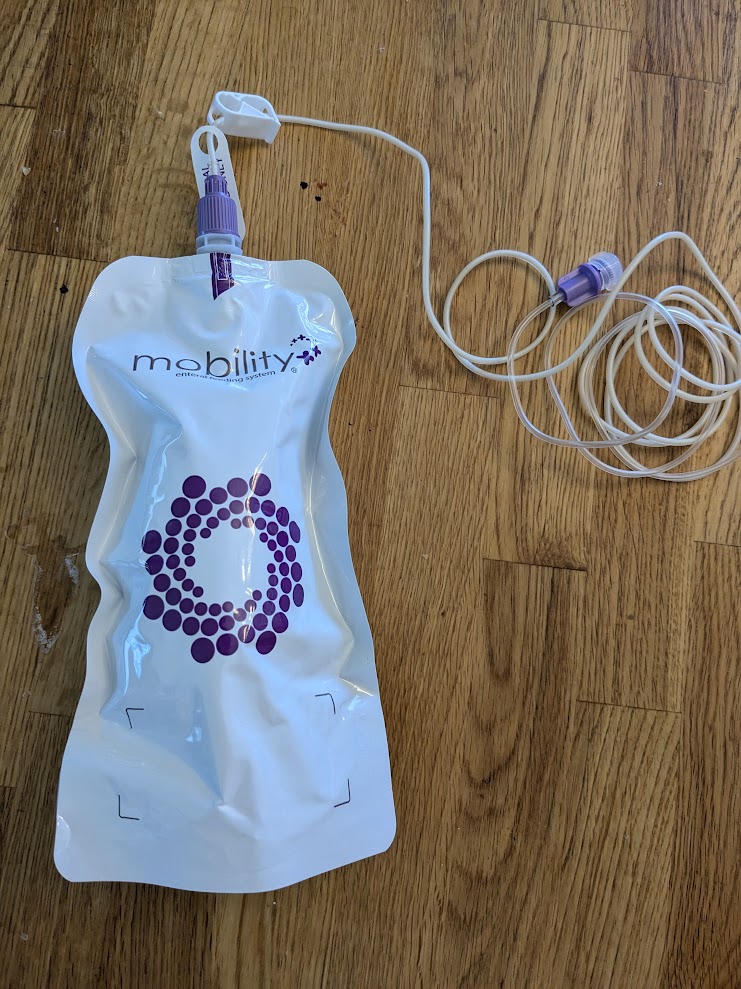


Because this is a brand new product, it was just barely approved by the FDA and entering the U.S. market. Patrick is one of the first patients using this feeding system. I wasn’t sure if we’d be able get access to it, but Rockfield Medical has been amazing to work with. We did several zoom calls to figure out the right bags to use and get me trained. They sent me samples to get started while I worked on getting it set up with my enteral supply company.
That took a few calls. At first, the company didn’t understand what the bags were and thought they might be too expensive to be worth the investment. However, Rockfield had already laid the groundwork and the product was available with several larger homecare companies, so my smaller company was willing to follow suit once I got through to the right person and they understood the benefits I was seeing.
It’s been a couple of weeks and it’s already routine.
Please note that this isn’t a sign that Patrick is unhealthy. He eats enough to maintain his weight. But his weight is low and keeping him eating has required constant behavioral support, what they call a “complex feeding program.” There is an emotional and mental health cost that comes with constant pressure to eat .
I have to say that it’s really nice to have the stress taken off of feeding. For example, Patrick got some vaccines this weekend and just hasn’t had an appetite. He took about ten bites of lunch today before abandoning it. In the past, I would have been pulling out timers and offering rewards to try to beg him to eat.
Instead, today, I said, “fine, we’ll put a bolus on.”
One of the first principles of working with an eating disorder is this.. the more anxious the parent is about the child’s eating, the less likely the child is to be willing to eat.
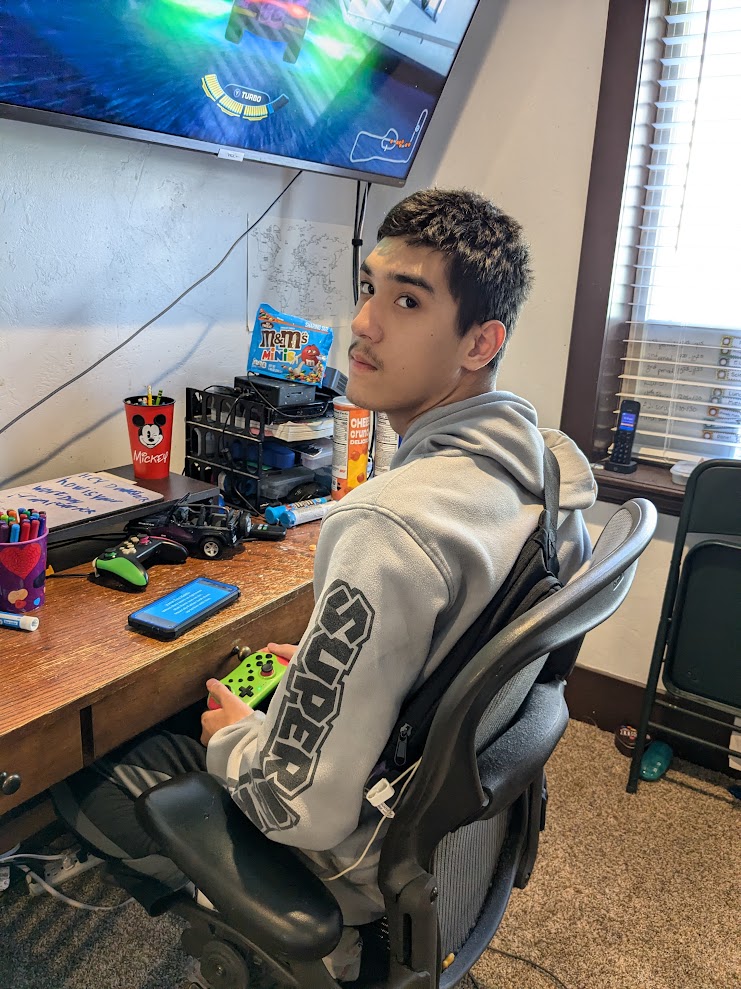
Instead, Patrick is super proud to own the hottest new gadget in tube feeding and can’t wait to set it up and put it on.
He’s excited to be fed.
And fed is best.
















 Patrick Hoopes